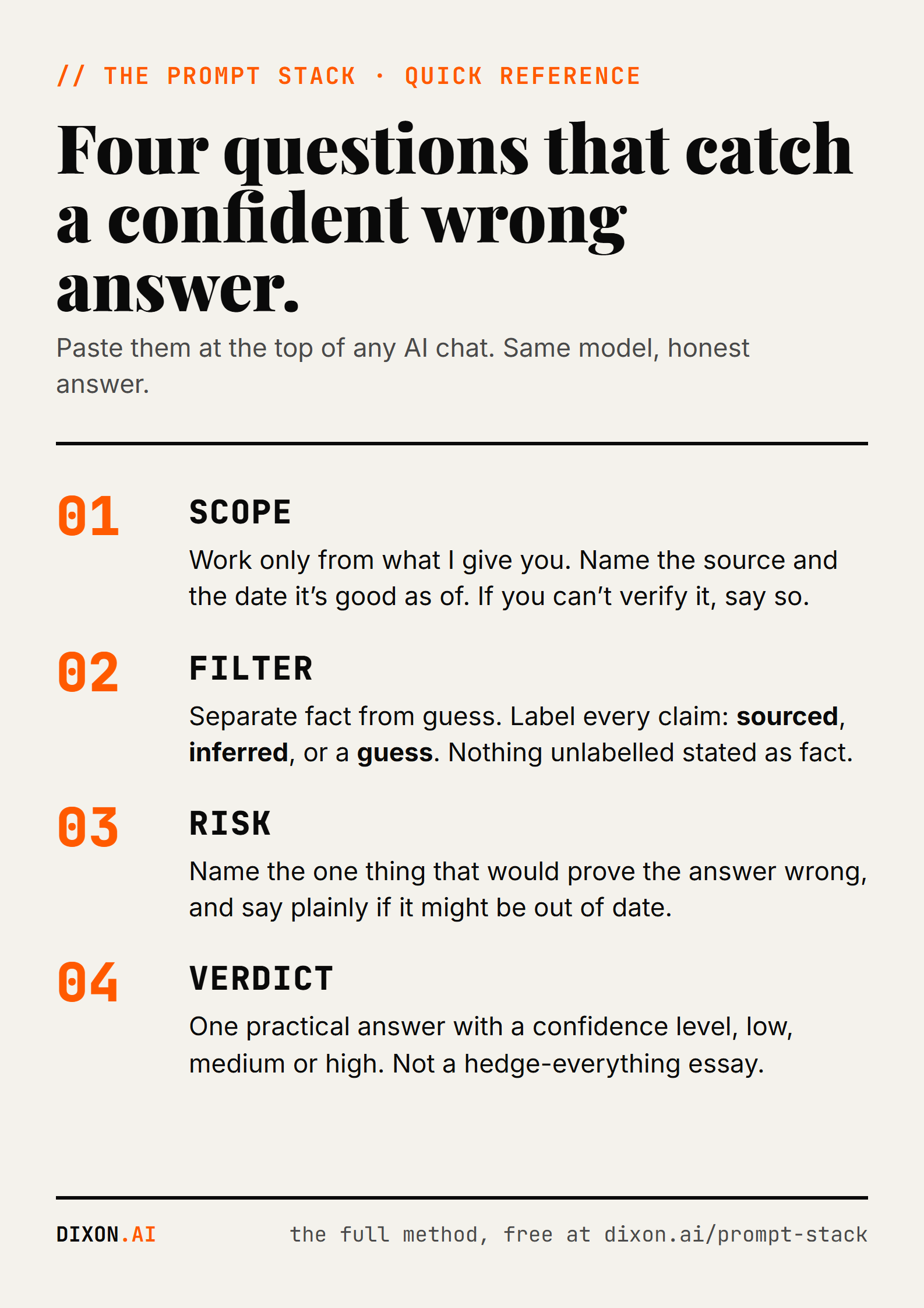

I test whether you can trust what an AI tells you.
How I got here.
The habit came before the subject. Before I trust something, I like to check where it actually came from, and I've been caught out enough times to know why. Testing whether an AI is telling the truth is the same habit, pointed at something new.
It came from teaching myself to invest, where checking the source is the whole game, and something sounding right and being right turn out to be very different things. I still invest, but here it mostly does another job: a question with a real answer, where being wrong costs you something, is the fairest test of whether an AI actually knows or is just sounding sure.
How I think about getting the truth out of AI.
Show the working before the answer.
If an AI output jumps to a verdict before laying out the facts it's drawing on, it isn't doing its job. Every prompt on this site puts the evidence step first. The verdict only comes when the evidence supports one.
In practice: the covered-call prompt puts the trade thesis in writing before asking for the verdict.
Make it argue back.
I don't ask AI to agree with me. The prompts force it to find what would make the case wrong, and name the signal that would prove it.
In practice: the RISK step asks the AI to name what would prove the thesis wrong.
One thing, properly.
The prompts I trust do one job. The ones that tried to do everything produced impressive-sounding nothing, so I deleted them.
In practice: the four-step Prompt Stack replaced six earlier prompts that each tried to do too much.
Write it down.
What I asked, what I got, what I'd do differently. The writing-up is where most of the actual learning happens. The site exists partly to keep me honest.
In practice: this site exists partly because I kept forgetting what had changed between sessions.
The Prompt Stack is also an open repository at github.com/CtrlCursor/prompt-stack: share, adapt, credit.
Where the work lives.
The principles above are claims. The three pages below are where they get tested: AI failures by tool and type, AI catches that surprised me, and what's on the desk right now.
 ↑ unverified
 When I'm not running experiments.
Mostly outside. Hiking with my girlfriend and the dog. Riding the motorbike. Kitesurfing and efoiling when the weather lets me. Gardening: six years in, still learning, still losing the occasional fight to slugs. Music in the background most of the day. I'm not a serious person, despite the subject matter on the site. The fun is in the learning and the doing.
A site worth reading.
I'd like dixon.ai to become the place you check before you act on something an AI told you: methodology that holds up, tested where being wrong actually costs something. Not stock picks. Not hype. Just the experiments, the failures I own up to, and the prompts that survived contact with real money.
Specifically: honest comparisons and audits of AI tools and models, on the tasks that cost real money to get wrong, including where a tool simply isn’t worth paying for.
I also think the method matters more than the subject. The habit of making a claim show its working, then checking it against a real source, is worth having whether the decision is a stock, a contract, or a letter from a doctor. If anything here helps a reader get better at that, even far from investing, that is a good outcome.
Nobody’s paid to be here.
No affiliate links, no sponsorships, no paid placements. Nobody has paid to appear on this site, and no company sees a verdict before you do.
That’s easy to write, so it shouldn’t be worth much by itself. Here’s what backs it: every tool is graded against a primary source on a dated test you can check on the Scoreboard, and I log the answers I got wrong as openly as the ones I got right. The method is the point: a claim has to show its working and hold up against a real source before it counts here, and that goes for the tools I test as much as for me.
What this site is not.
This is not financial advice. Nothing on this site is a recommendation to buy or sell anything. I'm documenting my own process for my own reasons. If it's useful to you too, even better.
I'm also not claiming AI is reliably useful for investing. My working view is that it's useful in narrow, well-defined situations with careful prompting, and actively misleading in others. Telling the difference is what the experiments are for.
What I'm using right now → · Something to say? Get in touch →
You should subscribe to my newsletter, Confidently Wrong
The Bluff Filter
A paste-in prompt that makes any AI flag what it’s guessing before you act on it.
Learn it once, use it on every answer.
Your email stays private, leave whenever you like.