
// On this page
AI has helped researchers read an ancient Greek argument hidden inside a burnt Roman scroll. The subject appears to be whether people can be made better. Nearly two thousand years later, we’re still working on that one.
The remarkable part is how they reached it. They scanned the surviving core, used machine learning to help reveal its writing, and had specialists read the Greek. The fragile remains didn’t need to be physically opened any further.
In June 2026, the Vesuvius Challenge announced the result. A scroll previously assigned a readability score of zero now had something to say.
Opening the book was the problem
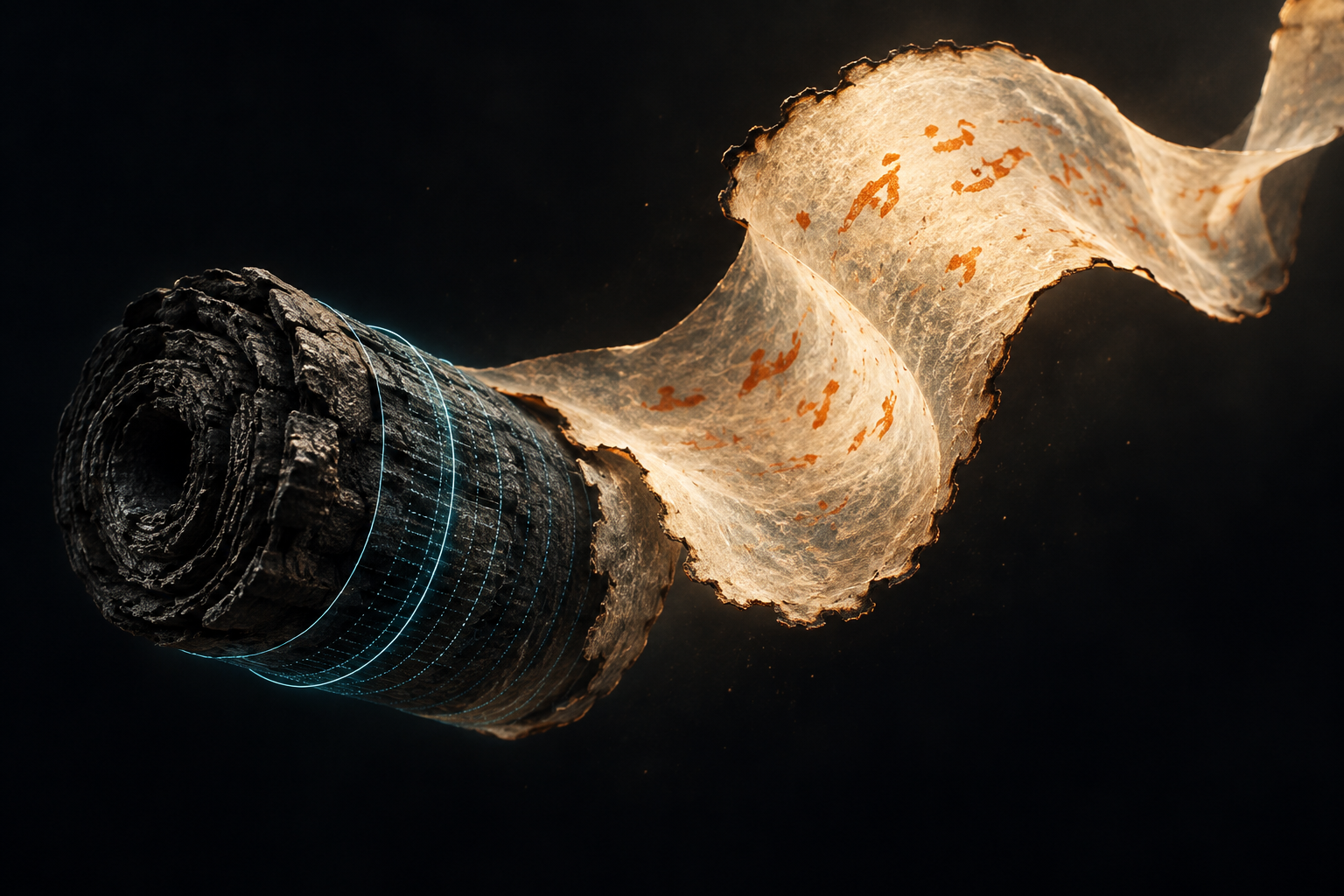
The scroll comes from Herculaneum, buried in the eruption of Vesuvius. Its carbonised papyri preserve what the research paper describes as the only large-scale library to survive from classical antiquity. Many rolls remain unopened because trying to get inside can permanently damage them.
This one, known as PHerc. 1667, had already suffered. A nineteenth-century attempt to open it failed. A later intervention reduced it further. In the 1980s, another attempt produced isolated letters beneath overlapping layers.
Federica Nicolardi, who leads the reading team, recounts its zero readability score in an account published by the University of Kentucky, a project partner.
What the AI actually did
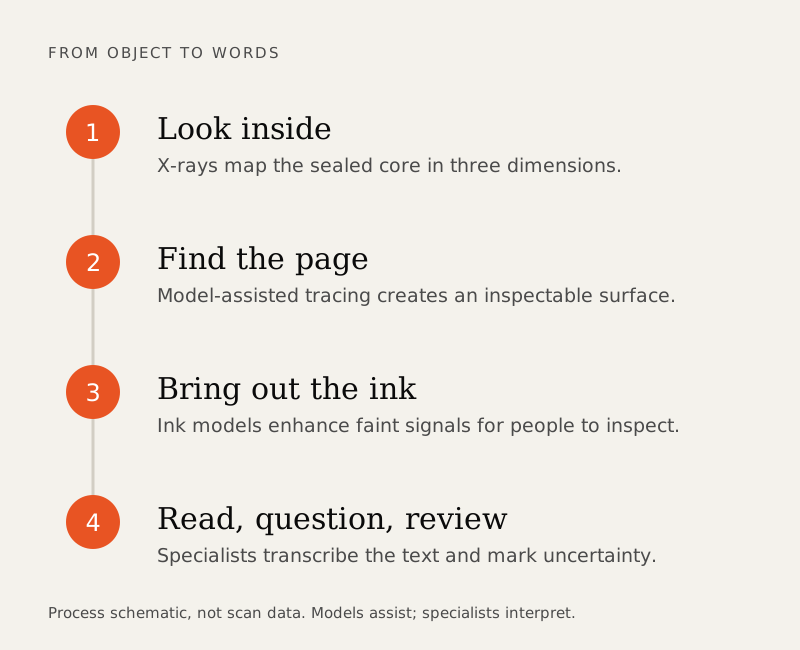
The starting point was a detailed X-ray scan. That lets researchers look inside the core, but a scan of tightly packed papyrus isn’t yet a page you can read.
Machine learning helped with two different jobs.
First, a model helped trace where the papyrus layers ran through the scan. Researchers could then turn those surfaces into digitally flattened pages. Think of following the paper through a rolled-up book, without having to pull the real thing apart.
Second, ink-detection models helped make faint writing visible on those pages. The ink and the carbonised papyrus can look very similar in X-ray scans. The models enhanced subtle traces that specialists could inspect.
That distinction matters: the AI helped expose evidence of writing. It wasn’t being asked to invent a plausible ancient text. The paper says the ink models were not trained on character identities, words or transcriptions. Their training identified ink.
Eight specialists in ancient papyrus texts worked on reading and interpreting the columns. AI helped make the marks visible. Human expertise made sense of them.
So what did the book say?
The recovered writing is part of a work on ethics, apparently concerned with whether people can be improved. It mentions the Stoic philosopher Aristocreon, nephew and pupil of Chrysippus. That name, along with features of the text, points towards a Stoic connection.
There’s a puzzle here. The library is almost entirely Epicurean. Nicolardi says a text like this, found elsewhere, would have been classed as Stoic without much argument. Its home is why the team are careful about saying so.
The author and title remain uncertain. We’ve recovered part of someone’s argument before recovering their name.
A readable book still has gaps
Surviving portions of the first three columns, 33 square centimetres of papyrus, remained too damaged to interpret securely. The team left those untranscribed. In the text they did publish, brackets mark letters restored over missing material, while dots identify uncertain readings.
That gives readers something more useful than a tidy reconstruction: a way to see where the evidence runs out.
The method won’t make every sealed scroll readable. Preservation, scan quality and the condition of the layers all matter. But hundreds more rolls remain sealed across the collections that hold them. This result shows how AI can help us reach some of the writing inside, without another attempt to prise the original apart.