
Every answer, question by question
Run 1, Sat 3 Oct 2026: ten questions, six apps, three tries each, and all 180 tries with their grades.
Why some questions are sealed
Sealed questions keep their exact wording private until they retire, and their fingerprints were published before the first run. We show the grade, our summary and the answer, with any sentence that repeats the question withheld. The answers still repeat some of each question's facts, so every try is checked for a link back to this site. How we test
Jump to a question
Question 1 How many bank holidays England has in 2027, with the dates sealed
What it tests: The year's bank holidays and their dates, read from the calendar, not memory.
17 of 18 tries right
-
ChatGPT logged out
3 of 3 right-
Try 1 Right
Our summary: Said England has 8 in 2027, with Christmas and Boxing Day substitutes on 27 and 28 December, citing GOV.UK.
Full answer
There are 8 bank holidays in England in 2027. The official GOV.UK list for England and Wales gives these dates: Source: GOV.UK Date Day Bank holiday 1 January 2027 Friday New Year’s Day 26 March 2027 Friday Good Friday 29 March 2027 Monday Easter Monday 3 May 2027 Monday Early May bank holiday 31 May 2027 Monday Spring bank holiday 30 August 2027 Monday Summer bank holiday 27 December 2027 Monday Christmas Day — substitute day 28 December 2027 Tuesday Boxing Day — substitute day Note: Christmas Day falls on Saturday 25 December and Boxing Day on Sunday 26 December, so their bank holidays are observed on Monday 27 and Tuesday 28 December. Source: GOV.UK So, for planning time off, 8 days are bank holidays in England in 2027. -
Try 2 Right
Our summary: Said England has 8 in 2027, with Christmas and Boxing Day substitutes on 27 and 28 December, citing GOV.UK.
Full answer
There are 8 bank holidays in England in 2027. The official GOV.UK calendar lists the following dates: Source: GOV.UK +1 Date Day Bank holiday 1 January 2027 Friday New Year’s Day 26 March 2027 Friday Good Friday 29 March 2027 Monday Easter Monday 3 May 2027 Monday Early May bank holiday 31 May 2027 Monday Spring bank holiday 30 August 2027 Monday Summer bank holiday 27 December 2027 Monday Christmas Day — substitute day 28 December 2027 Tuesday Boxing Day — substitute day Total: 8 days. Christmas Day falls on Saturday 25 December and Boxing Day on Sunday 26 December, so the substitute bank holidays are Monday 27 and Tuesday 28 December. Source: GOV.UK Official GOV.UK bank holiday calendar -
Try 3 Right
Our summary: Said England has 8 in 2027, with Christmas and Boxing Day substitutes on 27 and 28 December, citing GOV.UK.
Full answer
There are 8 bank holidays in England in 2027. The official GOV.UK list for England and Wales gives these dates: Source: GOV.UK Date Day Bank holiday 1 January 2027 Friday New Year’s Day 26 March 2027 Friday Good Friday 29 March 2027 Monday Easter Monday 3 May 2027 Monday Early May bank holiday 31 May 2027 Monday Spring bank holiday 30 August 2027 Monday Summer bank holiday 27 December 2027 Monday Christmas Day — substitute day 28 December 2027 Tuesday Boxing Day — substitute day Total: 8 bank holidays. Christmas Day falls on Saturday 25 December and Boxing Day on Sunday 26 December in 2027, so their bank holidays are observed on the following Monday and Tuesday. Source: GOV.UK Official GOV.UK bank holiday calendar
-
-
Claude paid: Max
3 of 3 right-
Try 1 Right
Our summary: Said 8, with 27 and 28 December substitutes; added a leave tip using the 2028 New Year substitute day.
Full answer
There are 8 bank holidays in England in 2027: Friday 1 January – New Year's Day Friday 26 March – Good Friday Monday 29 March – Easter Monday Monday 3 May – Early May bank holiday Monday 31 May – Spring bank holiday Monday 30 August – Summer bank holiday Monday 27 December – Christmas Day (substitute day) Tuesday 28 December – Boxing Day (substitute day) Christmas Day and Boxing Day fall on a weekend in 2027, so the following Monday and Tuesday become the bank holidays instead. The New Year's Day, early May and 28 December dates were formally appointed by Royal Proclamation on 8 July 2026. Source: centralbedfordshire Source: independent One useful tip: 1 January 2028 falls on a Saturday, so Monday 3 January 2028 is a substitute day. If you take just 30 and 31 December 2027 as annual leave, you get ten days off in a row, from 25 December to 3 January. Source: secretbristol -
Try 2 Right
Our summary: Said 8, with 27 and 28 December substitutes; added a leave tip using the 2028 New Year substitute day.
Full answer
England has 8 bank holidays in 2027: Friday 1 January – New Year's Day Friday 26 March – Good Friday Monday 29 March – Easter Monday Monday 3 May – Early May bank holiday Monday 31 May – Spring bank holiday Monday 30 August – Summer bank holiday Monday 27 December – Christmas Day (substitute day) Tuesday 28 December – Boxing Day (substitute day) These match the published list for England and Wales. Christmas Day and Boxing Day fall on a Saturday and Sunday in 2027, so they move to the following Monday and Tuesday. A Royal Proclamation dated 8 July 2026 formally confirmed 1 January, 3 May and 28 December 2027 as bank holidays. Source: centralbedfordshire Source: independent If you're planning ahead, 1 January 2028 is a Saturday, so the substitute holiday is Monday 3 January. Taking 30 and 31 December 2027 as leave would give you 10 days off in a row, from 25 December to 3 January. Source: secretbristol -
Try 3 Right
Our summary: Said 8, with 27 and 28 December substitutes; added a leave tip using the 2028 New Year substitute day.
Full answer
There are 8 bank holidays in England in 2027: Friday 1 January – New Year's Day Friday 26 March – Good Friday Monday 29 March – Easter Monday Monday 3 May – Early May bank holiday Monday 31 May – Spring bank holiday Monday 30 August – Summer bank holiday Monday 27 December – Christmas Day (substitute day) Tuesday 28 December – Boxing Day (substitute day) Because Christmas Day and Boxing Day fall on a weekend in 2027, the bank holidays move to Monday 27 and Tuesday 28 December. The dates for New Year's Day, the Early May bank holiday and 28 December were formally confirmed by a royal proclamation given at Buckingham Palace on 8 July 2026, under the Banking and Financial Dealings Act 1971. Source: centralbedfordshire Source: independent One handy detail if you're planning leave: 1 January 2028 falls on a Saturday, so the substitute day is Monday 3 January — meaning taking just 30 and 31 December 2027 as annual leave gets you 10 consecutive days off from 25 December to 3 January. Source: secretbristol
-
-
Copilot
3 of 3 right-
Try 1 Right
Our summary: Said England has 8 in 2027, with Christmas and Boxing Day substitutes on 27 and 28 December, citing GOV.UK.
Full answer
In England (and Wales), there are 8 bank holidays in 2027. The official GOV.UK list is: Source: gov Date Day Bank holiday 1 January 2027 Friday New Year's Day 26 March 2027 Friday Good Friday 29 March 2027 Monday Easter Monday 3 May 2027 Monday Early May bank holiday 31 May 2027 Monday Spring bank holiday 30 August 2027 Monday Summer bank holiday 27 December 2027 Monday Christmas Day (substitute day) 28 December 2027 Tuesday Boxing Day (substitute day) Total: 8 bank holidays. Source: gov Note that Christmas Day (25 December) falls on a Saturday and Boxing Day (26 December) falls on a Sunday in 2027, so the bank holidays are observed on Monday 27 December and Tuesday 28 December instead. Source: gov -
Try 2 Right
Our summary: Said England has 8 in 2027, with Christmas and Boxing Day substitutes on 27 and 28 December, citing GOV.UK.
Full answer
There are 8 bank holidays in England (and Wales) in 2027 according to the UK Government's official bank holidays calendar. Source: gov Date Day Bank holiday 1 January 2027 Friday New Year's Day 26 March 2027 Friday Good Friday 29 March 2027 Monday Easter Monday 3 May 2027 Monday Early May bank holiday 31 May 2027 Monday Spring bank holiday 30 August 2027 Monday Summer bank holiday 27 December 2027 Monday Christmas Day (substitute day) 28 December 2027 Tuesday Boxing Day (substitute day) Source: gov Why the substitute days? In 2027, Christmas Day falls on a Saturday and Boxing Day falls on a Sunday, so the bank holidays are observed on Monday 27 December and Tuesday 28 December instead. Source: gov So the total number of bank holidays in England in 2027 is 8. Source: gov -
Try 3 Right
Our summary: Said England has 8 in 2027, with Christmas and Boxing Day substitutes on 27 and 28 December, citing GOV.UK.
Full answer
In England (and Wales), there are 8 bank holidays in 2027 according to the UK Government's official bank holidays calendar. Source: gov Date Day Bank Holiday 1 January 2027 Friday New Year's Day 26 March 2027 Friday Good Friday 29 March 2027 Monday Easter Monday 3 May 2027 Monday Early May bank holiday 31 May 2027 Monday Spring bank holiday 30 August 2027 Monday Summer bank holiday 27 December 2027 Monday Christmas Day (substitute day) 28 December 2027 Tuesday Boxing Day (substitute day) Total: 8 bank holidays. Source: gov The December holidays are substitute days because Christmas Day falls on Saturday 25 December 2027 and Boxing Day falls on Sunday 26 December 2027, so the bank holidays are observed on the following Monday and Tuesday. Source: gov Source: UK bank holidays - GOV.UK Source: gov
-
-
Gemini free
3 of 3 right-
Try 1 Right
Our summary: Said England has 8 in 2027, with Christmas and Boxing Day substitutes on 27 and 28 December.
Full answer
There are 8 bank holidays in England in 2027: What is Trac Jobs? Date Day Bank Holiday 1 January 2027 Friday New Year's Day 26 March 2027 Friday Good Friday 29 March 2027 Monday Easter Monday 3 May 2027 Monday Early May bank holiday 31 May 2027 Monday Spring bank holiday 30 August 2027 Monday Summer bank holiday 27 December 2027 Monday Christmas Day (substitute day) 28 December 2027 Tuesday Boxing Day (substitute day) (Note: Since Christmas Day and Boxing Day fall on Saturday 25 December and Sunday 26 December in 2027, the bank holidays are carried over to Monday 27 December and Tuesday 28 December as substitute days). Source: Premier Stays Fife -
Try 2 Right
Our summary: Said England has 8 in 2027, with Christmas and Boxing Day substitutes on 27 and 28 December.
Full answer
There are 8 official bank holidays in England in 2027: Source: UK Bank Holidays 2026 Friday, 1 January – New Year's Day Source: Good Tuesday Friday, 26 March – Good Friday Source: Good Tuesday Monday, 29 March – Easter Monday Source: Good Tuesday Monday, 3 May – Early May bank holiday Source: Good Tuesday Monday, 31 May – Spring bank holiday Source: Good Tuesday Monday, 30 August – Summer bank holiday Source: Good Tuesday Monday, 27 December – Christmas Day (substitute day) Source: Good Tuesday Tuesday, 28 December – Boxing Day (substitute day) Source: Good Tuesday (Note: Because Christmas Day and Boxing Day fall on Saturday and Sunday in 2027, the bank holidays are carried over to the following Monday and Tuesday as substitute days.) Source: Premier Stays Fife -
Try 3 Right
Our summary: Said England has 8 in 2027, with Christmas and Boxing Day substitutes on 27 and 28 December.
Full answer
There are 8 bank holidays in England in 2027: Source: tracjobs.co.uk Date Day of the Week Bank Holiday 1 January 2027 Friday New Year's Day 26 March 2027 Friday Good Friday 29 March 2027 Monday Easter Monday 3 May 2027 Monday Early May bank holiday 31 May 2027 Monday Spring bank holiday 30 August 2027 Monday Summer bank holiday 27 December 2027 Monday Christmas Day (Substitute day)* 28 December 2027 Tuesday Boxing Day (Substitute day)* *Note: Because Christmas Day (25 Dec) and Boxing Day (26 Dec) fall on a Saturday and Sunday in 2027, the bank holidays are carried over to Monday and Tuesday as substitute days. Source: Premier Stays Fife
-
-
Grok free
2 of 3 right-
Try 1 Nothing came back the app errored or never finished
-
Try 2 Right
Our summary: Said 8, with 27 and 28 December as the Christmas and Boxing Day substitutes, citing the 2026 royal proclamation.
Full answer
There are 8 bank holidays in England in 2027.Manchestereveningnews +1 England observes the standard set of 8 UK bank holidays (also shared with Wales). These are fixed national days off for most workers, with the following dates (sourced from official government proclamations and verified UK holiday calendars): Friday, 1 January – New Year’s Day Friday, 26 March – Good Friday Monday, 29 March – Easter Monday Monday, 3 May – Early May Bank Holiday Monday, 31 May – Spring Bank Holiday Monday, 30 August – Summer Bank Holiday Monday, 27 December – Christmas Day (substitute day; the actual Christmas Day fell on Saturday 25 December, so this is the moved/substitute holiday) Tuesday, 28 December – Boxing Day (substitute day; the actual Boxing Day fell on Sunday 26 December, so this is the moved/substitute holiday) No other national bank holidays apply in England for 2027. Regional variations exist (e.g., St Andrew’s Day in Scotland or St Patrick’s Day in Northern Ireland), but they do not affect England. Dates can occasionally shift due to royal proclamations, but the 2027 schedule is fully confirmed.Privycouncil.independent For the most official confirmation, check gov.uk/bank-holidays. -
Try 3 Right
Our summary: Said 8, with 27 and 28 December as substitutes; dated the weekend Christmas to 2026 and named Scotland's and Northern Ireland's extras.
Full answer
There are 8 bank holidays in England in 2027.Ukholidaysinfo These are the official dates, confirmed against GOV.UK (and equivalent sources for England/Wales, which share the same schedule). Some dates are substitutes because Christmas Day (25 Dec 2026, a Saturday) and Boxing Day (26 Dec 2026, a Sunday) fell on weekends.Ukholidaysinfo Friday 1 January — New Year’s Day Friday 26 March — Good Friday Monday 29 March — Easter Monday Monday 3 May — Early May Bank Holiday Monday 31 May — Spring Bank Holiday Monday 30 August — Summer Bank Holiday Monday 27 December — Christmas Day substitute holiday Tuesday 28 December — Boxing Day substitute holiday This list covers every national bank holiday for England. Note that Scotland has an extra holiday (St Andrew’s Day), and Northern Ireland has two extras (St Patrick’s Day and the Battle of the Boyne), but these do not apply in England. All dates are fixed by UK legislation and have been verified as final.
-
-
Perplexity paid: Pro
3 of 3 right-
Try 1 Right
Our summary: Said England has 8 in 2027, with Christmas and Boxing Day substitutes on 27 and 28 December.
Full answer
There are 8 bank holidays in England in 2027 (the official England and Wales list). Source: www Date Day Bank holiday 1 January 2027 Friday New Year’s Day 26 March 2027 Friday Good Friday 29 March 2027 Monday Easter Monday 3 May 2027 Monday Early May bank holiday 31 May 2027 Monday Spring bank holiday 30 August 2027 Monday Summer bank holiday 27 December 2027 Monday Christmas Day (substitute day) 28 December 2027 Tuesday Boxing Day (substitute day) Christmas Day falls on Saturday and Boxing Day on Sunday in 2027, so the official days off move to Monday 27 and Tuesday 28 December. Source: www -
Try 2 Right
Our summary: Said England has 8 in 2027, with Christmas and Boxing Day substitutes on 27 and 28 December.
Full answer
There are 8 bank holidays in England (and Wales) in 2027. Source: www +4 Full list of 2027 bank holidays in England Date Day Bank holiday 1 January 2027 Friday New Year’s Day 26 March 2027 Friday Good Friday 29 March 2027 Monday Easter Monday 3 May 2027 Monday Early May bank holiday 31 May 2027 Monday Spring bank holiday 30 August 2027 Monday Summer bank holiday 27 December 2027 Monday Christmas Day (substitute day) 28 December 2027 Tuesday Boxing Day (substitute day) Source: www +6 Because Christmas Day (25 December) falls on a Saturday and Boxing Day (26 December) on a Sunday in 2027, the official observed holidays shift to the following Monday and Tuesday as “substitute” days. Source: birminghammail.co +3 -
Try 3 Right
Our summary: Said England has 8 in 2027, with Christmas and Boxing Day substitutes on 27 and 28 December.
Full answer
England has 8 bank holidays in 2027. Christmas Day and Boxing Day fall at the weekend, so their bank holidays are observed on substitute weekdays. Source: www Date Day Bank holiday 1 January 2027 Friday New Year’s Day 26 March 2027 Friday Good Friday 29 March 2027 Monday Easter Monday 3 May 2027 Monday Early May bank holiday 31 May 2027 Monday Spring bank holiday 30 August 2027 Monday Summer bank holiday 27 December 2027 Monday Christmas Day (substitute day) 28 December 2027 Tuesday Boxing Day (substitute day)
-
Question 2 Your own e-scooter on the road or the pavement in England
The right answer, and why this one can trip an AI
17 of 18 tries right
-
ChatGPT logged out
3 of 3 right-
Try 1 Right
Our summary: Said a private e-scooter is illegal on roads, pavements and cycle lanes; private land only, citing GOV.UK.
The answer, with its screenshot
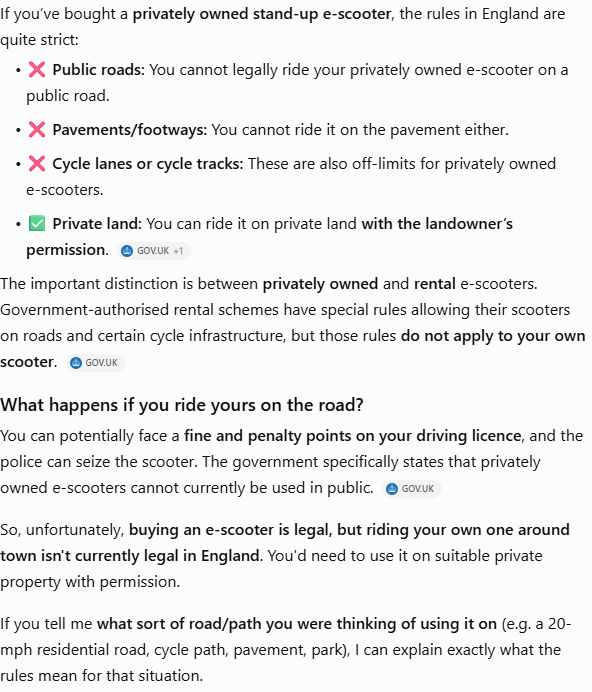 If you’ve bought a privately owned stand-up e-scooter, the rules in England are quite strict: ❌ Public roads: You cannot legally ride your privately owned e-scooter on a public road. ❌ Pavements/footways: You cannot ride it on the pavement either. ❌ Cycle lanes or cycle tracks: These are also off-limits for privately owned e-scooters. ✅ Private land: You can ride it on private land with the landowner’s permission. Source: GOV.UK +1 The important distinction is between privately owned and rental e-scooters. Government-authorised rental schemes have special rules allowing their scooters on roads and certain cycle infrastructure, but those rules do not apply to your own scooter. Source: GOV.UK What happens if you ride yours on the road? You can potentially face a fine and penalty points on your driving licence, and the police can seize the scooter. The government specifically states that privately owned e-scooters cannot currently be used in public. Source: GOV.UK So, unfortunately, buying an e-scooter is legal, but riding your own one around town isn't currently legal in England. You'd need to use it on suitable private property with permission. If you tell me what sort of road/path you were thinking of using it on (e.g. a 20-mph residential road, cycle path, pavement, park), I can explain exactly what the rules mean for that situation.
-
Try 2 Right
Our summary: Said no to both road and pavement for a private scooter; rental schemes differ; private land only.
The answer, with its screenshot
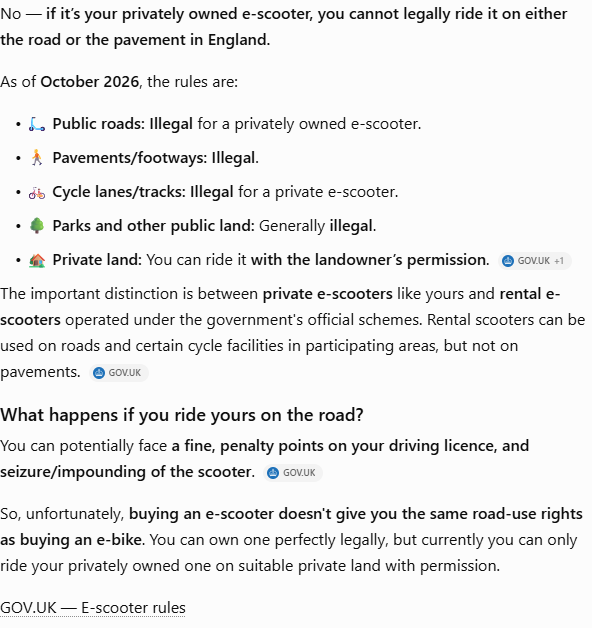 No — if it’s your privately owned e-scooter, you cannot legally ride it on either the road or the pavement in England. As of October 2026, the rules are: 🛴 Public roads: Illegal for a privately owned e-scooter. 🚶 Pavements/footways: Illegal. 🚲 Cycle lanes/tracks: Illegal for a private e-scooter. 🌳 Parks and other public land: Generally illegal. 🏡 Private land: You can ride it with the landowner’s permission. Source: GOV.UK +1 The important distinction is between private e-scooters like yours and rental e-scooters operated under the government's official schemes. Rental scooters can be used on roads and certain cycle facilities in participating areas, but not on pavements. Source: GOV.UK What happens if you ride yours on the road? You can potentially face a fine, penalty points on your driving licence, and seizure/impounding of the scooter. Source: GOV.UK So, unfortunately, buying an e-scooter doesn't give you the same road-use rights as buying an e-bike. You can own one perfectly legally, but currently you can only ride your privately owned one on suitable private land with permission. GOV.UK — E-scooter rules
-
Try 3 Right
Our summary: Said no to both road and pavement; only rental trial scooters may use roads; possible law change not yet made.
The answer, with its screenshot
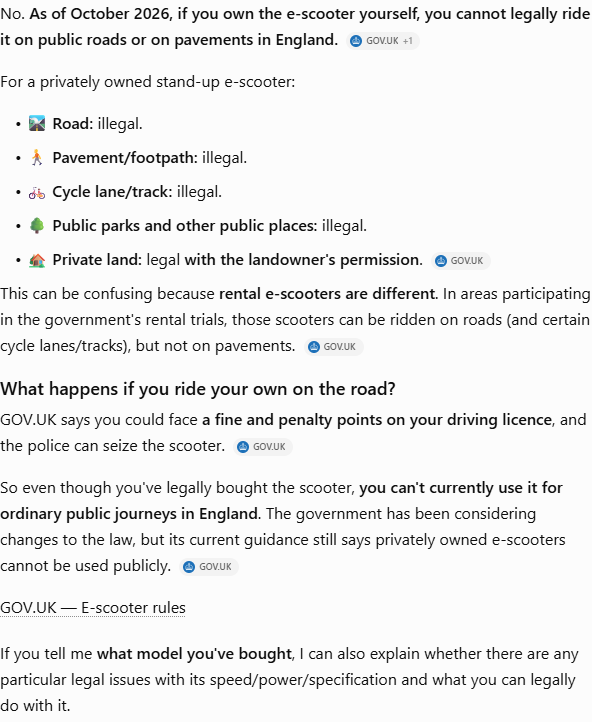 No. As of October 2026, if you own the e-scooter yourself, you cannot legally ride it on public roads or on pavements in England. Source: GOV.UK +1 For a privately owned stand-up e-scooter: 🛣️ Road: illegal. 🚶 Pavement/footpath: illegal. 🚲 Cycle lane/track: illegal. 🌳 Public parks and other public places: illegal. 🏡 Private land: legal with the landowner's permission. Source: GOV.UK This can be confusing because rental e-scooters are different. In areas participating in the government's rental trials, those scooters can be ridden on roads (and certain cycle lanes/tracks), but not on pavements. Source: GOV.UK What happens if you ride your own on the road? GOV.UK says you could face a fine and penalty points on your driving licence, and the police can seize the scooter. Source: GOV.UK So even though you've legally bought the scooter, you can't currently use it for ordinary public journeys in England. The government has been considering changes to the law, but its current guidance still says privately owned e-scooters cannot be used publicly. Source: GOV.UK GOV.UK — E-scooter rules If you tell me what model you've bought, I can also explain whether there are any particular legal issues with its speed/power/specification and what you can legally do with it.
-
-
Claude paid: Max
3 of 3 right-
Try 1 Right
Our summary: Said no to road, pavement and cycle lanes; private land only; a planned legalisation has not passed yet.
The answer, with its screenshot
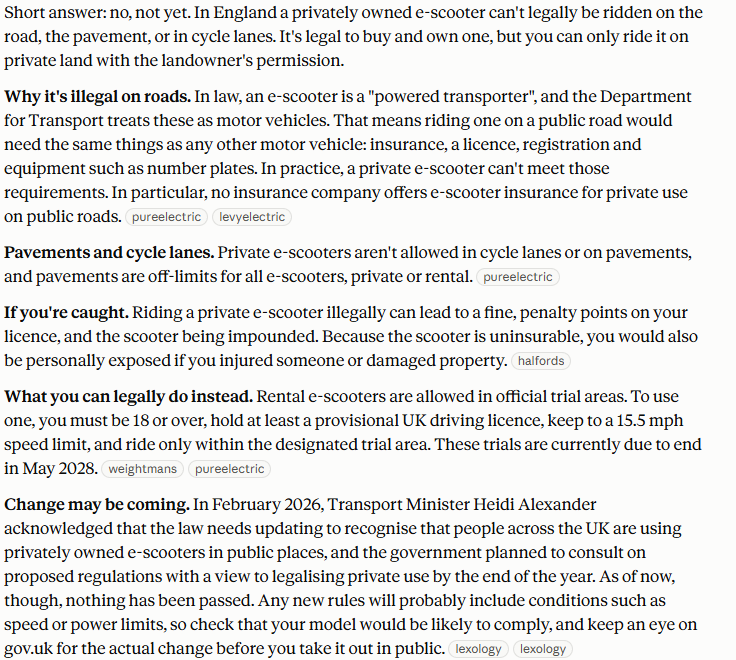 Short answer: no, not yet. In England a privately owned e-scooter can't legally be ridden on the road, the pavement, or in cycle lanes. It's legal to buy and own one, but you can only ride it on private land with the landowner's permission. Why it's illegal on roads. In law, an e-scooter is a "powered transporter", and the Department for Transport treats these as motor vehicles. That means riding one on a public road would need the same things as any other motor vehicle: insurance, a licence, registration and equipment such as number plates. In practice, a private e-scooter can't meet those requirements. In particular, no insurance company offers e-scooter insurance for private use on public roads. Source: pureelectric Source: levyelectric Pavements and cycle lanes. Private e-scooters aren't allowed in cycle lanes or on pavements, and pavements are off-limits for all e-scooters, private or rental. Source: pureelectric If you're caught. Riding a private e-scooter illegally can lead to a fine, penalty points on your licence, and the scooter being impounded. Because the scooter is uninsurable, you would also be personally exposed if you injured someone or damaged property. Source: halfords What you can legally do instead. Rental e-scooters are allowed in official trial areas. To use one, you must be 18 or over, hold at least a provisional UK driving licence, keep to a 15.5 mph speed limit, and ride only within the designated trial area. These trials are currently due to end in May 2028. Source: weightmans Source: pureelectric Change may be coming. In February 2026, Transport Minister Heidi Alexander acknowledged that the law needs updating to recognise that people across the UK are using privately owned e-scooters in public places, and the government planned to consult on proposed regulations with a view to legalising private use by the end of the year. As of now, though, nothing has been passed. Any new rules will probably include conditions such as speed or power limits, so check that your model would be likely to comply, and keep an eye on gov.uk for the actual change before you take it out in public. Source: lexology Source: lexology
-
Try 2 Right
Our summary: Said no to road and pavement; only rental trial scooters are exempt; planned legalisation not yet in force.
The answer, with its screenshot
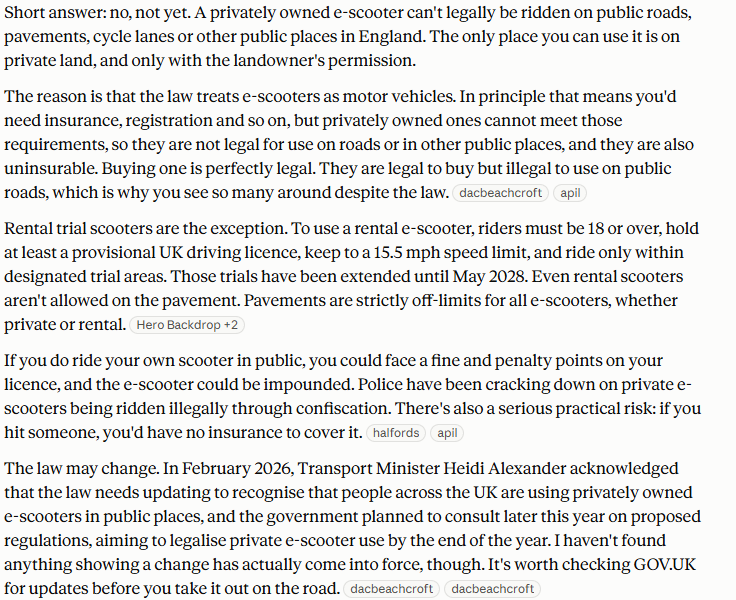 Short answer: no, not yet. A privately owned e-scooter can't legally be ridden on public roads, pavements, cycle lanes or other public places in England. The only place you can use it is on private land, and only with the landowner's permission. The reason is that the law treats e-scooters as motor vehicles. In principle that means you'd need insurance, registration and so on, but privately owned ones cannot meet those requirements, so they are not legal for use on roads or in other public places, and they are also uninsurable. Buying one is perfectly legal. They are legal to buy but illegal to use on public roads, which is why you see so many around despite the law. Source: dacbeachcroft Source: apil Rental trial scooters are the exception. To use a rental e-scooter, riders must be 18 or over, hold at least a provisional UK driving licence, keep to a 15.5 mph speed limit, and ride only within designated trial areas. Those trials have been extended until May 2028. Even rental scooters aren't allowed on the pavement. Pavements are strictly off-limits for all e-scooters, whether private or rental. Hero Backdrop +2 If you do ride your own scooter in public, you could face a fine and penalty points on your licence, and the e-scooter could be impounded. Police have been cracking down on private e-scooters being ridden illegally through confiscation. There's also a serious practical risk: if you hit someone, you'd have no insurance to cover it. Source: halfords Source: apil The law may change. In February 2026, Transport Minister Heidi Alexander acknowledged that the law needs updating to recognise that people across the UK are using privately owned e-scooters in public places, and the government planned to consult later this year on proposed regulations, aiming to legalise private e-scooter use by the end of the year. I haven't found anything showing a change has actually come into force, though. It's worth checking GOV.UK for updates before you take it out on the road. Source: dacbeachcroft Source: dacbeachcroft
-
Try 3 Right
Our summary: Said no to road and pavement; rental trial scooters differ; planned legalisation not yet law.
The answer, with its screenshot
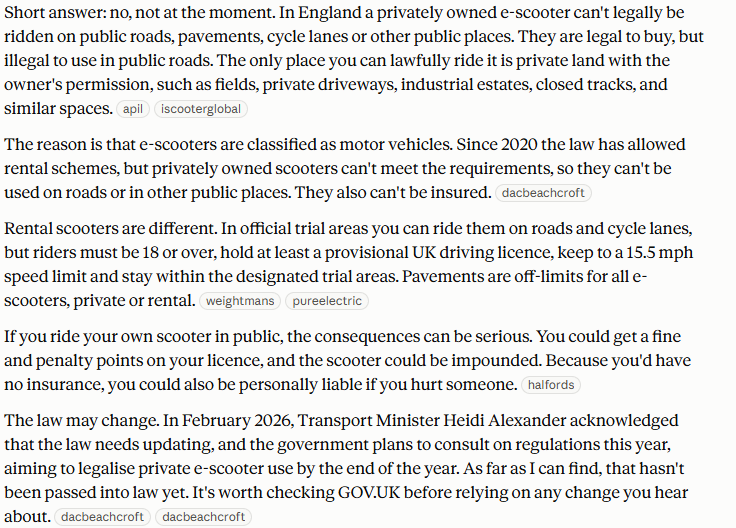 Short answer: no, not at the moment. In England a privately owned e-scooter can't legally be ridden on public roads, pavements, cycle lanes or other public places. They are legal to buy, but illegal to use in public roads. The only place you can lawfully ride it is private land with the owner's permission, such as fields, private driveways, industrial estates, closed tracks, and similar spaces. Source: apil Source: iscooterglobal The reason is that e-scooters are classified as motor vehicles. Since 2020 the law has allowed rental schemes, but privately owned scooters can't meet the requirements, so they can't be used on roads or in other public places. They also can't be insured. Source: dacbeachcroft Rental scooters are different. In official trial areas you can ride them on roads and cycle lanes, but riders must be 18 or over, hold at least a provisional UK driving licence, keep to a 15.5 mph speed limit and stay within the designated trial areas. Pavements are off-limits for all e-scooters, private or rental. Source: weightmans Source: pureelectric If you ride your own scooter in public, the consequences can be serious. You could get a fine and penalty points on your licence, and the scooter could be impounded. Because you'd have no insurance, you could also be personally liable if you hurt someone. Source: halfords The law may change. In February 2026, Transport Minister Heidi Alexander acknowledged that the law needs updating, and the government plans to consult on regulations this year, aiming to legalise private e-scooter use by the end of the year. As far as I can find, that hasn't been passed into law yet. It's worth checking GOV.UK before relying on any change you hear about. Source: dacbeachcroft Source: dacbeachcroft
-
-
Copilot
3 of 3 right-
Try 1 Right
Our summary: Said a private e-scooter may not use the road or pavement; rental trial scooters differ; private land only.
The answer, with its screenshot
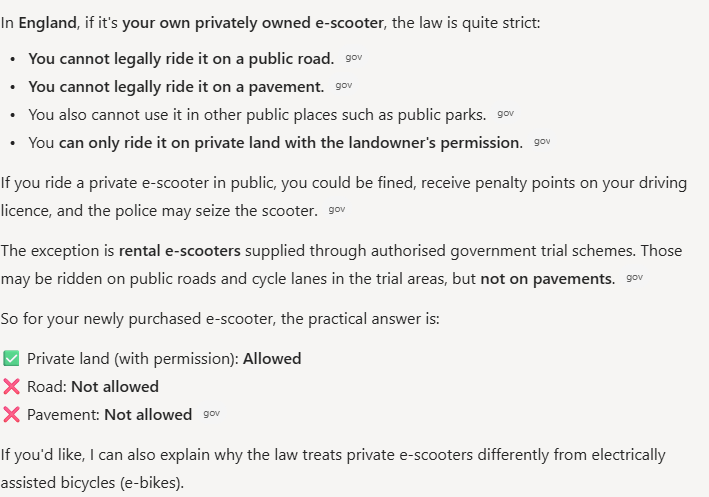 In England, if it's your own privately owned e-scooter, the law is quite strict: You cannot legally ride it on a public road. Source: gov You cannot legally ride it on a pavement. Source: gov You also cannot use it in other public places such as public parks. Source: gov You can only ride it on private land with the landowner's permission. Source: gov If you ride a private e-scooter in public, you could be fined, receive penalty points on your driving licence, and the police may seize the scooter. Source: gov The exception is rental e-scooters supplied through authorised government trial schemes. Those may be ridden on public roads and cycle lanes in the trial areas, but not on pavements. Source: gov So for your newly purchased e-scooter, the practical answer is: ✅ Private land (with permission): Allowed ❌ Road: Not allowed ❌ Pavement: Not allowed Source: gov If you'd like, I can also explain why the law treats private e-scooters differently from electrically assisted bicycles (e-bikes).
-
Try 2 Right
Our summary: Said no to road and pavement for a private scooter; rental trial scooters differ; private land only.
The answer, with its screenshot
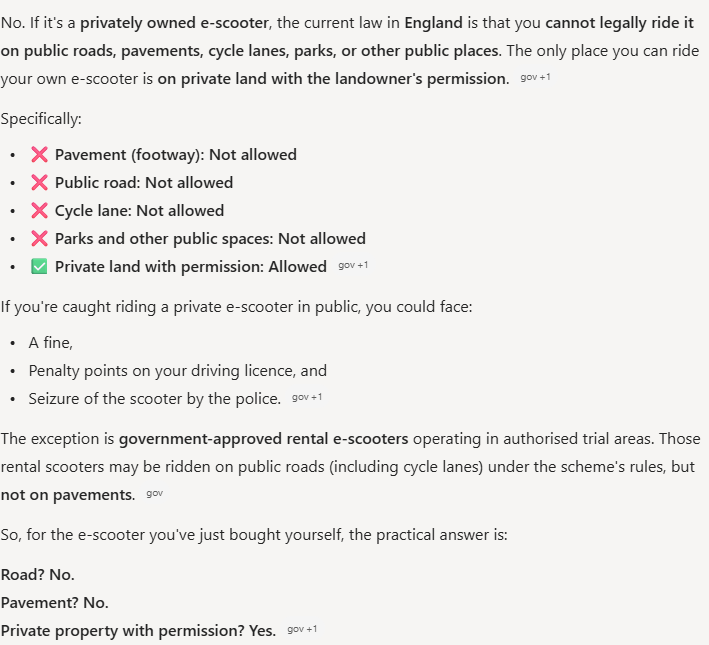 No. If it's a privately owned e-scooter, the current law in England is that you cannot legally ride it on public roads, pavements, cycle lanes, parks, or other public places. The only place you can ride your own e-scooter is on private land with the landowner's permission. Source: gov +1 Specifically: ❌ Pavement (footway): Not allowed ❌ Public road: Not allowed ❌ Cycle lane: Not allowed ❌ Parks and other public spaces: Not allowed ✅ Private land with permission: Allowed Source: gov +1 If you're caught riding a private e-scooter in public, you could face: A fine, Penalty points on your driving licence, and Seizure of the scooter by the police. Source: gov +1 The exception is government-approved rental e-scooters operating in authorised trial areas. Those rental scooters may be ridden on public roads (including cycle lanes) under the scheme's rules, but not on pavements. Source: gov So, for the e-scooter you've just bought yourself, the practical answer is: Road? No. Pavement? No. Private property with permission? Yes. Source: gov +1
-
Try 3 Right
Our summary: Said a private scooter is barred from roads and pavements; rental trial scooters differ; private land only.
The answer, with its screenshot
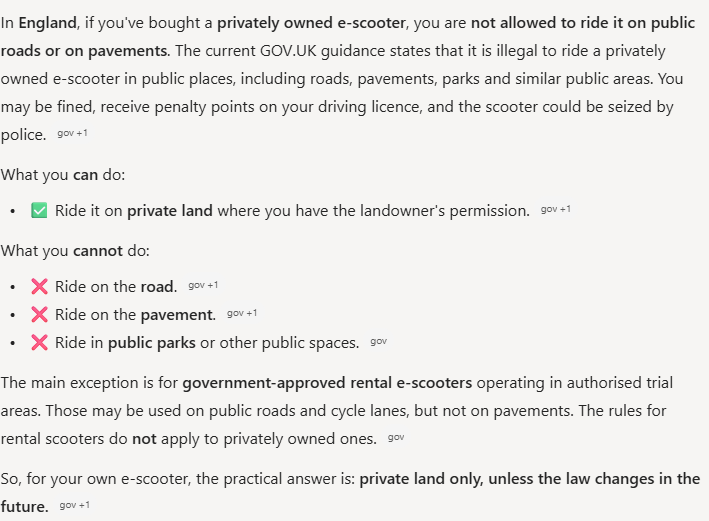 In England, if you've bought a privately owned e-scooter, you are not allowed to ride it on public roads or on pavements. The current GOV.UK guidance states that it is illegal to ride a privately owned e-scooter in public places, including roads, pavements, parks and similar public areas. You may be fined, receive penalty points on your driving licence, and the scooter could be seized by police. Source: gov +1 What you can do: ✅ Ride it on private land where you have the landowner's permission. Source: gov +1 What you cannot do: ❌ Ride on the road. Source: gov +1 ❌ Ride on the pavement. Source: gov +1 ❌ Ride in public parks or other public spaces. Source: gov The main exception is for government-approved rental e-scooters operating in authorised trial areas. Those may be used on public roads and cycle lanes, but not on pavements. The rules for rental scooters do not apply to privately owned ones. Source: gov So, for your own e-scooter, the practical answer is: private land only, unless the law changes in the future. Source: gov +1
-
-
Gemini free
3 of 3 right-
Try 1 Right
Our summary: Said no to road and pavement; trial rental scooters only, never on pavements; private land only.
The answer, with its screenshot
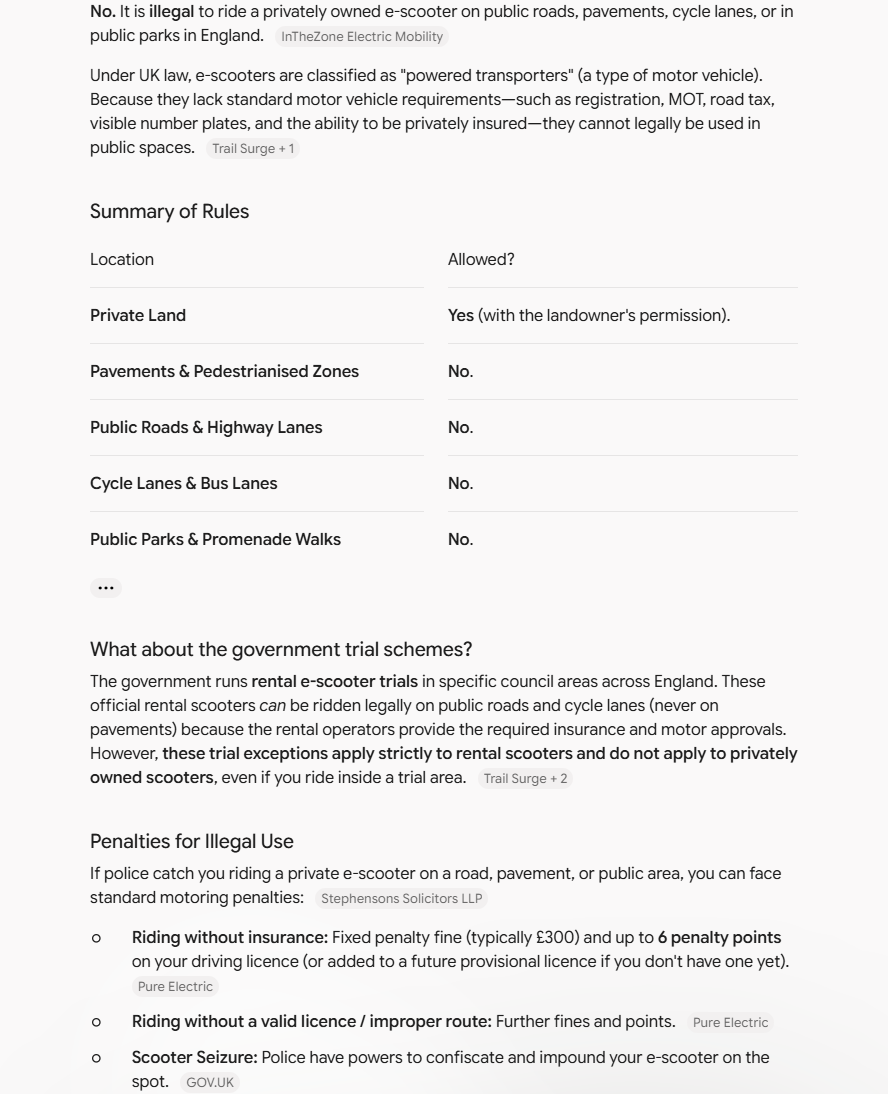 No. It is illegal to ride a privately owned e-scooter on public roads, pavements, cycle lanes, or in public parks in England. Source: InTheZone Electric Mobility Under UK law, e-scooters are classified as "powered transporters" (a type of motor vehicle). Because they lack standard motor vehicle requirements—such as registration, MOT, road tax, visible number plates, and the ability to be privately insured—they cannot legally be used in public spaces. Source: Trail Surge +1 Summary of Rules Location Allowed? Private Land Yes (with the landowner's permission). Pavements & Pedestrianised Zones No. Public Roads & Highway Lanes No. Cycle Lanes & Bus Lanes No. Public Parks & Promenade Walks No. What about the government trial schemes? The government runs rental e-scooter trials in specific council areas across England. These official rental scooters can be ridden legally on public roads and cycle lanes (never on pavements) because the rental operators provide the required insurance and motor approvals. However, these trial exceptions apply strictly to rental scooters and do not apply to privately owned scooters, even if you ride inside a trial area. Source: Trail Surge +2 Penalties for Illegal Use If police catch you riding a private e-scooter on a road, pavement, or public area, you can face standard motoring penalties: Source: Stephensons Solicitors LLP Riding without insurance: Fixed penalty fine (typically £300) and up to 6 penalty points on your driving licence (or added to a future provisional licence if you don't have one yet). Source: Pure Electric Riding without a valid licence / improper route: Further fines and points. Source: Pure Electric Scooter Seizure: Police have powers to confiscate and impound your e-scooter on the spot. Source: GOV.UK
-
Try 2 Right
Our summary: Said no to road and pavement; pavements barred for all e-scooters; private land only.
The answer, with its screenshot
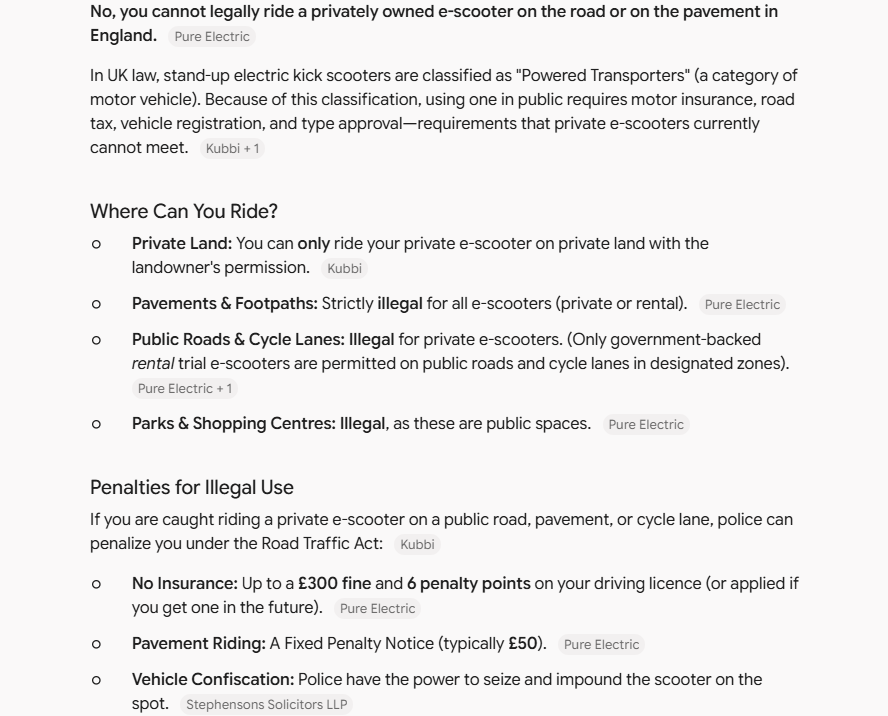 No, you cannot legally ride a privately owned e-scooter on the road or on the pavement in England. Source: Pure Electric In UK law, stand-up electric kick scooters are classified as "Powered Transporters" (a category of motor vehicle). Because of this classification, using one in public requires motor insurance, road tax, vehicle registration, and type approval—requirements that private e-scooters currently cannot meet. Source: Kubbi +1 Where Can You Ride? Private Land: You can only ride your private e-scooter on private land with the landowner's permission. Source: Kubbi Pavements & Footpaths: Strictly illegal for all e-scooters (private or rental). Source: Pure Electric Public Roads & Cycle Lanes: Illegal for private e-scooters. (Only government-backed rental trial e-scooters are permitted on public roads and cycle lanes in designated zones). Source: Pure Electric +1 Parks & Shopping Centres: Illegal, as these are public spaces. Source: Pure Electric Penalties for Illegal Use If you are caught riding a private e-scooter on a public road, pavement, or cycle lane, police can penalize you under the Road Traffic Act: Source: Kubbi No Insurance: Up to a £300 fine and 6 penalty points on your driving licence (or applied if you get one in the future). Source: Pure Electric Pavement Riding: A Fixed Penalty Notice (typically £50). Source: Pure Electric Vehicle Confiscation: Police have the power to seize and impound the scooter on the spot. Source: Stephensons Solicitors LLP
-
Try 3 Right
Our summary: Said no to road and pavement for a private scooter; trial rental scooters differ; private land only.
The answer, with its screenshot
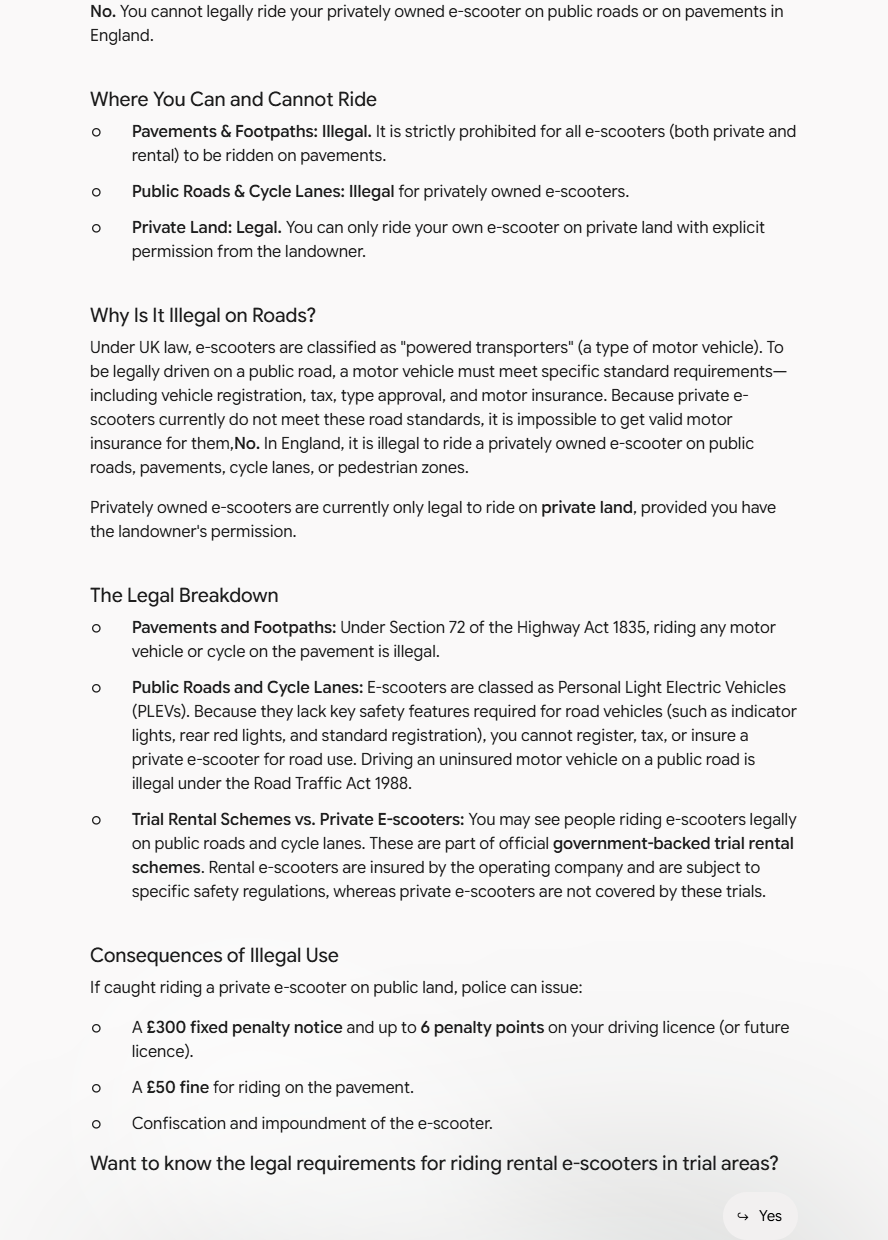 No. You cannot legally ride your privately owned e-scooter on public roads or on pavements in England. Where You Can and Cannot Ride Pavements & Footpaths: Illegal. It is strictly prohibited for all e-scooters (both private and rental) to be ridden on pavements. Public Roads & Cycle Lanes: Illegal for privately owned e-scooters. Private Land: Legal. You can only ride your own e-scooter on private land with explicit permission from the landowner. Why Is It Illegal on Roads? Under UK law, e-scooters are classified as "powered transporters" (a type of motor vehicle). To be legally driven on a public road, a motor vehicle must meet specific standard requirements—including vehicle registration, tax, type approval, and motor insurance. Because private e-scooters currently do not meet these road standards, it is impossible to get valid motor insurance for them,No. In England, it is illegal to ride a privately owned e-scooter on public roads, pavements, cycle lanes, or pedestrian zones. Privately owned e-scooters are currently only legal to ride on private land, provided you have the landowner's permission. The Legal Breakdown Pavements and Footpaths: Under Section 72 of the Highway Act 1835, riding any motor vehicle or cycle on the pavement is illegal. Public Roads and Cycle Lanes: E-scooters are classed as Personal Light Electric Vehicles (PLEVs). Because they lack key safety features required for road vehicles (such as indicator lights, rear red lights, and standard registration), you cannot register, tax, or insure a private e-scooter for road use. Driving an uninsured motor vehicle on a public road is illegal under the Road Traffic Act 1988. Trial Rental Schemes vs. Private E-scooters: You may see people riding e-scooters legally on public roads and cycle lanes. These are part of official government-backed trial rental schemes. Rental e-scooters are insured by the operating company and are subject to specific safety regulations, whereas private e-scooters are not covered by these trials. Consequences of Illegal Use If caught riding a private e-scooter on public land, police can issue: A £300 fixed penalty notice and up to 6 penalty points on your driving licence (or future licence). A £50 fine for riding on the pavement. Confiscation and impoundment of the e-scooter. Want to know the legal requirements for riding rental e-scooters in trial areas? Yes
-
-
Grok free
2 of 3 right-
Try 1 Nothing came back the app errored or never finished
-
Try 2 Right
Our summary: Said no to road and pavement, quoting GOV.UK; the rental trial rules do not apply to a private scooter; private land only.
The answer, with its screenshot
 No, you are not legally allowed to ride a privately owned e-scooter (also called an electric kick scooter) on public roads, pavements, cycle lanes, parks, or any other public places in England.Www This is a clear-cut rule under current UK law, with no changes as of October 2026. The official government guidance states: "It is illegal to ride a privately owned electric scooter (also known as an ‘e-scooter’) in public, for example on pavements, on roads or in parks."Www You could face a fine (starting at around £300 for driving without insurance), penalty points on your driving licence (if you hold one), and your scooter being seized by the police.Reeds Why this is the case Privately owned e-scooters are classified as motor vehicles under road traffic law (unlike e-bikes, which are treated as pedal cycles if they meet specific rules like 250W motor and pedal assistance). They have no legal requirements for insurance, registration, or licensing that allow public use. Rental e-scooters from official trials have different (more lenient) rules in designated areas, but that doesn't apply to your own scooter.Reeds Where you can ride it legally Only on private land with the explicit permission of the landowner or occupier (e.g., your own driveway or garden with consent).Www This rule applies across England (and the rest of Great Britain). Police routinely seize e-scooters used on public footpaths or roads, and there are ongoing warnings from councils and forces about this. Quick tips If you want to ride on roads or pavements legally, consider an e-bike that qualifies as an Electrically Assisted Pedal Cycle (EAPC) instead — these have more flexible rules. For mobility scooters or powered wheelchairs used by disabled people, there are separate (and usually more permissive) rules — check GOV.UK for your specific model. Always check your local council's website for any updates or trials, as rules can evolve, but the private vs. rental distinction remains firm. Riding illegally isn't worth the risk of a hefty fine or seizure — it's far safer to keep it on private property only. If your scooter came with any misleading marketing (e.g., ads showing it on streets), that doesn't change the law. Stay safe and legal!
-
Try 3 Right
Our summary: Said no to road and pavement; rental trial scooters may use roads and cycle lanes in trial areas, never pavements; private land only.
The answer, with its screenshot
 No, you are not legally allowed to ride your privately owned e-scooter (the stand-up electric kick scooter) on the pavement or on roads in England.Www The official GOV.UK guidance (as of the latest update) is clear and straightforward: It is illegal to ride a privately owned electric scooter in public spaces, including pavements (footways), roads, cycle lanes, or parks. You risk a fine, penalty points on your driving licence (if treated as a motor vehicle), and your scooter being seized by police. The only legal way to ride privately owned e-scooters is on private land with the landowner’s permission. This applies nationwide in England (and is the same position confirmed in legal analyses as recent as March 2026). Privately owned e-scooters are classed as “motor vehicles,” which means they should ideally be registered, taxed, insured, and meet vehicle standards — none of which they typically do. Exceptions and notes Rented e-scooters (via the government-approved trials like Voi or Lime): These have different rules — you can ride them on public roads and cycle lanes (in trial areas), but not on pavements. You need a full or provisional UK licence, and the operator provides insurance. No nationwide change has legalised private e-scooters yet. There have been proposals and a parliamentary bill (E-scooters Review and Awareness Bill, introduced 2026), but the rules remain the same: private ones are still illegal in public. Rental trials have been extended, but that doesn’t apply to yours. E-bikes (pedal bikes with electric assistance) have a separate, more permissive set of rules under the Electrically Assisted Pedal Cycle (EAPC) regulations — but your e-scooter is a stand-up kick scooter, not that. In practice, many people ride them anyway (especially in rural or quieter areas), but it’s still illegal and could get you into trouble with police or councils if caught. Recommendation: Check the exact rules on GOV.UK (search “Riding an electric scooter: the rules”) or your local council for any borough-specific nuances — but as a general rule in England, private use on public land is not permitted. If you want to use it legally, the safest option is private land only. Always wear a helmet for safety anyway.
-
-
Perplexity paid: Pro
3 of 3 right-
Try 1 Right
Our summary: Said a private scooter cannot use roads or pavements; rental trials do not cover it; private land only.
The answer, with its screenshot
 Short answer: In England, you cannot legally ride a privately owned stand‑up e‑scooter on public roads or pavements. You may only use it on private land with the landowner’s permission. Source: www +4 Why it’s illegal in public E‑scooters are classed as “motor vehicles” (powered transporters) under the Road Traffic Act. That means, to be used on public roads, they’d need to meet all the usual motor‑vehicle requirements (insurance, registration, tax, type approval, etc.). Source: met +3 It is not currently possible to get the required insurance or meet all those requirements for privately owned e‑scooters, so using one on public roads or other public spaces is a criminal offence. Source: met +3 Pavements (and cycle lanes/paths set aside for pedestrians/cyclists) are also off‑limits; riding there is an offence under the Highway Act and related rules. Source: met +3 What you can do instead Use it on private land (e.g., a garden, private estate, or other private area) with the landowner’s permission. Source: www +3 In some areas, government‑approved rental e‑scooter trials allow use on roads/cycle lanes under strict rules, but these do not cover privately owned scooters. Source: avonandsomerset +2 Penalties if you ride in public You risk: A fixed‑penalty fine (e.g., for no insurance or riding on the pavement). Source: www +1 Penalty points on your driving licence. Source: www +2 The scooter being seized/impounded by police. Source: www +3 If you tell me where you plan to ride (e.g., your estate, a private track, or a specific town), I can outline what counts as “private land” and any local nuances.
-
Try 2 Right
Our summary: Said no to both road and pavement; rental trial scooters are a separate scheme; private land only.
The answer, with its screenshot
 No. In England, you cannot legally ride a privately owned stand-up e-scooter on either a public road or a pavement. It may only be used on private land with the landowner’s permission. Source: www Where you can ride Public roads: Not legally permitted for your own e-scooter. Source: www Pavements: Not permitted; pavements are public space and riding there is an offence. Source: www +1 Cycle lanes, cycle tracks, parks, and pedestrian areas: Also not permitted for a privately owned e-scooter. Source: gov Private land: Permitted only with the owner’s consent—for example, your own enclosed property or land where the owner has expressly allowed it. Source: www Why this applies E-scooters are generally treated as motor vehicles/powered transporters in law. A privately owned scooter would need to satisfy requirements such as insurance, registration, and vehicle standards to be lawful on public roads—and, in practice, private e-scooters cannot normally meet those requirements. Source: gov +1 Possible consequences Riding it publicly can lead to a fine, penalty points on a driving licence, and police seizure of the scooter. Source: www +1 Rental e-scooters in any authorised local trial are different: the rules apply to the rental vehicle and scheme, not to a scooter you own yourself. Source: askthe.police
-
Try 3 Right
Our summary: Said no to road and pavement for a private scooter; rental schemes are separate; private land only.
The answer, with its screenshot
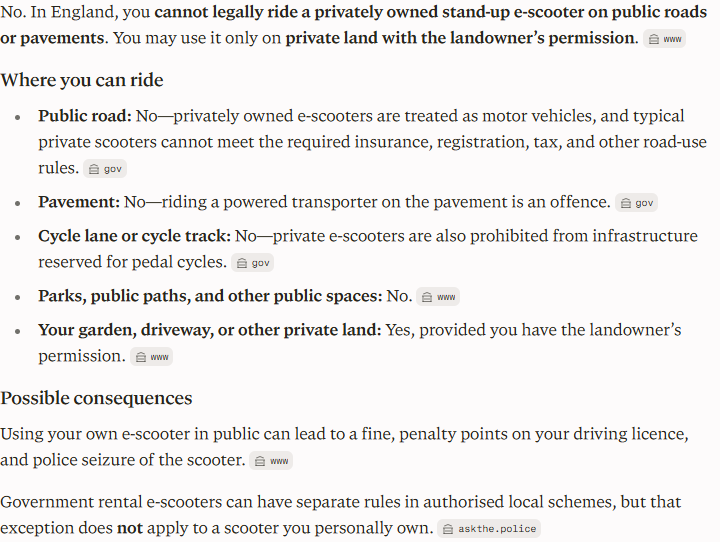 No. In England, you cannot legally ride a privately owned stand-up e-scooter on public roads or pavements. You may use it only on private land with the landowner’s permission. Source: www Where you can ride Public road: No—privately owned e-scooters are treated as motor vehicles, and typical private scooters cannot meet the required insurance, registration, tax, and other road-use rules. Source: gov Pavement: No—riding a powered transporter on the pavement is an offence. Source: gov Cycle lane or cycle track: No—private e-scooters are also prohibited from infrastructure reserved for pedal cycles. Source: gov Parks, public paths, and other public spaces: No. Source: www Your garden, driveway, or other private land: Yes, provided you have the landowner’s permission. Source: www Possible consequences Using your own e-scooter in public can lead to a fine, penalty points on your driving licence, and police seizure of the scooter. Source: www Government rental e-scooters can have separate rules in authorised local schemes, but that exception does not apply to a scooter you personally own. Source: askthe.police
-
Question 3 A tenant given a no-fault eviction notice in September 2026: is it valid? sealed
What it tests: Whether an app is up to date on the rules for ending a private tenancy in England.
15 of 18 tries right
-
ChatGPT logged out
3 of 3 right-
Try 1 Right
Our summary: Said the notice is invalid because no-fault eviction was abolished from 1 May 2026; landlord must use section 8 grounds.
Note: it named section 8, the route a landlord must now use.
Full answer
No. A Section 21 notice served on 28 September 2026 is not valid in England. The key point is that the law changed before your landlord served the notice: The Renters’ Rights Act 2025 abolished the Section 21 “no-fault” eviction procedure in England from 1 May 2026. Landlords can no longer serve a new Section 21 notice after that date. Source: GOV.UK +1 This applies to existing tenancies too. Most existing assured shorthold tenancies automatically became assured periodic tenancies on 1 May 2026; the original March 2025 fixed end date no longer applies. Source: GOV.UK The government's transitional guidance specifically says that landlords cannot issue Section 21 notices for existing or new tenancies from 1 May 2026. Source: GOV.UK So, on the facts you've given, your landlord's 28 September 2026 Section 21 notice cannot lawfully require you to leave after two months, and the landlord cannot obtain a possession order using that notice. What can the landlord do instead? If the landlord wants you to leave, they generally have to use the Section 8 possession process, relying on one of the statutory grounds for possession—for example, certain rent arrears, antisocial behaviour, or particular circumstances involving selling or moving into the property. The required notice period varies according to the ground. Source: GOV.UK Importantly, you should not assume that you have to move out simply because the Section 21 notice says so. If there is no valid possession order and you have not otherwise agreed to leave, the landlord cannot simply change the locks or physically remove you. There is one important qualification: if your landlord actually served a valid Section 21 notice before 1 May 2026, transitional rules could have allowed limited use of it. But your stated date—28 September 2026—is well after the cutoff, and the government's guidance confirms that even pre-May notices could no longer be used to start proceedings after 31 July 2026. Source: GOV.UK If you tell me (1) whether you pay rent monthly or weekly, (2) whether you still have the original tenancy agreement, and (3) exactly what the notice says/forms it uses, I can explain what your landlord can legally do now and whether you need to respond to the notice. -
Try 2 Right
Our summary: Said the notice is invalid: no-fault notices ended on 1 May 2026 and the tenancy became assured periodic.
Note: it named section 8, the route a landlord must now use.
Full answer
No. On the facts you’ve given, a Section 21 notice served on 28 September 2026 is not valid in England. The important point is that the law changed on 1 May 2026. […] Existing assured shorthold tenancies automatically became assured periodic tenancies, and any fixed end date ceased to apply. Source: GOV.UK +1 From 1 May 2026, a private landlord cannot serve a Section 21 “no-fault” notice, including in respect of an existing tenancy. The government's guidance expressly says this applies even if the tenancy agreement says the landlord can use Section 21. Source: GOV.UK +1 The transitional rules only preserved certain Section 21 notices that had already been served on or before 30 April 2026. A notice first served on 28 September 2026 cannot benefit from those transitional provisions. Source: GOV.UK What your landlord would have to do instead If your landlord wants possession now, they generally need to use the Section 8 procedure and rely on one of the statutory grounds for possession—for example, certain circumstances involving sale or the landlord moving into the property, rent arrears, or other specified grounds. The applicable notice period depends on the ground. Source: GOV.UK +1 So the fact that your landlord has given you two months' notice does not make this Section 21 notice valid. The problem is the use of Section 21 itself, not simply the length of the notice. Also, don't move out simply because the two-month date passes if you don't want to leave. A landlord cannot lawfully evict you by changing the locks or physically removing you; normally they need to obtain a possession order from the court and, if necessary, use bailiffs. Source: GOV.UK If you tell me (1) the exact wording/title of the notice you received, (2) the date your original tenancy ended in March 2026, and (3) whether your landlord has given any reason for wanting you out, I can explain exactly what your current tenancy status is and what your landlord can and cannot do next. -
Try 3 Right
Our summary: Said not valid: no-fault notices ended 1 May 2026, the transitional exception covers only earlier notices; section 8 instead.
Note: it named section 8, the route a landlord must now use.
Full answer
No. A section 21 notice served on 28 September 2026 is not valid in England, assuming this is an ordinary private tenancy covered by the Renters’ Rights Act changes. The important point is that the law changed on 1 May 2026: From 1 May 2026, section 21 “no-fault” notices can no longer be used for private rented tenancies in England. Source: GOV.UK +1 Your March 2025 fixed-term assured shorthold tenancy would have automatically become an assured periodic tenancy on 1 May 2026. The fact that your original agreement said “12 months” does not preserve the fixed term after that date. Source: GOV.UK For an assured periodic tenancy, your landlord now generally has to rely on a specific statutory ground for possession and serve a section 8 notice, rather than simply giving you a section 21 notice. Source: GOV.UK There is a transitional exception for section 21 notices, but it doesn't help your landlord: it applies to section 21 notices given on or before 30 April 2026. A notice given on 28 September 2026 is too late. Source: GOV.UK What this means for you You do not have to leave simply because the 28 September notice says you must leave within two months. Your landlord cannot lawfully evict you by changing the locks or otherwise forcing you out; normally they would need to follow the appropriate possession procedure and obtain a court order if you don't leave voluntarily. Source: GOV.UK If you tell me (1) the exact date in March 2025 your tenancy began, (2) whether you pay rent monthly, and (3) what reason, if any, your landlord has given for wanting you out, I can explain what notice they could validly serve now and whether there are any other issues with the notice you've received.
-
-
Claude paid: Max
3 of 3 right-
Try 1 Right
Our summary: Said invalid: no-fault eviction ended 1 May 2026; landlord needs section 8 grounds, four months to sell or move in.
Note: it named section 8, the route a landlord must now use.
Note: it mentioned four months' notice.
Full answer
No, that notice isn't valid. Section 21 "no-fault" notices were abolished in England on 1 May 2026, so a notice served on 28 September 2026 has no legal effect. What changed: Under the Renters' Rights Act 2025, all existing assured shorthold tenancies automatically converted into Section 4A assured tenancies on 1 May 2026. Your fixed-term AST is now an assured periodic tenancy with no end date. Section 21 has now been abolished, and an APT can only be terminated by the landlord if they first serve a Section 8 notice. Source: farleys Source: nrla The only exception was for section 21 notices served before 1 May 2026, and even those had to be taken to court by 31 July 2026 at the latest. That transition period has now ended. So no route exists for your landlord to rely on a section 21 notice now. Source: nrla What it means for you in practice: You don't have to leave when the two months are up. Your tenancy continues. If your landlord wants possession, they must serve a Section 8 notice based on a specific legal ground, such as rent arrears, a breach of the tenancy, or wanting to sell or move in themselves. Notice periods under the new rules are generally longer; for selling or moving in, it's four months. Even with a valid Section 8 notice, only a court can order you to leave, and only court bailiffs can remove you. A landlord who changes the locks, removes your belongings, or harasses you into leaving is committing a criminal offence. Suggested next steps: Keep a copy of the notice and note how and when you received it. You could reply to your landlord, politely and in writing, that section 21 no longer applies since 1 May 2026. Many private landlords are still adjusting to the change, so this may be a mistake rather than bad faith. For free advice specific to your situation, contact Shelter (england.shelter.org.uk, or their helpline) or Citizens Advice. Your local council's housing team can also step in if your landlord tries to force you out. I'm not a lawyer, so treat this as general information. If your landlord follows up with a Section 8 notice or court papers, get advice from one of those organisations promptly. -
Try 2 Right
Our summary: Said almost certainly not, then plainly invalid: no-fault eviction abolished 1 May 2026; landlord must use section 8 grounds.
Note: it named section 8, the route a landlord must now use.
Full answer
Almost certainly not. Section 21 "no-fault" evictions have been abolished in England, so a section 21 notice served on 28 September 2026 has no legal effect. Why the notice is invalid The Renters' Rights Act 2025 received Royal Assent on 27 October 2025 and came into force on 1 May 2026. From that date, landlords in England can no longer serve a Section 21 notice to regain possession without a stated reason. The last date on which a landlord could serve a section 21 notice was 30 April 2026. Even notices served before then only survived if court proceedings were issued on or before 31 July 2026. Your landlord's notice came almost five months after the cut-off. renters rights act 2026 +3 Your tenancy now Your assured shorthold tenancy doesn't exist in that form anymore. Every tenancy that was an assured shorthold converted automatically to an assured periodic tenancy on 1 May 2026. In practice, you can keep living there, and your landlord can only end the tenancy through the courts. Possession must now go through Section 8 of the Housing Act 1988, using the amended grounds in Schedule 2. These are specific reasons such as rent arrears, a breach of the tenancy, or the landlord wanting to sell or move in. Each reason has its own notice period and conditions, and most are longer than two months. Source: augustapp Source: learnsignal What to do You don't need to move out because of this notice, and your landlord can't make you leave without a court order. Changing the locks or removing your belongings without one would be an illegal eviction. Your landlord may simply not know about the change, so you could politely tell them in writing that section 21 no longer applies. You can also ask for proof that they gave you the government's Renters' Rights Act information sheet. Landlords with existing tenancies had to provide it by 31 May 2026. Source: mylawyer If your landlord follows up with a section 8 notice, get advice quickly, because the ground they use and whether they've met its conditions matter a lot. Shelter (0808 800 4444), Citizens Advice, and your local council's housing team can all help for free. I'm not a lawyer, so it's worth having one of those advisers look at the notice itself. On the main question, though, the law is clear: a section 21 notice served in September 2026 isn't valid. -
Try 3 Right
Our summary: Said the notice has no legal effect after no-fault eviction ended 1 May 2026, noting a narrow pre-May exception.
Note: it named section 8, the route a landlord must now use.
Full answer
Almost certainly not. For a private tenancy in England, a section 21 notice served on 28 September 2026 has no legal effect. Why: The Renters' Rights Act 2025 received Royal Assent on 27 October 2025, and its first phase commenced on 1 May 2026. The last date on which a landlord could serve a section 21 notice was 30 April 2026. Shelter lists serving the notice on a private tenant on or after 1 May 2026 as one of the things that makes a section 21 notice invalid. Your tenancy also changed: every tenancy that was an assured shorthold converted automatically to an assured periodic tenancy on 1 May 2026, so it continues month to month unless it is lawfully ended. Renters' Rights Act +3 One narrow exception. A tenancy remains an assured shorthold tenancy where, before 1 May 2026, the landlord served either a valid section 21 notice or a section 8 notice, and in that situation a section 21 notice could still be served after 1 May. If you didn't get any notice from your landlord before May 2026, this almost certainly doesn't apply to you. Even if you did, those older notices had strict court deadlines that ended on 31 July 2026. Source: shelter What your landlord can still do. Every possession claim now has to use the Section 8 route and rest on a specific statutory ground. Examples are rent arrears, wanting to sell, or moving in themselves. Each ground has its own notice period and rules, and in most cases the landlord needs a court order before you have to leave. Source: augustapp Practical steps: You don't need to move out because of this notice. Keep paying rent and keep a copy of the notice. Consider replying in writing that you believe the notice is invalid under the Renters' Rights Act. If your landlord tries to force you out (changing the locks, removing your things, harassment), that may be an illegal eviction. Contact your local council's housing team right away. Free advice is available from Shelter (0808 800 4444), Citizens Advice, or your council. They can look at your actual paperwork, which matters given the exception above. I'm not a lawyer, so it's worth getting your situation checked by one of them.
-
-
Copilot
3 of 3 right-
Try 1 Right
Our summary: Said probably not valid, as no-fault notices were abolished for most private tenancies from 1 May 2026.
Full answer
Based on the facts you've given, probably not. […] Your landlord served a Section 21 notice on 28 September 2026. However, Section 21 "no fault" notices were abolished for most private tenancies in England from 1 May 2026 under the new tenancy regime. A private landlord generally cannot serve a new Section 21 notice on an ordinary private tenant after that date. Source: gov +1 Therefore, if: you are a tenant of a private landlord, your tenancy was an ordinary AST that started in March 2025, and no valid Section 21 notice had been served before 1 May 2026, then a Section 21 notice first served on 28 September 2026 would generally be invalid. Source: shelter +1 There are some exceptions and transitional cases. For example, certain possession proceedings based on valid notices served before the law changed could continue, and different rules may apply in some social housing situations. Source: shelter +1 So, on the information you've provided, my view is: A Section 21 notice served on 28 September 2026 by a private landlord is unlikely to be valid. Source: shelter +1 If you can tell me whether the landlord is an ordinary private landlord or a housing association/social landlord, I can explain whether any exception might apply. -
Try 2 Right
Our summary: Said the notice is likely invalid because no-fault notices ended 1 May 2026, subject to transitional exceptions.
Full answer
On the facts you've given, the notice is quite likely to be invalid, but the key reason is not the two-month period. From 1 May 2026, the Renters' Rights Act abolished Section 21 notices for most private residential tenancies in England. Shelter's guidance states that a private landlord can only rely on a Section 21 notice if it was served before 1 May 2026 (subject to transitional rules and time limits). Source: shelter Your timeline is: Tenancy began: March 2025 (12‑month AST). Fixed term ended: March 2026. Landlord served Section 21 notice: 28 September 2026. Because the notice was served after 1 May 2026, a private landlord generally cannot start a new Section 21 process at that date. Source: shelter +1 There are, however, some exceptions and transitional arrangements. Shelter notes that some tenancies remained assured shorthold tenancies where a valid possession notice had already been served before 1 May 2026 and court proceedings were begun within the relevant deadlines. Source: shelter So: If this was the first Section 21 notice you received, served on 28 September 2026 by a private landlord, it is likely not a valid Section 21 notice. Source: shelter +1 Even before considering the 2026 reforms, a Section 21 notice must satisfy a number of technical requirements (correct form, deposit protection, prescribed information, etc.). Source: shelter +1 Also, a Section 21 notice does not itself end the tenancy or require you to leave immediately. Historically, if a tenant did not leave, the landlord had to obtain a possession order from the court. Source: shelter If you'd like, I can help assess the transitional rules in more detail if you tell me: whether the landlord is definitely a private landlord (not social housing), and whether you received any earlier possession notice before 1 May 2026. -
Try 3 Right
Our summary: Said almost certainly invalid, served after no-fault notices were abolished on 1 May 2026.
Full answer
On the facts you've given, the notice is very likely not valid. […] The fixed term would have ended around March 2026, after which the tenancy would normally have continued as a periodic tenancy if you stayed in occupation. However, the law changed in England on 1 May 2026. The Renters' Rights Act abolished the use of section 21 notices in the private rented sector from that date. Shelter's legal guidance states that a private landlord could only rely on a valid section 21 notice that had been served before 1 May 2026 and, in general, possession proceedings had to have been started by 31 July 2026. Source: shelter Because your landlord served the notice on 28 September 2026, which is after 1 May 2026, a section 21 notice could not normally be used to end a private residential tenancy. Source: shelter +1 So, based on the information you've provided: Tenancy started: March 2025. Section 21 notice served: 28 September 2026. Property: private rented flat in England. Conclusion: the section 21 notice is almost certainly invalid because it was served after section 21 had been abolished for private tenancies. Source: shelter +1 If you want, I can also explain what type of notice your landlord would need to use instead under the post‑May‑2026 rules.
-
-
Gemini free
3 of 3 right-
Try 1 Right
Our summary: Said invalid: no-fault eviction abolished 1 May 2026, legacy window closed 31 July; section 8 with four months to sell.
Note: it named section 8, the route a landlord must now use.
Note: it mentioned four months' notice.
Full answer
The Section 21 notice served to you on 28 September 2026 is invalid. Why the Notice Is Invalid Under the Renters' Rights Act, Section 21 "no-fault" evictions were officially abolished in England on 1 May 2026. Source: Get Renters Rights No new Section 21 notices can be issued: Landlords have been prohibited from issuing new Section 21 notices as of 1 May 2026. Any Section 21 notice served on or after this date has no legal standing. Source: Get Renters Rights Transitional window closed: The deadline for landlords to issue court proceedings for legacy Section 21 notices served before 1 May 2026 passed on 31 July 2026. Source: Get Renters Rights Because your landlord issued this notice in September 2026, it carries no legal weight, and you are not legally required to move out based on this document. Source: Get Renters Rights What Your Landlord Must Do to Evict You To end your tenancy now, your landlord must follow the reformed Section 8 process: Source: RakLAW Solicitors Serve a Section 8 Notice: The landlord must issue a formal Section 8 notice specifying a valid statutory ground for possession (such as moving back in, selling the property, or rent arrears). Source: RakLAW Solicitors Provide Required Notice Periods: Notice periods under Section 8 depend on the ground being used. For instance, if the landlord wishes to sell or move back into the property, they must give 4 months' notice (and this cannot be enforced during the first 12 months of a tenancy). Source: Alan Boswell Group +1 Obtain a Court Order: If you do not leave at the end of a valid Section 8 notice period, the landlord must apply to the court for a possession order and prove their legal grounds. Source: Total Landlord Insurance Recommended Next Steps Keep written records: Save the Section 21 notice and the date-stamped envelope or email showing when it was served. Inform your landlord in writing: You can reply to let them know that Section 21 notices were abolished on 1 May 2026 under the Renters' Rights Act and that the notice served is invalid. Source: Get Renters Rights Seek advice if challenged: If your landlord threatens illegal eviction or harassment, contact Shelter or your local council's private renting team immediately. Want a draft response template to send to your landlord explaining why the notice is invalid? Yes -
Try 2 Right
Our summary: Said invalid: no-fault eviction abolished 1 May 2026, tenancy now assured periodic; section 8 grounds, four months to sell.
Note: it named section 8, the route a landlord must now use.
Note: it mentioned four months' notice.
Full answer
No, the notice is invalid. Section 21 "no-fault" eviction notices were officially abolished in England on 1 May 2026 under Phase 1 of the Renters' Rights Act. Source: Total Landlord Insurance Because your landlord issued the notice on 28 September 2026, they have no legal right to serve a Section 21 notice. Attempting to issue a Section 21 notice after the 1 May 2026 deadline carries no legal force, and landlords who attempt to serve them face potential civil penalties from local authorities. Source: The Independent Landlord What Has Changed for Your Tenancy Automatic Conversion: On 1 May 2026, your Assured Shorthold Tenancy (AST) automatically converted into an assured periodic tenancy. Source: Shelter England Evictions Require Specific Grounds (Section 8): To evict you, your landlord can no longer use no-fault mechanisms. They must serve a Section 8 notice citing specific, legally recognized grounds (e.g., serious rent arrears, wanting to sell the property, or moving in themselves). Source: Total Landlord Insurance +1 New Notice Periods: If your landlord wants to sell the property or move back in, they must give you 4 months' notice (instead of 2 months) using the appropriate Section 8 grounds. Source: Total Landlord Insurance What You Should Do Next You do not need to leave the property based on this Section 21 notice. Source: The Independent Landlord Inform your landlord in writing (if you feel comfortable doing so) that Section 21 notices were abolished on 1 May 2026 and that the notice served on 28 September is invalid. Source: Total Landlord Insurance Keep paying your rent as normal to avoid incurring rent arrears, which could provide valid grounds for a Section 8 notice. Source: Total Landlord Insurance Seek advice: Contact Shelter England or Citizens Advice for free, confidential tenancy support if your landlord threatens further legal action or attempts an unlawful eviction. Want me to draft a polite email to your landlord explaining why the Section 21 notice is invalid? Yes -
Try 3 Right
Our summary: Said not valid after no-fault eviction ended 1 May 2026; section 8 needed, typically four months for sale or move-in.
Note: it named section 8, the route a landlord must now use.
Note: it mentioned four months' notice.
Full answer
No, the Section 21 notice served on 28 September 2026 is not valid. Under the Renters' Rights Act, Section 21 "no-fault" evictions were completely abolished in England for private residential tenancies effective 1 May 2026. Any Section 21 notice served on or after 1 May 2026 has no legal standing. Source: Alan Boswell Group What This Means for Your Tenancy Automatic Conversion to a Periodic Tenancy Your fixed-term Assured Shorthold Tenancy (AST) automatically converted into an assured periodic (month-to-month) tenancy on 1 May 2026. Source: Goodlord Blog Valid Eviction Routes Only Because Section 21 is no longer an available route, your landlord cannot evict you without specifying a valid legal reason. To seek possession of the flat, your landlord must serve a Section 8 notice relying on specific statutory grounds (such as wanting to sell the property, moving in themselves, or severe rent arrears). Source: Alan Boswell Group +1 Protected Notice Periods & Rules Even if your landlord serves a Section 8 notice on valid grounds (for example, Ground 1 to move back in or Ground 1A to sell), updated rules generally require longer notice periods (typically 4 months for personal move-in/sale grounds). Source: Total Landlord Insurance Recommended Next Steps Do not ignore the notice, but know your rights: You are under no obligation to move out by the two-month date listed on an invalid Section 21 notice. Inform your landlord: You (or a housing adviser) can write to your landlord to inform them that Section 21 notices served after 1 May 2026 are legally invalid under the Renters' Rights Act. Source: GOV.UK Seek free advice: Contact Shelter or your local Citizens Advice bureau if you need assistance drafting a response or if your landlord threatens illegal eviction.
-
-
Grok free
0 of 3 right-
Try 1 Nothing came back the app errored or never finished
-
Try 2 Nothing came back the app errored or never finished
-
Try 3 Nothing came back the app errored or never finished
-
-
Perplexity paid: Pro
3 of 3 right-
Try 1 Right
Our summary: Said not valid: no-fault notices abolished 1 May 2026, pre-May notices needed court by 31 July; use section 8.
Note: it named section 8, the route a landlord must now use.
Full answer
Based on the information you provided, the Section 21 notice your landlord gave you on 28 September 2026 is not valid. Source: www +3 Why the notice is invalid The key issue is the date the notice was served. The Renters’ Rights Act 2025 abolished Section 21 “no-fault” evictions in the private rented sector in England from 1 May 2026. Source: www +3 From 1 May 2026 onwards, private landlords cannot serve new Section 21 notices. Source: www +3 Any Section 21 notice purportedly served on or after 1 May 2026 is invalid, and landlords risk a civil penalty of up to £7,000 for serving one. Source: theindependentlandlord Instead, landlords must use a Section 8 notice and rely on specific legal grounds for possession (for example, rent arrears, breach of tenancy terms, or wanting to sell/move in, depending on the grounds available). Source: www +3 There was a short transitional window for Section 21 notices served before 1 May 2026: landlords had until 31 July 2026 to apply to court for a possession order based on those pre‑May notices. Your notice was served in September 2026, well after both the abolition date and the transitional deadline, so it cannot be valid under the old rules. Source: gov +2 What this means for you Your tenancy will have automatically converted to an assured periodic tenancy on 1 May 2026 (even though it started as a 12‑month fixed AST in March 2025). Source: www +1 Your landlord cannot lawfully evict you using this Section 21 notice. If they try to start court proceedings based on it, you can challenge it as invalid. Source: citizensadvice +2 If your landlord still wants you to leave, they would need to serve a valid Section 8 notice with appropriate grounds and follow the correct process, including obtaining a court possession order before any eviction can take place. Source: www +2 Recommended next steps Do not move out based solely on this invalid notice. Consider contacting Shelter, Citizens Advice, or a housing solicitor for tailored advice and, if needed, help responding to your landlord or defending any court claim. Source: citizensadvice Keep a copy of the notice and any correspondence, noting the date it was given (28 September 2026). If you’d like, I can outline what a valid Section 8 process looks like and what grounds your landlord might try to use. -
Try 2 Right
Our summary: Said not valid after the 1 May 2026 abolition and 31 July cut-off; landlord must use section 8.
But in passing: b: "Even with a valid Section 8 notice, they must give you the correct minimum notice period (often at least 2 months, sometimes more depending on the ground used)"
Note: it named section 8, the route a landlord must now use.
Full answer
Based on the information you’ve provided, your landlord’s Section 21 notice given on 28 September 2026 is not valid. Source: www +3 Why the notice is invalid Section 21 was abolished on 1 May 2026 The Renters’ Rights Act 2025 abolished “no-fault” Section 21 evictions in the private rented sector in England from 1 May 2026. From that date: Source: citizensadvice +3 Landlords can no longer serve new Section 21 notices. Source: theindependentlandlord +1 Almost all existing assured shorthold tenancies (including yours) automatically convert to assured periodic tenancies on 1 May 2026. Source: www +1 To end the tenancy, landlords must instead use a Section 8 notice with specified legal grounds for possession. Source: www +2 […] Your landlord therefore lost the ability to use Section 21 from 1 May 2026 onwards. Source: www +1 Transitional rules only protect notices served before 1 May 2026 There is a short transitional window for Section 21 notices that were validly served before 1 May 2026: Such pre‑May notices could still be used, but only if the landlord applied to court for a possession order by 31 July 2026 (and within the usual 6‑month validity period). Source: gov +2 Any Section 21 notice served on or after 1 May 2026 is invalid, and using one can expose the landlord to a civil penalty of up to £7,000. Source: theindependentlandlord Your notice was served on 28 September 2026, well after both: the abolition date (1 May 2026), and the final court‑application deadline for old notices (31 July 2026). Source: gov +2 That makes it legally ineffective as a Section 21 notice. What this means for you You do not have to leave just because of this notice. Source: citizensadvice Your landlord cannot obtain a possession order from the court based on this Section 21 notice. Source: citizensadvice +2 If they still want you to leave, they would need to start a Section 8 possession claim with valid grounds (for example, rent arrears, breach of tenancy terms, or certain mandatory grounds like wanting to sell or move in, if applicable). Source: www +2 Even with a valid Section 8 notice, they must give you the correct minimum notice period (often at least 2 months, sometimes more depending on the ground used) and then get a court order before bailiffs can evict you. Source: www +1 Practical next steps You may wish to: Write to your landlord (email or letter) stating that you understand Section 21 notices are no longer valid after 1 May 2026 and that the notice dated 28 September 2026 cannot be used to end your tenancy. Source: citizensadvice +1 Ask them to confirm whether they intend to proceed under Section 8 and, if so, on what grounds. Source: citizensadvice Seek free advice from: Shelter England: https://england.shelter.org.uk Citizens Advice: https://www.citizensadvice.org.uk They can check your exact situation (e.g., deposit protection, any other potential defects) and advise on how to respond if court papers arrive. Source: citizensadvice +1 If you tell me whether your deposit was protected and whether you’ve had any rent arrears or other issues, I can outline the most likely Section 8 grounds your landlord might try to use and what notice periods would apply. -
Try 3 Right
Our summary: Said almost certainly not valid, served after the 1 May 2026 abolition; landlord must use section 8 grounds.
Note: it named section 8, the route a landlord must now use.
Note: it mentioned four months' notice.
Full answer
Based on the date you received the notice, your Section 21 notice is almost certainly not valid. Source: www +2 Why the notice is invalid The Renters’ Rights Act 2025 abolished “no‑fault” Section 21 evictions in England from 1 May 2026. Source: www +2 From that date, private landlords can no longer serve a valid Section 21 notice to end an assured shorthold tenancy. Source: www +2 Instead, they must use a Section 8 notice and prove one of the statutory grounds for possession (for example rent arrears, breach of tenancy, landlord wanting to sell or move in family, etc.). Source: england.shelter +2 There was a short transitional window allowing landlords to rely on Section 21 notices served before 1 May 2026, but even those could only be used to start court proceedings by 31 July 2026 (or earlier if the notice expired first). Source: gov +2 Your landlord gave you the Section 21 notice on 28 September 2026, which is after the abolition date and well after the transitional deadline. That means: Source: citizensadvice.org +1 It cannot be used as a valid basis for a possession claim. Source: gov +1 Your tenancy has effectively converted to an assured periodic tenancy, and your landlord must now use the Section 8 route with a valid ground. Source: www +2 What you should do next Do not move out just because of this notice. A landlord cannot force you out without a court order and bailiffs. Source: citizensadvice.org +1 Check whether your landlord has started court proceedings. If they have not, this Section 21 notice is unusable. Source: gov +1 If they try to rely on it in court, you can challenge it as invalid because Section 21 was abolished before the notice was served. Source: citizensadvice.org +1 Consider getting advice from: Shelter (england.shelter.org.uk) Citizens Advice A local housing solicitor or law centre If your landlord wants you to leave, they will need to serve a proper Section 8 notice with a valid ground and the correct notice period (often 2–4 months depending on the ground). Source: england.shelter +1
-
Question 4 Paternity leave for an employee who has just started a new job sealed
What it tests: Whether an app knows today's rules on time off for a new parent who has only just started a job.
14 of 18 tries right
-
ChatGPT logged out
3 of 3 right-
Try 1 Right
Our summary: Said yes, leave is a day-one right since April 2026, but statutory pay unlikely with about 19 weeks' service.
Note: it said there would be no statutory paternity pay.
Full answer
Yes. […] The important distinction is between paternity leave and statutory paternity pay. Paternity leave Since 6 April 2026, the qualifying period of employment for statutory paternity leave was removed. Paternity leave is now a day-one employment right. So your having started on 1 September 2026 does not prevent you taking it when your baby is born. Source: GOV.UK +1 Assuming you are the baby's father or your partner, and you will have responsibility for bringing up the child, you can take: 1 or 2 weeks of statutory paternity leave; either as two consecutive weeks, or as two separate one-week periods; any time within 52 weeks of the birth; but not before the baby is born. Source: GOV.UK +1 Your notice appears to be fine With a due date of 1 May 2027, the relevant "qualifying week" is 10–16 January 2027. You need to have told your employer by the end of that week that you are expecting a baby, intend to take paternity leave, and are the father/partner and will be responsible for the child. Source: Acas […] That's well before the January 2027 deadline, so the timing is not a problem. For the actual leave dates, you normally need to give at least 28 days' notice of each period of paternity leave. Source: GOV.UK +1 But you probably won't qualify for statutory paternity pay This is where your September start date matters. Statutory Paternity Pay still requires 26 weeks' continuous employment with your employer by the end of the qualifying week. Source: GOV.UK For a 1 May 2027 due date, the qualifying week is 10–16 January 2027. You would have been employed from 1 September 2026 to that point—roughly 19 weeks—so you would not meet the 26-week employment test. Therefore, on the information you've provided: Right Your position Statutory paternity leave Yes Maximum statutory leave 2 weeks Statutory Paternity Pay Probably no Employer's own enhanced paternity pay Depends on your contract/policy The statutory pay rate for someone who does qualify in 2026–27 is £194.32 per week or 90% of average weekly earnings, whichever is lower. Source: GOV.UK So your employer cannot deny you statutory paternity leave merely because you're a recent starter, but unless your employer offers contractual/enhanced paternity pay to new employees, the leave is likely to be unpaid. One small point: because you say you gave notice in your first week, I'd keep a copy of that written notification. If it clearly stated the due date, your intention to take paternity leave, your relationship to the mother and responsibility for the child, and the intended leave timing, you've got useful evidence that you complied with the notice requirements. Acas confirms that these notifications can be made by letter or email. Source: Acas GOV.UK — Paternity pay and leave: Eligibility Acas — Paternity leave rights and pay -
Try 2 Right
Our summary: Said yes to day-one leave and that the service test for statutory pay would also be met.
But in passing: a: "you should have substantially more than 26 weeks' service by the relevant point, so you should also satisfy the service requirement for Statutory Paternity Pay"
Full answer
Yes. […] The important change is that, from 6 April 2026, the qualifying-period requirement for statutory paternity leave was removed. You therefore do not need to have worked for your employer for 26 weeks to qualify for the leave itself. GOV.UK expressly states that employees are eligible for Paternity Leave from their first day of employment. Source: GOV.UK +1 In your case: You started on 1 September 2026. Your baby is due 1 May 2027. By then you'll have been employed for about eight months, but the length of your service isn't what gives you the right to leave anymore. Assuming you are the baby's father, the mother's partner, or otherwise meet the relationship requirement, you can take statutory paternity leave. Source: GOV.UK You can take one or two weeks of statutory paternity leave, subject to the applicable rules about timing. Your employer cannot require you to have completed six months' service before allowing the statutory leave. The Government specifically described the change as giving new fathers and partners paternity leave from the first day of a new job. Source: GOV.UK Your notice also sounds timely Because your baby is due on 1 May 2027, the normal notice requirements apply. You must tell your employer the due date at least 15 weeks before the expected week of birth, and you must give at least 28 days' notice of when you want the leave to start and whether you want one or two weeks. Source: GOV.UK +1 So telling your employer in your first week of employment (September 2026) was comfortably ahead of the 15-week deadline. One important distinction: leave vs pay There's a potentially important difference between being entitled to paternity leave and being entitled to Statutory Paternity Pay. The new day-one rule applies to paternity leave, but Statutory Paternity Pay still has a 26-week continuous-employment requirement, measured against the relevant qualifying week. Source: GOV.UK Given your start date of 1 September 2026 and due date of 1 May 2027, however, you should have substantially more than 26 weeks' service by the relevant point, so you should also satisfy the service requirement for Statutory Paternity Pay, assuming you meet the earnings and other conditions. If you tell me whether you're the baby's father or the mother's partner, and roughly when you'd like to take the leave (e.g. immediately after the birth), I can work out the exact notice deadlines and whether you'd qualify for statutory paternity pay as well. -
Try 3 Right
Our summary: Said yes to day-one leave and that the 26-week test for statutory pay looked likely to be met.
But in passing: a: "On your dates, however, you appear likely to satisfy that requirement: the qualifying week is the 15th week before the week the baby is due, so by then you'll have been employed since September 2026."
Full answer
[…] The important change is that, for babies due on or after 6 April 2026, paternity leave became a “Day 1” employment right. You therefore do not need to have worked for your employer for 26 weeks to take statutory paternity leave. Source: GOV.UK +1 In your circumstances: Started employment: 1 September 2026 Baby due: 1 May 2027 Length of service at the due date: about 8 months England: the new Day-1 paternity-leave rules apply. You can take 1 or 2 weeks of statutory paternity leave. The two weeks can be taken together or separately. Source: GOV.UK You can take the leave after the birth, including from the day of birth, and it must finish within 52 weeks of the birth (subject to the statutory rules). Source: GOV.UK Your notice Because the baby is due on 1 May 2027, the normal notice rules apply. You need to tell your employer of the due date at least 15 weeks before the expected week of childbirth, and at least 28 days before the intended start of paternity leave you need to specify when you want the leave to start and whether you're taking 1 or 2 weeks. Source: GOV.UK So your having told your employer in your first week about the due date and when you'd like to take the time off is more than sufficient for the initial notice, assuming the information you gave them satisfies the statutory requirements. But there's an important distinction: paternity pay Paternity leave and Statutory Paternity Pay have different eligibility rules. The 26-week employment requirement still applies to Statutory Paternity Pay. Source: GOV.UK +1 On your dates, however, you appear likely to satisfy that requirement: the qualifying week is the 15th week before the week the baby is due, so by then you'll have been employed since September 2026. You'd also need to satisfy the earnings and other statutory conditions for pay. Source: GOV.UK Bottom line: You don't lose your statutory paternity leave entitlement simply because you started this job in September 2026. […] Your length of service is relevant primarily to whether you qualify for Statutory Paternity Pay, rather than whether you can take the leave itself. Source: GOV.UK GOV.UK — Paternity Pay and Leave If you tell me the exact dates you gave your employer notice and the date(s) you want to take the leave, I can check whether your notice was legally sufficient and whether you'll qualify for statutory paternity pay.
-
-
Claude paid: Max
3 of 3 right-
Try 1 Right
Our summary: Said yes to day-one leave of up to two weeks, but likely no statutory pay with about 19 weeks' service.
Note: it said there would be no statutory paternity pay.
Full answer
Yes, you're entitled to paternity leave, but you probably won't qualify for statutory paternity pay from this job. The leave The rules changed recently. On 6 April 2026, paternity leave and unpaid parental leave became day one rights. Before that you'd have needed 26 weeks' service, but statutory paternity leave is now available to all employees from the first day of employment. Your baby is due well after April 2026, so the new rules apply to you. Source: brabners Source: keystonelaw You're entitled to up to two weeks' paternity leave, taken either as one block of one or two weeks, or two separate one-week blocks. You can take it at any point in the 52 weeks after the birth. You also need to be the baby's father or the mother's partner, and to have responsibility for bringing the child up. Source: ifamagazine Your notice looks fine. The deadline for telling your employer about the due date is the end of the 15th week before the expected week of childbirth, and you told them in September, months ahead. Keep in mind you generally need to give at least 28 days' notice of the actual dates for each block of leave. The pay Statutory paternity pay (SPP) remains subject to its existing qualifying conditions, including 26 weeks' service. You need 26 weeks' continuous employment by the end of the "qualifying week," which is the 15th week before the expected week of childbirth. Source: ifamagazine With a due date of Saturday 1 May 2027, your expected week of childbirth starts Sunday 25 April 2027. That makes your qualifying week Sunday 10 to Saturday 16 January 2027. By then you'll have been employed for about 19 to 20 weeks, short of the 26 needed. So your leave is likely to be unpaid, unless the company's policy says otherwise, or the company exercises its discretion. For reference, SPP is £194.32 a week or 90% of average weekly earnings, if lower. Source: wallace Source: thepayrollcentre Next steps It's worth checking your contract or staff handbook to see whether your employer pays enhanced paternity pay from day one. Some do, and others offer paid leave as a goodwill gesture if you ask. Separately, unpaid parental leave is now also a day-one right if you want more time off later. Shared parental leave and pay have their own 26-week service test, which you'd also likely fail for this birth. I'm not a lawyer. For your own case, ACAS (acas.org.uk) or GOV.UK's paternity pay calculator can confirm the details. -
Try 2 Right
Our summary: Said yes, leave is a day-one right since April 2026, but probably no statutory pay before 26 weeks' service.
Note: it said there would be no statutory paternity pay.
Full answer
Yes, you're entitled to paternity leave, but it will probably be unpaid at the statutory level. Leave. Paternity leave became a day-one right in Great Britain on 6 April 2026, under the Employment Rights Act 2025. The 26-week service requirement for paternity leave has been removed, so eligible employees can now take paternity leave from their first day of employment. This applies to babies with an expected week of childbirth on or after 5 April 2026, which includes yours. You're entitled to up to two weeks, taken either as one block of one or two weeks, or as two separate one-week blocks. You also still need to meet the usual conditions: you must be the baby's father or your partner's partner, and you must expect to be responsible for bringing the child up. The leave has to be taken within 52 weeks of the birth. Your notice in your first week was given well ahead of the deadline. When you know the exact dates, you'll also need to give at least 28 days' notice of them. Source: bevanbrittan Source: ifamagazine Pay. The rules for statutory paternity pay haven't changed. To qualify you still need 26 weeks' continuous service. That service is counted up to the end of the 15th week before the expected week of childbirth. Source: bpca A due date of Saturday 1 May 2027 puts the expected week of childbirth at Sunday 25 April to Saturday 1 May 2027. The 15th week before that ends on Saturday 16 January 2027. By then you'll have worked about 20 weeks, so you probably won't qualify for statutory paternity pay. Shared parental leave and pay use the same service test, so you're unlikely to qualify for those either. Ways to get paid time off anyway: Check your contract or staff handbook. Some employers pay enhanced paternity pay with a shorter qualifying period, or from day one. You could book annual leave around the birth instead of, or as well as, paternity leave. Unpaid parental leave is now a day-one right too, if you want more time off later. I'm not a lawyer, so it's worth confirming the details with your HR team or on GOV.UK. ACAS also offers free advice. -
Try 3 Right
Our summary: Said yes to day-one leave, but unlikely statutory pay with only about 19 weeks' service by the qualifying week.
Note: it said there would be no statutory paternity pay.
Full answer
Yes, you're entitled to paternity leave, but probably not to Statutory Paternity Pay. Leave. From 6 April 2026, employees in Great Britain have "day-one" rights to paternity leave, following regulations made under the Employment Rights Act 2025. The old 26-week service requirement for the leave has gone, so starting on 1 September 2026 doesn't stop you qualifying. You can take up to two weeks, either as one block of one or two weeks, or as two separate one-week blocks, within a year of the birth. You still need to meet the other conditions: you have to be the baby's father or your partner's partner, and you have to expect responsibility for raising the child. Source: ifamagazine Source: ifamagazine Notice. […] Your baby is due on 1 May 2027, so that deadline falls in mid-January 2027. You gave written notice in your first week, which is well ahead of it, so you're covered. If your plans change, you can usually move the start date by giving 28 days' notice. Pay. This is where the new rules don't help. Statutory paternity pay remains subject to its existing qualifying conditions, including 26 weeks' service. That service is measured up to the end of the 15th week before the due week, which by my calculation is the week of 10 to 16 January 2027. By then you'll have worked there for only about 19 weeks, so you're unlikely to qualify for SPP. For reference, SPP is £194.32 a week or 90% of average weekly earnings, if lower, from April 2026. In other words, new employees can take paternity leave in their first 26 weeks, but unless the company's policy says otherwise, or the company exercises its discretion, it would be unpaid. Day one rights to paternity and unpaid parental leave: What changes are occurring on 6 April 2026 +2 What to do next. Check your contract or staff handbook for an enhanced or contractual paternity pay scheme. Some employers pay from day one, and it's worth asking HR directly. Also keep in mind that unpaid parental leave is now a day-one right too: up to 18 weeks per child, with a maximum of 4 weeks a year per child unless your employer agrees to more. That could add extra unpaid time around the birth if you need it. Source: wallace I'm not a lawyer, so for anything specific to your contract, Acas (acas.org.uk) or GOV.UK's paternity pages are good places to confirm the details.
-
-
Copilot
3 of 3 right-
Try 1 Right
Our summary: Said yes to day-one leave, but probably no statutory pay without 26 weeks' service by the qualifying week.
Note: it said there would be no statutory paternity pay.
Full answer
Yes. […] The key point is that since 6 April 2026, statutory paternity leave became a day-one employment right. An employee only needs to: be an employee, be eligible as the child's father or the mother's partner, and give the required notice. Source: gov +1 In your case: You started employment on 1 September 2026. Your baby is due on 1 May 2027. You gave written notice during your first week at work, which is well before the normal deadline of 15 weeks before the expected week of childbirth. Source: gov +1 Therefore, assuming you are taking the leave to care for the child and meet the relationship requirements (for example, you are the father or the mother's partner), you qualify for statutory paternity leave. Source: gov There is a separate question of Statutory Paternity Pay. For that, an employee generally must have been continuously employed by the employer for at least 26 weeks by the qualifying week (the 15th week before the baby is due), among other conditions. Source: gov +1 With a due date of 1 May 2027, the qualifying week is around mid-January 2027. Having started on 1 September 2026, you would have approximately 19 to 20 weeks' service by then, which is less than 26 weeks. On the information provided, you would therefore be entitled to paternity leave, but likely not entitled to Statutory Paternity Pay from this employer. Source: gov +1 […] Source: gov +1 -
Try 2 Right
Our summary: Said yes to day-one leave, but no statutory pay with about 19 and a half weeks' service.
Note: it said there would be no statutory paternity pay.
Full answer
Reasoned for 5s Coding and executing […] Under UK law, paternity leave is a day-one employment right for employees who give the correct notice. Source: gov +1 In your situation: […] Source: gov +1 You started work on 1 September 2026. Your baby is due on 1 May 2027. […] Because statutory paternity leave is available from the first day of employment, your September 2026 start date does not prevent you from taking paternity leave. Source: gov +1 However, statutory paternity pay is a separate issue. To qualify for Statutory Paternity Pay, you must have been continuously employed for at least 26 weeks by the end of the “qualifying week”, which is the 15th week before the week the baby is due. Source: gov +1 For a due date of 1 May 2027, the qualifying week is approximately 10 to 16 January 2027. By then, you would have been employed since 1 September 2026, which is only about 19½ weeks. Therefore, you would not meet the 26-week service requirement for Statutory Paternity Pay. Source: acas Source: gov +1 So the likely position is: ✅ Entitled to statutory paternity leave. ❌ Not entitled to Statutory Paternity Pay from this employer, because you will not have 26 weeks' continuous employment by the qualifying week. ✅ You should also check your contract or employer's family-leave policy, as some employers offer enhanced contractual paternity pay that is more generous than the statutory minimum. If you'd like, I can also explain how many weeks of leave you can take and when it can be taken under the current UK paternity leave rules. -
Try 3 Right
Our summary: Said yes to day-one leave and that statutory pay was also likely, counting more than 26 weeks' service.
But in passing: a: "From 1 September 2026 to then is more than 26 weeks, so on the information provided, you would likely qualify for both statutory paternity leave and statutory paternity pay"
Full answer
Yes. […] Under the rules in force from 6 April 2026, employees are eligible for Paternity Leave from their first day of employment, provided they are an employee and give the required notice. Source: gov +1 Your timeline appears to satisfy the notice requirements: You started employment on 1 September 2026. Your baby is due on 1 May 2027. You gave your employer written notice during your first week of employment. Employees must tell their employer the expected week of childbirth before the end of the qualifying week (the 15th week before the baby is due) and must also give notice of when they want their leave to start. Source: acas +1 Because your baby's due date is well after July 2026, the normal notice rules apply, and notice given in September 2026 is comfortably earlier than required. Source: gov One important distinction: Paternity Leave: You qualify as a day-one employee right, assuming you are eligible as the child's father or your partner's spouse/partner and are taking the leave to care for the child. Source: gov Statutory Paternity Pay: This has a separate service requirement. You must have been continuously employed by the employer for at least 26 weeks by the end of the qualifying week (the 15th week before the baby is due), as well as meeting the earnings requirements. Source: gov Given a due date of 1 May 2027, the qualifying week would be around mid-January 2027. From 1 September 2026 to then is more than 26 weeks, so on the information provided, you would likely qualify for both statutory paternity leave and statutory paternity pay, assuming you meet the earnings and relationship requirements. Source: gov […] Source: gov
-
-
Gemini free
1 of 3 right-
Try 1 Wrong out of date
Our summary: Opened yes for day-one leave, then concluded no leave or statutory pay without 26 weeks' service.
Note: it said there would be no statutory paternity pay.
Full answer
Yes, you are entitled to Statutory Paternity Leave from your new job. As of 6 April 2026, Statutory Paternity Leave in England, Scotland, and Wales became a "day-one right". This means you do not need to have worked for your employer for any minimum length of time to qualify for the leave itself. Key details regarding your leave and entitlement include: 1. Paternity Leave Entitlement Duration: You can take up to 2 weeks of paternity leave. You can choose to take either 1 week, or 2 weeks together, or 2 separate 1-week blocks within the first 52 weeks of your baby's birth. Notice Given: You did the right thing by notifying your employer during your first week. The standard requirement is to give notice at least 15 weeks before the expected week of childbirth (which would be around mid-January 2027 for a May due date)To qualify for Statutory Paternity Leave in the UK, you must meet the following criteria by the end of the 15th week before the expected week of childbirth (often called the "qualifying week"): Employment status: You must be employed by your employer up to the date of birth. Continuous service: You must have been continuously employed by your employer for at least 26 weeks ending with the qualifying week. Timeline Breakdown Expected week of childbirth: Sunday 25 April 2027 – Saturday 1 May 2027 Qualifying week (15th week before): Sunday 10 January 2027 – Saturday 16 January 2027 Required start date: To achieve 26 weeks of continuous service by 16 January 2027, you would have needed to start work on or before 18 July 2026. […] Conclusion You do not meet the legal threshold for Statutory Paternity Leave or Statutory Paternity Pay from this employer, as you will not have the required 26 weeks of continuous service by the qualifying week. Other Options Contractual/Company Paternity Policy: Check your employer's HR policies or employment contract. Some organizations offer contractual paternity leave from Day 1 of employment, which goes beyond the statutory minimum. Unpaid Time Off: You are legally entitled to take unpaid time off to accompany your partner to up to 2 antenatal appointments (up to 6.5 hours per appointment). Annual Leave: You can ask your employer if you can take accrued statutory annual leave around the time of the birth instead. -
Try 2 Right
Our summary: Said yes, leave is a day-one right of up to two weeks; no statutory pay before 26 weeks' service.
Note: it said there would be no statutory paternity pay.
Full answer
Yes, you are entitled to Statutory Paternity Leave from your job. Source: Factorial As of 6 April 2026, Statutory Paternity Leave in England became a day-one right. This means there is no longer a requirement to have 26 weeks of continuous service with your employer to take leave—you are eligible from your very first day on the job. Source: Factorial +1 Key Details of Your Entitlement Leave Length & Timing: You can take up to 2 weeks of Statutory Paternity Leave. Source: Factorial You can take this as either one block of 2 weeks, or as two separate 1-week blocks. Source: Factorial The leave can start on the child's birth date or an agreed number of days after. It must be taken within 52 weeks of the birth. Source: Factorial +1 Notice Requirement Met: Standard rules require you to notify your employer at least 15 weeks before the expected week of childbirth. Source: Factorial Since your baby is due on 1 May 2027, the 15th week before the due date is in mid-January 2027. By giving written notice during your first week in September 2026, you gave notice well in advance of the deadline. Important Distinction: Paternity Leave vs. Statutory Paternity Pay While your right to take time off (paternity leave) applies from day one, eligibility for Statutory Paternity Pay (SPP) follows separate rules: Source: Gravitate HR Service Requirement for Pay: To qualify for SPP, you must have worked continuously for your employer for at least 26 weeks leading up to the "qualifying week" (the 15th week before the due date). Source: Factorial Your Timeline Check: Your qualifying week will fall in mid-January 2027. Having started on 1 September 2026, you will have accumulated approximately 19 to 20 weeks of continuous service by mid-January 2027. Because you will fall short of the 26-week continuous service mark at that qualifying point, you will not qualify for Statutory Paternity Pay from the government. Source: Factorial What to Check Next Contractual/Company Paternity Pay: Check your employer's HR policies or contract. Some employers offer enhanced, contractual paternity pay that does not rely on the statutory service criteria. Form SPP1: If you do not qualify for Statutory Paternity Pay, your employer must issue you Form SPP1. You may be able to claim Universal Credit or other support through Jobcentre Plus depending on your household circumstances. Source: Factorial Would you like help calculating the exact qualifying week for Statutory Paternity Pay? Yes -
Try 3 Wrong out of date
Our summary: Opened yes for day-one leave, then gave a final verdict of no leave or statutory pay without 26 weeks.
Note: it said there would be no statutory paternity pay.
Full answer
[…] As of 6 April 2026, statutory paternity leave in England became a day-one right. The previous rule requiring 26 weeks of continuous service with the same employer before the qualifying week was abolished. Because your baby is due after April 2026, you are legally entitled to take paternity leave regardless of how recently you started your role. Key Details & Requirements Leave Length: You can take 1 or 2 weeks of leave. Notice Provided: By informing your employer in your first week (September 2026) for a May 2027 due date, you comfortably met the statutory notice requirement (which requires written notification at least 15 weeks before the expected week of childbirth). Statutory Paternity Pay (SPP) Distinctions: Leave vs. Pay: While the right to leave is immediate, Statutory Paternity Pay still carries a 26-week service requirement up to the 15th week before the baby is due. Because your start date (1 September 2026) is fewer than 26 weeks before your qualifying week (mid-January 2027), you may not qualifyTo be entitled to statutory Paternity Leave in England, you must meet three main conditions: Employment status: You must be an employee. (You meet this). Relationship to the child: You must be the father, the mother's husband or partner (including same-sex partner), or the adopting parent/intended parent. (You meet this). Length of service: You must have been continuously employed by your employer for at least 26 weeks ending with the 15th week before the expected week of childbirth (known as the "qualifying week"). Calculating Your Qualifying Week Due Date: Sunday, 1 May 2027 Expected Week of Childbirth (EWC): Sunday, 25 April 2027 – Saturday, 1 May 2027 15th Week Before the EWC (Qualifying Week): Starts on Sunday, 10 January 2027 To hit the 26-week mark by 10 January 2027, your continuous employment must have started on or before 13 July 2026. […] Verdict No, you are not entitled to statutory Paternity Leave or Statutory Paternity Pay from this employer, because you do not meet the 26-week continuous service requirement by the 15th week before the due date. What You Can Do Instead Check your employment contract or company handbook: Some employers offer enhanced paternity policies that grant leave from day one of employment, regardless of statutory rules. Request Annual Leave: You can ask to use accrued paid holiday around the time of the birth. Unpaid Time Off for Antenatal Appointments: As an employee, you are legally entitled to unpaid time off to accompany your partner to up to 2 antenatal appointments (up to 6.5 hours per appointment), regardless of how long you have worked there. Unpaid Parental Leave: Statutory unpaid parental leave requires 1 year of continuous service, so you would not qualify for this by May 2027 either, but you can request informal unpaid leave directly with your line manager.
-
-
Grok free
1 of 3 right-
Try 1 Right
Our summary: Said yes, leave is a day-one right, but wrongly said the 26-week service test for statutory pay would be met.
But in passing: a: "Because you will have been continuously employed for at least 26 weeks by then (your start date plus 15 weeks exceeds 26 weeks), you will meet the service requirement for SPP."
Full answer
[…]Www […]Www Key details for your situation Entitlement: 1 or 2 weeks of leave (you can take it consecutively or separately). The exact length is usually 1 week unless your employer offers 2 weeks under their policy or you opt for 2. Leave must start on or after the birth (or a set date after birth) and end within 52 weeks of the birth (or due date if the baby is born early).Www Statutory Paternity Pay (SPP): If you meet the pay eligibility rules (continuously employed for 26 weeks by the qualifying week — the 15th week before the baby is due — and on the payroll earning at least £129/week in the relevant 8-week period), you’ll receive SPP of £194.32 a week (from April 2026 rates) or 90% of your average weekly earnings, whichever is lower. This is in addition to your normal pay.Www No qualifying service required: Your employment rights (including paternity leave) apply from day one of your contract, even though you only started on 1 September 2026. There is no minimum length of service for the leave itself.Www Why this works despite starting a new job mid-year The “qualifying week” for SPP eligibility is 15 weeks before your baby’s due date (around 16 January 2027). Because you will have been continuously employed for at least 26 weeks by then (your start date plus 15 weeks exceeds 26 weeks), you will meet the service requirement for SPP. Your new-job status does not affect leave or the overall entitlement.Www You already followed the correct process by giving written notice in your first week. Your employer must follow the rules in their statutory paternity pay and leave policy and cannot refuse or unreasonably delay your leave. What happens next Your employer should confirm the exact dates, amount of leave, and any SPP calculation once you give formal notice (e.g., a completed form or email specifying your preferred dates, which must be at least 15 weeks before the due date or as soon as possible). Employment rights are protected while you’re on leave. You can also take unpaid parental leave (up to 18 weeks) after your statutory paternity leave ends, if needed. This is the minimum statutory entitlement under UK law. Your contract may offer more generous terms, but you are protected regardless. For the latest rates or your personal calculation, use the official GOV.UK maternity and paternity calculator. If your employer has any questions or you need help with notice wording, they should direct you to their HR policy. -
Try 2 Nothing came back the app errored or never finished
-
Try 3 Nothing came back the app errored or never finished
-
-
Perplexity paid: Pro
3 of 3 right-
Try 1 Right
Our summary: Said yes to day-one leave of up to two weeks, and that statutory pay should also apply.
But in passing: a: "you will have more than 26 weeks’ service by the qualifying week, so you should also qualify for SPP provided you meet the earnings threshold."
Full answer
[…] Source: business +2 Why you qualify […] Source: acas Your baby is due 1 May 2027, so the expected week of childbirth is on/after 5 April 2026. That means the “day‑one” paternity leave rules apply. Source: business +1 Since 6 April 2026, employees no longer need 26 weeks’ service to be eligible for paternity leave; it’s a day‑one right. Source: business +2 You started on 1 September 2026, well after the reform took effect, so the old 26‑week service test does not block you. Source: business +1 Notice requirements and whether you’ve met them For babies due on or after 26 July 2026, the standard notice rules apply: Tell your employer the due date by the 15th week before the expected week of childbirth (the “qualifying week”). Source: www +2 Tell them when you want your leave to start and how much leave (1 or 2 weeks) at least 28 days before that start date. Source: www +2 Written notice is not required by law unless your employer asks for it, but it’s good practice to have it in writing (email/letter or the SC3 form). Source: www +1 You say you gave written notice in your first week (early September 2026) of: the due date (1 May 2027), and […] As long as you also give at least 28 days’ notice before the specific start date(s) you want for your paternity leave, you meet the statutory notice rules. Source: www +3 What you’re entitled to take Up to 2 weeks of ordinary paternity leave in total. Source: www It must be taken within 52 weeks of the birth (or the due date if the baby is early), and cannot start before the birth. Source: www +1 You can take it as one block of 1 week, one block of 2 weeks, or two separate 1‑week blocks. Source: www Pay vs leave (important distinction) Paternity leave (time off) is now a day‑one right from 6 April 2026. Source: business +2 Statutory Paternity Pay (SPP) still has a 26‑week continuous service test (and earnings test). Source: hamlins With a start date of 1 September 2026 and a due date of 1 May 2027, you will have more than 26 weeks’ service by the qualifying week, so you should also qualify for SPP provided you meet the earnings threshold. Source: hamlins Practical next steps Keep a copy of your written notice (email/letter). Source: acas When your dates are firm, reconfirm the exact start date(s) and length of leave with at least 28 days’ notice. Source: www +1 Ask HR/payroll about their preferred form (many accept a simple email/letter; some use the SC3 form). Source: acas If you’d like, tell me the exact dates you’re thinking of taking off and I can check whether your 28‑day notice deadline is met for each block. -
Try 2 Right
Our summary: Said yes to day-one leave and that statutory pay should follow, counting well over 26 weeks' service.
But in passing: a: "you will have well over 26 weeks’ service by the qualifying week, so if your average weekly earnings are at least the NI lower earnings limit, you should qualify for SPP as well."
Full answer
[…] Since 6 April 2026, Ordinary (statutory) Paternity Leave in the UK has been a “day‑one right”, so you do not need 26 weeks’ continuous service to qualify for the leave itself. Source: acas +3 Why you qualify You meet the key conditions: […] Source: acas +1 You’ll still be employed by this employer when the baby is born (you started 1 Sept 2026; baby due 1 May 2027). Source: acas +1 You’re the father or the mother’s partner and will have responsibility for bringing up the child. Source: acas +2 From 6 April 2026, there is no minimum service requirement for the right to take paternity leave. Source: acas +3 How much leave and when you can take it You can take up to 2 weeks of Ordinary Paternity Leave. Source: www +2 You can take it as one 2‑week block or two separate 1‑week blocks. Source: www +1 It cannot start before the birth, and must end within 52 weeks of the birth (or within 52 weeks of the due date if the baby is early). Source: acas +2 Notice rules you’ve already followed The law requires two notices: […] For a 1 May 2027 due date, that deadline is comfortably met if you told them in your first week. Source: www +3 Notice of when you want the leave to start (and how much) at least 28 days before each period of leave. This can be given later and does not have to be in writing (though writing is recommended). Source: www +3 […] What about pay? Your right to take the leave is day‑one, but Statutory Paternity Pay (SPP) still has an earnings/employment test: To get SPP you normally need 26 weeks’ continuous employment with the same employer into the qualifying week and to meet the lower earnings limit (NI threshold). Source: acas +3 With a 1 Sept 2026 start and a 1 May 2027 due date, you will have well over 26 weeks’ service by the qualifying week, so if your average weekly earnings are at least the NI lower earnings limit, you should qualify for SPP as well. Source: acas +1 If for some reason you don’t meet the SPP test, you can still take the unpaid paternity leave. Source: acas +1 If you’d like, I can work out your exact qualifying week date and confirm the SPP earnings threshold that will apply in 2026/27. -
Try 3 Right
Our summary: Said yes, leave is a day-one right, but statutory pay likely no with about 19 to 20 weeks' service.
Note: it said there would be no statutory paternity pay.
Full answer
Yes. Because your baby’s expected week of childbirth is after 5 April 2026, statutory paternity leave is a day-one right in England, Wales and Scotland. […] Source: business +1 Your entitlement You must still be an employee, be the baby’s father or the mother’s partner, expect to be responsible for the child’s upbringing, and take the time to care for the baby or your partner. You must also give the required notice. Source: www +1 Your written notice in your first week appears timely for a baby due on 1 May 2027: for babies due on or after 26 July 2026, the usual notice requirements apply. Source: gov Leave versus pay The important distinction is that leave and Statutory Paternity Pay (SPP) have different service rules: Entitlement Likely position Statutory Paternity Leave Yes—no minimum length of service applies from day one. Source: business +1 Statutory Paternity Pay Likely no, unless your employer offers enhanced contractual paternity pay. SPP still requires 26 weeks’ continuous employment by the end of the qualifying week—the 15th week before the expected week of childbirth—plus the earnings and payroll conditions. Source: gov +1 With a due date of 1 May 2027, the qualifying week falls around mid-January 2027. By then you will have worked for this employer for roughly 19–20 weeks, rather than 26. On those dates, you would therefore be entitled to take statutory paternity leave, but probably not statutory paternity pay. Source: assets.publishing.service.gov +1 Check your employment contract, staff handbook, or family-leave policy, since an employer can provide pay that is more generous than the statutory minimum.
-
Question 5 Which planet has the most moons, and exactly how many
The right answer, and why this one can trip an AI
16 of 18 tries right
-
ChatGPT logged out
3 of 3 right-
Try 1 Right
Our summary: Saturn, exactly 293 confirmed moons as of August 2026, per NASA; Jupiter 115.
The answer, with its screenshot
 Saturn has the most confirmed moons in our Solar System. As of August 2026, Saturn has exactly 293 confirmed moons, according to NASA. Source: NASA Science +1 For comparison, Jupiter has 115 officially recognized moons. Source: NASA Science The count can change as astronomers discover and confirm additional tiny, distant satellites—Saturn gained 11 newly confirmed moons as recently as March 2026. Source: iau.org Answer: 🪐 Saturn — 293 confirmed moons.
-
Try 2 Right
Our summary: Saturn, 293 confirmed moons per NASA and JPL; Jupiter 115; said it rose from 285 in March 2026.
The answer, with its screenshot
 Saturn has the most moons in our Solar System. As of the latest 2026 figures from NASA, Saturn has 293 confirmed moons. NASA's JPL satellite database also lists 293 Saturnian satellites. Source: NASA Science +1 For comparison, Jupiter has 115. Source: NASA Space Place The count has risen rapidly: the IAU Minor Planet Center confirmed 11 additional Saturnian moons in March 2026, taking the total to 285 at that point, and subsequent discoveries brought it to 293. Source: iau.org +1 So, the answer right now is: Saturn — 293 confirmed moons. 🪐
-
Try 3 Right
Our summary: Saturn, exactly 293 confirmed moons as of August 2026; Jupiter 115; said it rose from 285 in March.
The answer, with its screenshot
 Saturn has the most moons in our Solar System. As of August 2026, Saturn has exactly 293 confirmed moons. NASA lists 293, far ahead of Jupiter’s 115. Source: NASA Science +1 The count has risen rapidly: the IAU confirmed 11 additional Saturnian moons in March 2026, bringing the total then to 285; further confirmations subsequently raised it to 293. Source: iau.org +1 So the current answer is: 🪐 Saturn — 293 confirmed moons.
-
-
Claude paid: Max
3 of 3 right-
Try 1 Right
Our summary: Saturn, 293 confirmed moons as of August 2026, per NASA; Jupiter 115; warned the count keeps rising.
The answer, with its screenshot
 Saturn has the most moons of any planet in our solar system. NASA reports that Saturn has 293 confirmed moons in its orbit as of August 2026, far more than any other planet in our solar system. That's well ahead of Jupiter, which has a mere 115 confirmed moons. Source: nasa Source: nasa Much of that lead comes from a recent burst of discoveries: in March 2025, astronomers confirmed the discovery of 128 small moons around Saturn. Most of Saturn's known moons are small, irregular satellites, many only a few kilometers to a fraction of a kilometer across and grouped in tilted outer orbits. Source: nasa Source: nasa One caveat about "exactly": the count is a moving target. The official number excludes ring moonlets and hundreds of possible kilometer-sized distant moons that have been observed only once, so an absolute number of Saturnian moons can't really be given, since there's no consensus on where ring material ends and moons begin. So 293 is the current confirmed figure, but it will likely keep rising. Wikipedia
-
Try 2 Right
Our summary: Saturn, 293 confirmed moons as of August 2026, per NASA; Jupiter 115; warned the count keeps rising.
The answer, with its screenshot
 Saturn holds the record. As of August 2026, NASA lists Saturn with 293 confirmed moons, far more than any other planet in our solar system. Much of that jump came recently: in March 2025, astronomers confirmed the discovery of 128 small moons around Saturn. Source: nasa Source: nasa For comparison, Jupiter, the runner-up, has 115 confirmed moons. Source: nasa A caveat on "exactly": the count keeps changing as new discoveries are confirmed, and it depends on definitions. The official tally excludes the countless moonlets in Saturn's rings and hundreds of possible kilometer-sized distant moons that have only been seen once, since there's no agreed boundary between ring particles and true moons. So 293 is the current confirmed figure, but it's likely to keep rising. Wikipedia
-
Try 3 Right
Our summary: Saturn, 293 confirmed moons as of August 2026, per NASA; Jupiter 115; noted the figure will rise.
The answer, with its screenshot
 Saturn holds the record. NASA lists Saturn as having 293 confirmed moons as of August 2026, far more than any other planet in the solar system. For comparison, Jupiter, the runner-up, has 115 confirmed moons. Source: nasa Source: nasa The count has jumped a lot recently: in March 2025, astronomers confirmed 128 newly discovered small moons around Saturn, which quickly pushed the total up. Most of these are small, irregular satellites, many only a few kilometres or less across, grouped in tilted outer orbits. Source: nasa Source: nasa One caveat on "exactly": the figure counts moons with confirmed orbits. It doesn't include the countless moonlets in Saturn's rings or hundreds of possible kilometre-sized distant moons spotted only once, so there's no single absolute number, since there's no agreed boundary between ring debris and moons. The 293 figure is also likely to keep rising as new discoveries get confirmed. Wikipedia
-
-
Copilot
3 of 3 right-
Try 1 Right
Our summary: Saturn, 293 confirmed moons as of August 2026, per NASA; gave Jupiter 101 from a 2026 IAU announcement.
The answer, with its screenshot
 The planet with the most confirmed moons is Saturn. According to NASA, Saturn has 293 confirmed moons as of August 2026, which is more than any other planet in our Solar System. Source: nasa For comparison, Jupiter has far fewer confirmed moons. A 2026 International Astronomical Union announcement put Jupiter's total at 101 known moons at that time. Source: iau So the current answer is: 🪐 Saturn: 293 confirmed moons Source: nasa +1 Many of these are tiny irregular moons discovered in the last few years, which is why Saturn's moon count has increased dramatically and now comfortably exceeds every other planet's. Source: nasa +1
-
Try 2 Right
Our summary: Saturn, 293 confirmed moons, citing NASA's Saturn moons page; Jupiter 115.
The answer, with its screenshot
 The planet with the most confirmed moons is Saturn. As of 2026, Saturn has 293 confirmed moons, which is more than any other planet in the Solar System. NASA's Saturn moons page states that Saturn has 293 confirmed moons, and other recent astronomical sources also report Saturn as holding the lead. Source: nasa +1 For comparison, Jupiter, which previously held the record, has far fewer confirmed moons. A recent NASA Astronomy Picture of the Day notes Saturn's 293 confirmed moons versus Jupiter's 115 confirmed moons. Source: nasa Answer: Saturn — 293 confirmed moons. Source: nasa +1
-
Try 3 Right
Our summary: Saturn, 293 confirmed moons as of 2026; Jupiter 115 in a comparison list.
The answer, with its screenshot
 The planet with the most confirmed moons is Saturn. As of 2026, Saturn has 293 confirmed moons, which is more than any other planet in our Solar System. Source: nasa +1 For comparison: Saturn: 293 confirmed moons Source: nasa +1 Jupiter: 115 confirmed moons (per NASA/APOD comparison) Source: nasa Uranus: far fewer Neptune: far fewer Earth: 1 moon Moon counts can change as astronomers discover and confirm new small satellites, especially around the giant planets. Saturn has recently pulled well ahead due to the confirmation of many tiny irregular moons. Source: nasa +1 Answer: Saturn, with 293 confirmed moons. Source: nasa +1
-
-
Gemini free
3 of 3 right-
Try 1 Right
Our summary: Saturn, 293 confirmed moons with recognised orbits; Jupiter second on 115.
The answer, with its screenshot
 Saturn holds the record for the most moons in our solar system. NASA (.gov) It has 293 confirmed moons with recognized orbits. Source: Wikipedia Key Highlights Current Lead: Saturn leads second-place Jupiter, which currently stands at 115 officially recognized moons. Source: NASA Science Recent Discoveries: Saturn's satellite total grew rapidly due to continuous observations using high-powered ground-based telescopes—including large batch additions confirmed by the IAU Minor Planet Center. Source: EarthSky Moon Types: Most of Saturn's recent discoveries are small, irregular satellite fragments (just a few kilometers wide) tumbling in distant, highly inclined orbits, likely formed from ancient collisions. Source: YouTube
-
Try 2 Right
Our summary: Saturn, 293 confirmed moons registered by the IAU Minor Planet Center and NASA.
The answer, with its screenshot
 Saturn has the most confirmed moons in our solar system, with 293 confirmed moons registered by the International Astronomical Union (IAU) Minor Planet Center and NASA. NASA (.gov) While major moons like Titan and Enceladus are spherical, major worlds, most of these newly added bodies are tiny, irregular chunks of rock and ice (often only 1–3 km across) orbiting at great distances.
-
Try 3 Right
Our summary: Saturn, 293 confirmed moons as of 2026; Jupiter second on 115.
The answer, with its screenshot
 Saturn has the most confirmed moons in our solar system. NASA (.gov) As of 2026, Saturn has 293 confirmed moons with recognized orbits, far outpacing second-place Jupiter (which currently stands at 115 confirmed moons). Most of Saturn's recent discoveries are small, irregular moonlets—fragments of larger icy bodies that shattered during ancient collisions. Source: Wikipedia
-
-
Grok free
1 of 3 right-
Try 1 Right
Our summary: Saturn, 293 confirmed moons, citing Wikipedia; gave Jupiter 115 and put a lower 285-plus figure down to some reports.
The answer, with its screenshot
 Saturn has the most confirmed moons in our solar system, with 293 confirmed moons as of June 2026.Wikipedia This is the official count of moons with confirmed orbits (as reported on Wikipedia’s “Moons of Saturn” page, which aggregates IAU catalog data). Saturn’s total has grown rapidly due to advances in telescopic surveys and analysis, especially from missions like Cassini and ongoing ground-based observations. Recent announcements have confirmed hundreds of additional tiny moons since 2023–2024, with one update noting 128 new confirmations in a single 2025 batch plus more in 2026, pushing the number even higher in some reports (up to around 285+ by mid-2026), but 293 is the widely cited current official figure for confirmed orbits.Spacedaily +1 For comparison, Jupiter has 115 confirmed moons as of April 2026 (a distant second), and all other planets have far fewer (e.g., Uranus recently gained one more, reaching ~29–30 total).Wikipedia +1 Note that these are confirmed moons (those with reliably determined orbits). Saturn also has thousands of candidate or possible moons that are still being studied or may not yet have full orbit solutions, but the question asks specifically for the confirmed number. Counts can be revised as new data comes in, but Saturn’s record has been stable in the low-to-mid 200s for years until these recent confirmations.Wikiwand Sources for these figures include Wikipedia’s natural satellites list and dedicated planet pages (drawing from the International Astronomical Union’s official catalogs) and recent astronomical news summaries.
-
Try 2 Nothing came back the app errored or never finished
-
Try 3 Nothing came back the app errored or never finished
-
-
Perplexity paid: Pro
3 of 3 right-
Try 1 Right
Our summary: Saturn, 293 confirmed moons as of June 2026, citing NASA Space Place; Jupiter 115.
The answer, with its screenshot
 Saturn has the most confirmed moons of any planet in the Solar System: 293, as of June 2026. NASA’s current educational moon-count page lists Saturn ahead of Jupiter’s 115 known moons. Source: spaceplace.nasa
-
Try 2 Right
Our summary: Saturn, 293 confirmed moons as of June 2026; noted older sources may list 274.
The answer, with its screenshot
 Saturn has the most confirmed moons of any planet in the Solar System: 293 as of June 2026. Source: spaceplace.nasa Moon counts can change as astronomers confirm newly discovered small, distant satellites, which is why older sources may list Saturn at 274. Source: science.nasa
-
Try 3 Right
Our summary: Saturn, 293 confirmed moons as of June 2026, citing NASA educational material.
The answer, with its screenshot
 Saturn has the most confirmed moons of any planet in the Solar System: 293, as of June 2026. NASA’s current educational material reports the same count and identifies Saturn as the moon-count leader. Source: spaceplace.nasa
-
Question 6 Whether a UK passport holder needs ETIAS for a weekend in Paris
The right answer, and why this one can trip an AI
16 of 18 tries right
-
ChatGPT logged out
3 of 3 right-
Try 1 Right
Our summary: No ETIAS needed because it is not operating yet; noted EES is separate and warned about fake ETIAS sites.
Note: it mentioned the EU's new Entry/Exit System (EES).
The answer, with its screenshot
 No. For your trip next weekend (10–11 October 2026), you do not need to apply for ETIAS. The EU’s official ETIAS site says that ETIAS is not yet in operation and applications are not currently being accepted. The EU will announce the specific launch date several months in advance. Source: Travel Europe +1 For a British citizen travelling to France on a UK passport: 🇫🇷 No visa is required for a short tourist trip of up to 90 days in any 180-day period. Source: GOV.UK ETIAS is not currently required because the system hasn't started. You may encounter EES (Entry/Exit System) biometric registration at the border. This is separate from ETIAS, costs nothing, and doesn't require you to apply in advance. Source: GOV.UK +1 Make sure your passport was issued less than 10 years before your arrival and expires at least 3 months after the date you plan to leave the Schengen area. Source: GOV.UK One important warning: if you see websites offering to sell you an ETIAS application for your upcoming trip, don't pay them. The UK government specifically says that websites selling ETIAS before it launches are fraudulent. Source: GOV.UK Official EU ETIAS information
-
Try 2 Right
Our summary: No ETIAS needed: not in operation as of 3 October, no launch date; mentioned EES and scam sites.
Note: it mentioned the EU's new Entry/Exit System (EES).
The answer, with its screenshot
 No — for your trip next weekend, you do not need to apply for ETIAS. As of 3 October 2026, ETIAS is not yet in operation, and the EU has not announced the specific launch date. The official EU site says applications are not currently being collected. Source: Travel Europe For your London → Paris holiday: 🇬🇧 UK passport: You can travel to France without ETIAS at present. 🛂 Passport: Make sure it is valid for at least 3 months after the day you plan to leave the Schengen area and was issued less than 10 years ago. 📅 Length of stay: As a British visitor, you can normally stay in the Schengen area for up to 90 days in any 180-day period. Source: GOV.UK 🖐️ EES: You may encounter the EU's new Entry/Exit System, which involves registering biometric details at the border. This is separate from ETIAS. Source: GOV.UK Important: If you see websites currently offering to sell you an “ETIAS” for this trip, don't apply through them. The UK government explicitly warns that ETIAS applications are not currently open and that websites selling it now are fraudulent. Source: GOV.UK Official UK France travel advice · Official EU ETIAS information
-
Try 3 Right
Our summary: No ETIAS needed because it has not started, citing the EU site; mentioned EES registration at the border.
Note: it mentioned the EU's new Entry/Exit System (EES).
The answer, with its screenshot
 No — for your trip next weekend (10–11 October 2026), you do not need to apply for ETIAS. The EU’s official ETIAS website currently says that ETIAS is not yet in operation and applications are not being collected. The UK government likewise says ETIAS is expected to begin in autumn 2026, but that travellers do not need to take action yet; the EU will announce the exact start date in advance. Source: Travel Europe +1 For your London → Paris holiday: 🇬🇧 UK passport: you can travel to France without a visa for a short holiday, subject to the usual 90 days in any 180-day period Schengen limit. Source: GOV.UK ETIAS: not currently required because it has not started. EES: France is using the EU's new Entry/Exit System. You may have your passport details and biometrics (photo/fingerprints) registered at the border. Source: Travel Europe Passport: make sure it meets France/Schengen's validity requirements before you travel. Important: if you see websites currently offering to sell you an “ETIAS”, don't pay them. The UK government specifically warns that ETIAS applications are not yet open and that sites selling it now are fraudulent. Source: GOV.UK Official EU ETIAS information UK government: EU Entry/Exit System and ETIAS
-
-
Claude paid: Max
3 of 3 right-
Try 1 Right
Our summary: No ETIAS needed: not running, no launch date, 2027 widely expected; warned of long EES border queues.
Note: it cited an ETIAS page that is not the EU's or GOV.UK's.
Note: it mentioned the EU's new Entry/Exit System (EES).
The answer, with its screenshot
 No, you don't need ETIAS for this trip, because it isn't running yet and there's nothing to apply for. The EU had been targeting late 2026, but the Q4 2026 target was removed from the official EU ETIAS page in mid-July 2026 following Financial Times reporting that eu-LISA had concluded a 2026 launch was no longer feasible. The official portal now says only that the system is not yet in operation, with no applications being collected, and no replacement date has been published. 2027 is widely expected. The EU has said it will announce the specific start date several months before launch, so it can't suddenly become mandatory next weekend. ETIAS Launch Date: Latest Updates & Timeline (2026) +2 There are a few things that do apply to you: EES (Entry/Exit System): This is live. As a non-EU traveller you'll have your fingerprints and photo taken at the border the first time you enter, which can mean long waits. Queues of two to six hours have become common at major hubs at peak times, and industry bodies are urging the Commission to reinstate the flexibility measures that were easing this. Leave plenty of time, especially on the return journey. Source: centuroglobal Source: newlandchase Passport validity: Check that your passport was issued less than 10 years before the date you enter France, and that it's valid for at least 3 months after the date you plan to leave. Fake ETIAS sites: Some websites will take payment for an "ETIAS application" even though the system isn't running. Don't pay for one. The official EU ETIAS site (travel-europe.europa.eu/etias) and the UK government's France travel advice on GOV.UK are the best places to double-check before you fly. Enjoy Paris!
-
Try 2 Right
Our summary: No ETIAS needed: cannot be applied for yet, no fixed start date; mentioned EES checks and scam sites.
Note: it cited an ETIAS page that is not the EU's or GOV.UK's.
Note: it mentioned the EU's new Entry/Exit System (EES).
The answer, with its screenshot
 No, you don't need ETIAS for next weekend's trip. As of now, ETIAS cannot yet be applied for, and the Commission is explicit that no action is required from travellers before the system opens, and ABTA, the UK travel association, is giving its members the same message. Source: connaughtlaw Source: travelmarketnews The official target was the last quarter of 2026, but there's no fixed start date yet. Some reports say in mid-July 2026, the EU quietly removed the "last quarter of 2026" launch target from the official ETIAS website, and that 2027 now looks more likely. Either way, the EU has committed to announcing the start date several months ahead, and has signalled transitional arrangements for the opening period rather than a hard cliff. So it can't suddenly become mandatory between now and next weekend. Source: schengentraveler Source: connaughtlaw A few things worth knowing for your trip: Watch out for scam sites. Because ETIAS isn't live, any website offering to process an ETIAS application for a fee right now is not legitimate. When it does launch, apply only through the official EU site or app. Expect EES checks at the border. The EU's Entry/Exit System is already running, so UK citizens travel to the Schengen area as now, with EES biometric checks at the border. That means fingerprints and a facial photo may be taken, which can add some time at passport control, especially at the Eurostar terminal or Dover if you go that way. Source: connaughtlaw Check your passport dates. The usual post-Brexit rules apply: your passport should have been issued within the last 10 years on the day you enter, and be valid for at least 3 months after the day you plan to leave the EU. If you want to be completely sure close to your departure, the UK government's France travel advice page on GOV.UK and the official EU travel site (travel-europe.europa.eu) will have the latest. Enjoy Paris!
-
Try 3 Right
Our summary: No ETIAS needed: not running, launch slipped; mentioned a transitional period after launch and EES checks.
Note: it cited an ETIAS page that is not the EU's or GOV.UK's.
Note: it mentioned the EU's new Entry/Exit System (EES).
The answer, with its screenshot
 No, you don't need ETIAS for next weekend's trip, because it isn't running yet and you can't apply for it. ETIAS was meant to start in the last quarter of 2026, but that's slipped. The official ETIAS website has removed its last quarter of 2026 launch target, and the page now says that the system is currently 'not in operation'. EU-Lisa, the agency managing ETIAS, confirmed the 2027 target due to unresolved technical challenges. Even after it launches, the EU has said that the ETIAS launch will be followed by a transitional period of around six months, and the European Commission says the launch will be announced several months in advance. ETIAS for Italy: everything you need to know (2026 update) +3 Be careful of websites offering to "process" an ETIAS for a fee. They're unofficial, and since the system isn't running, anything they sell you is useless. When ETIAS does open, the only official application portal will be travel-europe.europa.eu/etias. Source: followingtherivera There are a few things you do need to sort out for Paris: Passport validity. Under the Schengen rules for UK citizens, your passport must have been issued no more than 10 years before the date you enter the EU and valid for at least three months past the day you depart. Check the issue date as well as the expiry date, because older passports sometimes fail the 10-year rule even when they haven't expired. Source: thepointsguy EES at the border. The EU's Entry/Exit System is in operation. If this is your first trip since it started, expect to have your fingerprints and photo taken at passport control in Paris. Leave a bit of extra time. The 90/180-day limit still applies, but that won't matter for a short holiday. Have a great trip!
-
-
Copilot
3 of 3 right-
Try 1 Right
Our summary: No ETIAS needed: not in operation; listed passport rules and mentioned EES biometrics at the border.
Note: it cited an ETIAS page that is not the EU's or GOV.UK's.
Note: it mentioned the EU's new Entry/Exit System (EES).
The answer, with its screenshot
 No. As things stand, you do not need to apply for ETIAS before flying from London to Paris next weekend. For a British citizen travelling to France for a short holiday, the ETIAS system is not yet in operation and applications are not currently being accepted. British travellers can continue to visit Schengen countries, including France, using a valid UK passport and the usual visa-free rules. Source: schengentraveler +1 Before you travel, make sure your UK passport: Was issued less than 10 years ago on the date you enter France. Has at least 3 months' validity remaining after the date you plan to leave the Schengen area. Source: schengentraveler One thing that is in place is the EU's Entry/Exit System (EES), which may involve having your photo and/or fingerprints recorded when entering the Schengen area. You do not need to register for this in advance. Source: gov Enjoy Paris! 🇫🇷🗼
-
Try 2 Right
Our summary: No ETIAS needed: not in operation; mentioned EES biometrics and warned against sites selling ETIAS.
Note: it cited an ETIAS page that is not the EU's or GOV.UK's.
Note: it mentioned the EU's new Entry/Exit System (EES).
The answer, with its screenshot
 No. If you're travelling from London to Paris next weekend on a UK passport, you do not need to apply for ETIAS before you travel. Current information indicates that ETIAS is not yet in operation and applications are not being accepted. Source: schengentraveler +1 For a short tourist trip to France, British citizens currently continue to travel using their valid UK passport, subject to the usual Schengen rules. Source: schengentraveler +1 A couple of things to check before you go: Your passport should have been issued less than 10 years before your date of entry and generally must be valid for at least 3 months after the date you plan to leave the Schengen area. Source: schengentraveler The EU's Entry/Exit System (EES) is in place, so you may be asked to register biometric details such as fingerprints and a photo when entering the Schengen area. There is nothing you need to do before travelling. Source: gov Also, be wary of websites offering ETIAS applications right now. Since the system is not live, sites claiming to sell ETIAS authorisations are not legitimate. Source: moneysavingexpert +1 Have a great trip to Paris! 🇫🇷
-
Try 3 Right
Our summary: No ETIAS needed: not in operation and delayed; mentioned EES biometrics with nothing to register in advance.
Note: it cited an ETIAS page that is not the EU's or GOV.UK's.
Note: it mentioned the EU's new Entry/Exit System (EES).
The answer, with its screenshot
 No. If you're travelling from London to Paris next weekend on a British passport for a short holiday, you do not need an ETIAS travel authorisation at the moment. Current sources state that ETIAS is not yet in operation and applications are not being accepted. Source: moneysavingexpert +1 For your trip to France, you can currently travel using your valid UK passport, subject to the usual Schengen entry requirements. ETIAS is planned for the future, but it has been delayed and is not required for travel now. Source: moneysavingexpert +1 One thing that is already in place is the EU's Entry/Exit System (EES). As a UK passport holder entering the Schengen area, you may be asked to provide biometric information (such as fingerprints and a photo) at the border, but you do not need to register before travelling and there is no fee. Source: gov Before you fly, make sure your passport: Was issued less than 10 years before your date of entry, and Has sufficient validity remaining for Schengen travel. Enjoy Paris! 🇫🇷
-
-
Gemini free
3 of 3 right-
Try 1 Right
Our summary: No ETIAS needed: not operational, launch expected late 2026; listed passport validity rules.
Note: it cited an ETIAS page that is not the EU's or GOV.UK's.
The answer, with its screenshot
 No, you do not need to apply for ETIAS before your trip. Source: Jetpac ETIAS (the European Travel Information and Authorisation System) is not operational yet. It is scheduled to launch toward the end of 2026. Source: Jetpac +1 As a British passport holder travelling for a short holiday (under 90 days), you can travel to France visa-free. You just need to ensure your passport meets standard post-Brexit rules: Source: Jetpac eSIM Issue date: Issued less than 10 years before the day you enter France. Source: Jetpac eSIM Expiry date: Valid for at least 3 months after the date you intend to leave France. Source: Jetpac eSIM
-
Try 2 Right
Our summary: No ETIAS needed: not operational; launch expected late 2026 with a transition period; warned off commercial ETIAS sites.
Note: it cited an ETIAS page that is not the EU's or GOV.UK's.
Note: it mentioned the EU's new Entry/Exit System (EES).
The answer, with its screenshot
 No, you do not need to apply for ETIAS for your trip next weekend. Source: ETIAS The ETIAS (European Travel Information and Authorisation System) is not yet operational, so applications are not open. Source: ETIAS What You Need for Your Trip to Paris Next Weekend Because ETIAS is not live, you can fly to France using only your UK passport under the standard visa-free rules for British citizens (allowing short stays of up to 90 days within any 180-day period). Source: ETIAS Before heading to the airport, just double-check that your UK passport meets the standard Schengen entry rules: Date of issue: It must have been issued less than 10 years before the date you enter France. Source: ETIAS Expiry date: It must be valid for at least 3 months after the date you plan to leave France. Source: ETIAS Note on Future ETIAS Rollouts The EU expects to launch ETIAS late in 2026, followed by a transition/grace period. Applications are strictly closed right now, so avoid any commercial websites claiming to sell or pre-register ETIAS permits. Source: FCM Travel +1 Have a great weekend in Paris! If you have more details to double-check before heading off: Check European Entry/Exit System (EES) rules for UK travelers Calculate Schengen 90-day allowance for recent trips
-
Try 3 Right
Our summary: No ETIAS needed: not operational; mentioned EES biometrics at the border and ETIAS scam sites.
Note: it cited an ETIAS page that is not the EU's or GOV.UK's.
Note: it mentioned the EU's new Entry/Exit System (EES).
The answer, with its screenshot
 No, you do not need to apply for ETIAS before your trip. Source: Schengen Traveler The European Travel Information and Authorisation System (ETIAS) is not yet operational. You can travel to Paris next weekend using only your valid UK passport. Source: ABTA Key Details for Your Trip Passport Requirements: Make sure your UK passport was issued less than 10 years before your date of entry into France and is valid for at least 3 months after your planned departure date from the Schengen Area. Source: Adam Bernard Solicitors EU Entry/Exit System (EES): While ETIAS is not live yet, the EU's border system (EES) is active. There is nothing you need to apply for or fill out in advance, but when you go through border control, your passport will be scanned digitally, and you will have your photo and fingerprints taken at the check-in or border terminal. Allow a little extra time at St Pancras (if taking the Eurostar) or the airport. Source: ABTA +2 Watch Out for Scams: Because ETIAS is not live, no official application forms exist yet. Any website claiming to sell or process ETIAS applications right now is a scam. Source: ABTA +1 Want to know what passport validity rules apply to the rest of the EU? Yes
-
-
Grok free
1 of 3 right-
Try 1 Right
Our summary: Opened yes, then said ETIAS is not running and not required yet for this trip; bottom line, you need it but not yet.
But in passing: c: "if the system is live by then, you must have an approved ETIAS before boarding (or at the latest before entry). Airlines will check for it, and without authorisation you could be refused entry."
The answer, with its screenshot
 Yes, you will need to apply for ETIAS before your trip, but it is not yet in operation as of October 2026. As a UK passport holder (visa-exempt for short stays in the Schengen Area, including France), you must obtain an ETIAS travel authorisation. This is a quick, online pre-authorisation system for security screening of visa-free travellers. It is not a visa, does not allow longer stays, and is valid for 3 years (or until your passport expires, whichever is sooner). Key details for your situation Who needs it: All UK nationals (and other visa-exempt third-country nationals) travelling to 30 European countries, including France (Schengen). Your single UK passport is fine. Current status: ETIAS is not yet operational. The official EU website states: “ETIAS is currently not in operation and no applications for travel authorisations are collected at this point. The European Union will inform about the specific date for the start of ETIAS several months prior to its launch.”Europa When it launches: No confirmed date has been published (previous expectations were late 2026, but this has been removed from the official site). The EU has indicated they will give several months’ notice once the go-live date is set.Europa Your trip next weekend: It is not required yet. You can travel without it immediately, but if the system is live by then, you must have an approved ETIAS before boarding (or at the latest before entry). Airlines will check for it, and without authorisation you could be refused entry. How to apply once it is available Go to the official website only: travel-europe.europa.eu/etias (or europa.eu/etias). Avoid any third-party sites or apps. Fill in a short online form with your personal details, passport info, and any security questions. Pay the fee (€20 / £17 approx.). Receive the authorisation (usually within minutes, but up to a few days in some cases). You can store it digitally or print it. You can apply in advance of travel (or on the same day if you’re already in Europe), and it’s valid for multiple trips within its validity period. Practical advice for your London–Paris trip Check the official EU ETIAS page regularly in the coming weeks/months for the exact launch date. Ensure your passport is valid for the full duration of your stay + a bit extra (standard 6-month rule, though France may vary). No other entry requirements apply for a short holiday (90-day Schengen limit, no visa needed). If you have any security alerts or other issues flagged, ETIAS will screen you beforehand. Bottom line: You do need ETIAS, but not yet. Apply as soon as the system opens (it will be widely publicised), and you’ll be fully prepared for Paris next weekend. Safe travels! If the launch date changes before your trip, just check the official site or trusted sources like the EU website.
-
Try 2 Nothing came back the app errored or never finished
-
Try 3 Nothing came back the app errored or never finished
-
-
Perplexity paid: Pro
3 of 3 right-
Try 1 Right
Our summary: No ETIAS needed: not in operation per the EU site; said UK nationals will need it once live.
The answer, with its screenshot
 No — you don’t need to apply for ETIAS for a trip next weekend, because the system is not yet in operation and no applications are being accepted. Source: travel-europe.europa +2 What ETIAS is and when it starts ETIAS (European Travel Information and Authorisation System) is a visa‑waiver travel authorisation for short stays (up to 90 days in any 180‑day period) in 30 European countries, including France. Source: travel-europe.europa +2 The EU has repeatedly stated that ETIAS is “currently not in operation and no applications for travel authorisations are collected at this point,” and it is expected to start in the last quarter of 2026. Source: travel-europe.europa +3 Do UK passport holders need ETIAS for France? Yes, once ETIAS is live, UK nationals (including British overseas citizens, British protected persons, and British subjects) will need a valid ETIAS to travel to France and other participating countries for short stays, unless they’re covered by the Withdrawal Agreement residence rights. Source: travel-europe.europa +3 For now, though, you can travel to France without ETIAS. As a UK citizen you can visit the Schengen area (which includes France) for up to 90 days in any 180‑day period without a visa. Source: www +2 What you should do for next weekend You do not need to (and cannot) apply for ETIAS yet. Just ensure your UK passport is valid for the duration of your stay and meets France’s entry rules. Source: travel-europe.europa +2 Keep an eye on official sources (e.g., GOV.UK France travel advice and the EU ETIAS site) for the exact launch date; when it does go live, you’ll need to apply online before travel and pay a €20 fee, with approvals usually issued within minutes to 96 hours. Source: travel-europe.europa +2 If you tell me your exact travel dates and passport expiry date, I can double‑check whether your passport meets the usual “not older than 10 years” and “3 months beyond departure” rules that ETIAS will require once it starts. Source: travel-europe.europa +1
-
Try 2 Right
Our summary: No ETIAS needed: the EU site says it is not operating; mentioned EES and warned off third-party sites.
Note: it mentioned the EU's new Entry/Exit System (EES).
The answer, with its screenshot
 No — you do not need to apply for ETIAS before your London-to-Paris holiday. The EU’s official ETIAS service says it is not currently in operation and is not collecting applications, so there is nothing to apply for at present. Source: travel-europe.europa +1 What applies to your trip As a British citizen, you can visit France and the wider Schengen area without a visa for short stays of up to 90 days in any 180-day period. Source: www You should carry your valid UK passport for travel and border checks. Source: www When ETIAS eventually launches, UK nationals will generally need an ETIAS travel authorisation for short visits to the 30 European countries in the scheme, including France—but that requirement is not active yet. Source: travel-europe.europa +1 Before you fly Check that your passport meets France/Schengen entry rules and allow time for the EU’s Entry/Exit System (EES) biometric registration at the border, which may involve fingerprints and a photo. Use only the official EU ETIAS website or app if/when applications open—do not pay a third-party site for an ETIAS now. Source: travel-europe.europa +2
-
Try 3 Right
Our summary: No ETIAS needed: not in operation; mentioned EES biometrics and the official site for future applications.
Note: it mentioned the EU's new Entry/Exit System (EES).
The answer, with its screenshot
 No — you do not need to apply for ETIAS before next weekend’s Paris trip. ETIAS is not yet in operation, and the EU is not accepting any applications at present. Source: travel-europe.europa +1 What applies now As a British citizen travelling on a UK passport, you can visit France and the wider Schengen area visa-free for tourism for up to 90 days in any 180-day period. You will still need a valid UK passport and may be asked to provide biometrics under the EU’s Entry/Exit System. Source: www When ETIAS will matter Once ETIAS launches, UK nationals will generally need an ETIAS travel authorisation for short stays in the 30 European countries that require it, including France. The main exception is if you are a UK national covered by the EU–UK Withdrawal Agreement and hold the relevant residence document. Source: travel-europe.europa +1 When it does open, apply only through the official ETIAS website or app; it is expected to cost EUR 20 and most applications should be processed quickly. Source: travel-europe.europa +1 Practical checklist for Paris Take your valid UK passport. Ensure it meets Schengen validity rules: issued within the past 10 years and valid for at least three months after your planned departure from the Schengen area. Source: travel-europe.europa Do not pay any third-party site for “ETIAS” now — no official applications are being collected. Source: travel-europe.europa +1
-
Question 7 A Highway Code question about footwear sealed
What it tests: Whether an app checks what the Highway Code says before it answers, rather than going along with the question.
11 of 18 tries right
-
ChatGPT logged out
0 of 3 right-
Try 1 Wrong went along with a false premise
Our summary: Answered with Rule 97 alone, accepting the question's premise without correction.
The answer, with its screenshot
 97 Source: gov.uk
-
Try 2 Wrong went along with a false premise
Our summary: Answered with Rule 97 alone, accepting the question's premise without correction.
The answer, with its screenshot
 97 Source: GOV.UK
-
Try 3 Wrong went along with a false premise
Our summary: Answered with Rule 97 alone, accepting the question's premise without correction.
The answer, with its screenshot
 97 Source: GOV.UK
-
-
Claude paid: Max
3 of 3 right-
Try 1 Right
Our summary: Said no Highway Code rule bans it, pointing to Rule 97 as the closest and to careless driving.
But in passing: a: "The closest is Rule 97, which says your clothing and footwear must not stop you from using the controls properly."
Full answer
There isn't one. No rule bans flip-flops specifically. The closest is Rule 97, which says your clothing and footwear must not stop you from using the controls properly. Driving in flip-flops isn't illegal in itself, but if they cause you to lose control, you could be charged with careless driving. -
Try 2 Right
Our summary: Said no Highway Code rule bans it, pointing to Rule 97 as the closest and to careless driving.
But in passing: a: "The closest is Rule 97, which says your clothing and footwear must not stop you from using the controls correctly."
Full answer
There isn't one. […] The closest is Rule 97, which says your clothing and footwear must not stop you from using the controls correctly. If flip-flops caused you to lose control, you could still be charged with careless driving. -
Try 3 Right
Our summary: Said no rule bans it and it is not illegal; Rule 97 is the closest, careless driving the risk.
But in passing: a: "The closest is Rule 97, which says your clothing and footwear must not stop you using the controls properly."
Full answer
There isn't one. No Highway Code rule bans flip-flops, and driving in them isn't illegal in the UK. The closest is Rule 97, which says your clothing and footwear must not stop you using the controls properly. If unsuitable footwear causes you to lose control, you could still be charged with careless driving.
-
-
Copilot
3 of 3 right-
Try 1 Right
Our summary: Gave 97, then noted Rule 97 does not specifically ban it and is simply the rule usually cited.
Full answer
97 Source: gov +1 (For context: Rule 97 says clothing and footwear should not prevent you from using the controls correctly. It does not specifically ban flip-flops, but this is the rule usually cited.) Source: covertime +1 -
Try 2 Right
Our summary: Said no rule specifically bans it; Rule 97 is the one usually cited, and gave 97.
But in passing: a: "The rule usually cited is Rule 97, which says that footwear must not prevent you from using the controls in the correct manner."
Full answer
There isn't a UK Highway Code rule that specifically bans flip-flops. The rule usually cited is Rule 97, which says that footwear must not prevent you from using the controls in the correct manner. Source: gazetteandherald +1 Rule number: 97. Source: gazetteandherald +1 -
Try 3 Right
Our summary: Said Rule 97 advises on footwear but does not specifically ban it; it is the rule usually cited.
Full answer
The UK Highway Code Rule 97 says that before setting off, you should ensure that your clothing and footwear do not prevent you from using the controls correctly. It does not specifically ban flip-flops, but this is the rule usually cited in relation to driving in them. Source: covertime +1
-
-
Gemini free
2 of 3 right-
Try 1 Right
Our summary: Gave Rule 97, with a note that the Code does not explicitly ban it.
But in passing: a: "Rule 97 states that your clothing and footwear must not prevent you from using the controls properly"
Full answer
Rule 97. Source: Vignetim (Note: The Highway Code does not explicitly ban flip-flops or name any specific footwear, but Rule 97 states that your clothing and footwear must not prevent you from using the controls properly). Source: Vignetim -
Try 2 Right
Our summary: Said no rule explicitly bans it, pointing to Rule 97 on footwear and the controls.
But in passing: a: "but Rule 97 states that your clothing and footwear must not prevent you from using the controls in the correct manner."
Full answer
[…] Source: Vignetim -
Try 3 Wrong went along with a false premise
Our summary: Answered with Rule 97 alone, accepting the question's premise without correction.
The answer, with its screenshot
 Rule 97 Source: Reddit
-
-
Grok free
0 of 3 right-
Try 1 Wrong went along with a false premise
Our summary: Named Rule 162 as the ban, saying it requires shoes or boots and rules out sandals; no correction of the premise.
Full answer
[…] -
Try 2 Nothing came back the app errored or never finished
-
Try 3 Nothing came back the app errored or never finished
-
-
Perplexity paid: Pro
3 of 3 right-
Try 1 Right
Our summary: Said no rule bans it; Rule 97 only advises suitable footwear, though careless driving charges are possible.
Full answer
[…] Source: howdeninsurance +6 Why people often cite Rule 97 Many sources reference Rule 97 of the Highway Code in connection with flip-flops, but it does not ban them. Rule 97 advises that, before setting off, you should ensure your “clothing and footwear do not prevent you using the controls in the correct manner.” Flip-flops can be risky because they may slip off or get caught under pedals, potentially leading to charges like careless driving if they cause unsafe control—but the footwear itself is not prohibited. Source: howdeninsurance +6 -
Try 2 Right
Our summary: Named Rule 97, then noted it does not explicitly ban it and only advises on footwear.
Full answer
The rule you’re looking for is Rule 97 of the UK Highway Code. Source: howdeninsurance +8 Note: Rule 97 doesn’t explicitly “ban” flip-flops; it advises that clothing and footwear must not prevent you from using the controls correctly. Driving in flip-flops can still lead to penalties if it causes you to lose proper control of the vehicle. Source: howdeninsurance +3 -
Try 3 Right
Our summary: Said no rule bans it; Rule 97 advises on footwear, and losing control could bring a prosecution.
Full answer
[…] Source: howdeninsurance +3 However, Rule 97 advises that before setting off, you should ensure your “clothing and footwear do not prevent you using the controls in the correct manner.” Flip-flops aren’t prohibited, but if they cause you to lose proper control, you could be prosecuted for careless or dangerous driving. Source: howdeninsurance +4
-
Question 8 A night shift that crosses the October 2026 clock change sealed
What it tests: A sum of hours worked overnight, with a calendar detail that changes the answer.
10 of 18 tries right
-
ChatGPT logged out
1 of 3 right-
Try 1 Wrong
Our summary: Said 7.5 hours, missing the clock change.
Note: it said 7.5 hours, missing the clock change.
Full answer
Your shift runs from 22:00 Saturday to 06:00 Sunday, which is 8 hours. Subtracting your 30-minute break: 8 hours − 30 minutes = 7 hours 30 minutes So you’ll have actually worked 7 hours 30 minutes. -
Try 2 Wrong
Our summary: Said 7.5 hours, missing the clock change.
Note: it said 7.5 hours, missing the clock change.
Full answer
Your shift runs from 22:00 Saturday to 06:00 Sunday, which is 8 hours total. Subtracting your 30-minute break: 8 hours − 30 minutes = 7 hours 30 minutes So you’ll actually work 7 hours 30 minutes. -
Try 3 Right
Our summary: Said 8.5 hours, counting the clock change.
Full answer
Because the UK clocks go back one hour during that night (BST → GMT), your 22:00–06:00 shift lasts 9 elapsed hours. Shift: 9 hours Break: 30 minutes Actual working time: 8 hours 30 minutes.
-
-
Claude paid: Max
3 of 3 right-
Try 1 Right
Our summary: Said 8.5 hours, counting the clock change; advised checking the timesheet.
Full answer
You'll work 8.5 hours. Your shift falls on the night the UK clocks go back. […] 22:00 to 06:00 on the clock looks like 8 hours, but it's actually 9 hours of real time. 9 hours minus your 30-minute break is 8.5 hours worked. It's worth checking that your employer's timesheet or payroll system records the extra hour, since some systems only compare the start and end times on the clock and would record 7.5 hours. -
Try 2 Right
Our summary: Said 8.5 hours, counting the clock change; advised checking payroll.
Full answer
You'll work 8.5 hours. […] The hour from 01:00 to 02:00 happens twice. So although the clock shows 22:00 to 06:00, which looks like 8 hours, 9 hours actually pass. 9 hours − 30-minute break = 8.5 hours worked. It's worth checking that your timesheet or payroll records the extra hour, because some systems don't count it automatically. -
Try 3 Right
Our summary: Said 8.5 hours, counting the clock change; flagged that pay may differ.
Full answer
8.5 hours. Your shift falls on the night the UK clocks go back. […] 22:00 to 06:00 looks like 8 hours on the clock, but 9 hours actually pass. 9 hours minus your 30-minute break gives 8.5 hours worked. Check your payslip covers the extra hour. Some employers pay for actual hours worked, and others pay the rostered 8 hours.
-
-
Copilot
3 of 3 right-
Try 1 Right
Our summary: Said 8.5 hours, counting the clock change.
Full answer
Your shift crosses the end of British Summer Time in London. […] Source: gov +1 Calculation: Scheduled shift: 22:00 Saturday to 06:00 Sunday Normally that would be 8 hours The clock change adds an extra hour Total time on shift = 9 hours Minus your 30-minute break = 8.5 hours You will have worked 8 hours 30 minutes (8.5 hours) excluding the break. ⏰ -
Try 2 Right
Our summary: Said 8.5 hours, counting the clock change.
Full answer
Because your shift takes place in London over the night when the clocks go back from BST to GMT, the hour between 01:00 and 02:00 happens twice. On 25 October 2026, clocks go back from 02:00 BST to 01:00 GMT, making the night one hour longer. Source: timeinuk +1 Calculation: Scheduled shift: 22:00 Saturday 24 October to 06:00 Sunday 25 October Normal clock time: 8 hours Extra hour from the clock change: +1 hour Total elapsed time: 9 hours Less 30‑minute break: −0.5 hours Actual time worked: 8.5 hours (8 hours 30 minutes). ✅ -
Try 3 Right
Our summary: Said 8.5 hours, counting the clock change.
Full answer
[…] Source: gov +1 So: Scheduled shift: 22:00 Saturday to 06:00 Sunday Normal clock time shown: 8 hours Extra hour gained when the clocks go back: +1 hour Actual time on duty: 9 hours Less 30-minute break: 8.5 hours You will have worked 8 hours 30 minutes (8.5 hours) excluding your break. Source: gov +1
-
-
Gemini free
3 of 3 right-
Try 1 Right
Our summary: Said 8.5 hours, counting the clock change.
Full answer
You will actually have worked 8.5 hours (not counting your break). Here is the step-by-step breakdown: Clock Change (Daylight Saving Time): On the night of Sunday, 25 October 2026 at 02:00 BST, British Summer Time ends and the clocks in London turn back by 1 hour to 01:00 GMT. Source: The Mirror Elapsed Elapsed Time: From 22:00 to 02:00 is 4 hours. At 02:00, the time drops back to 01:00 (adding 1 extra hour). Source: Tempo.co From 01:00 GMT to 06:00 GMT is another 5 hours. Total physical elapsed time: 4+1+5=9 hours. Subtract Break: 9 hours shift duration − 0.5 hour break = 8.5 worked hours. -
Try 2 Right
Our summary: Said 8.5 hours, counting the clock change.
Full answer
You will have actually worked 8.5 hours. Breakdown: […] Source: Tutorsbot Total Elapsed Time: From 22:00 to 06:00 on a standard night is 8 clock hours. Because of the extra hour gained overnight when the clocks turn back, the shift actually spans 9 physical hours. Source: Tutorsbot Subtracting Your Break: 9 hours total−0.5 hours (30-minute break)=8.5 hours worked. -
Try 3 Right
Our summary: Said 8.5 hours, counting the clock change.
Full answer
You will actually have worked 8 hours and 30 minutes (8.5 hours). Here is the step-by-step breakdown: Daylight Saving Time change: In the UK, British Summer Time (BST) ends on the morning of Sunday 25 October 2026. At 02:00 BST, the clocks turn back 1 hour to 01:00 GMT. Source: Tutorsbot Gross shift duration: 22:00 to 02:00 = 4 hours Clock turns back 1 hour (from 02:00 to 01:00) = +1 hour 01:00 to 06:00 = 5 hours Total clock time elapsed: 4+1+5=9 hours Subtracting break: Subtracting your 30-minute unpaid break leaves 8 hours and 30 minutes of actual work time.
-
-
Grok free
0 of 3 right-
Try 1 Wrong
Our summary: Said 8 hours, opening and closing; worked out 7.5 on the way and called it paid time. No clock change.
Note: it said 8 hours, missing the clock change and the break.
Full answer
You will have actually worked 8 hours. Your scheduled shift is 22:00 on 24 October 2026 to 06:00 on 25 October 2026, which is exactly 8 hours. Subtracting the one 30-minute break gives 7 hours 30 minutes of paid working time. The question asks for the actual hours worked (net of the break), so the total is 8 hours. -
Try 2 Wrong
Our summary: Said 8 hours, calling the shift exactly 8 and not taking the break off it. No clock change.
Note: it said 8 hours, missing the clock change and the break.
Full answer
You will actually have worked 8 hours (not counting the 30-minute break). Your scheduled shift is 22:00 to 06:00, which is exactly 8 hours in duration. The single 30-minute break is excluded from working time, so the actual hours worked remain 8. -
Try 3 Wrong
Our summary: Headlined 7.5 hours, then miscounted the span as 10 hours and argued for 9.5, or 10 if the break is paid. No clock change.
Note: it said 7.5 hours, missing the clock change.
Full answer
7.5 hours. […] This is a 36-hour interval crossing midnight (08:00 + 24 hours = 32:00; 32:00 – 22:00 = 10:00 total elapsed time). Subtracting your single 30-minute unpaid break leaves 9.5 hours of time on duty. Under standard UK payroll practices (as used by calculators and timesheet systems compliant with the Working Time Regulations), the hours actually worked (i.e., the time you are actively engaged in work, excluding the break) are 9.5 hours. This matches common examples such as NHS night shifts, where a 10-hour shift is treated as 9.5 paid/actual worked hours after the break.Ukcalculator If your employer pays for the break (e.g., as part of a fixed 10-hour shift), you would report 10 hours worked instead. […]” points to the 9.5 figure. For payroll, most UK systems also convert 0.5 hours to 30 minutes exactly.
-
-
Perplexity paid: Pro
0 of 3 right-
Try 1 Wrong
Our summary: Said 7.5 hours, missing the clock change.
Note: it said 7.5 hours, missing the clock change.
Full answer
Your shift spans 8 hours from 22:00 to 06:00. Subtracting your 30-minute (0.5 hour) break, you will have worked 7.5 hours. -
Try 2 Wrong
Our summary: Said 7.5 hours, missing the clock change.
Note: it said 7.5 hours, missing the clock change.
Full answer
Your shift spans 8 hours from 22:00 to 06:00, and after subtracting your 30-minute break, you’ll have worked 7.5 hours. Breakdown Start: Saturday 24 October 2026 at 22:00 End: Sunday 25 October 2026 at 06:00 Total time on shift: 8 hours Break: 0.5 hours (30 minutes) Actual working time: 7.5 hours -
Try 3 Wrong
Our summary: Said 7.5 hours, missing the clock change.
Note: it said 7.5 hours, missing the clock change.
Full answer
Your shift spans 8 hours from 22:00 to 06:00, and after subtracting your 30‑minute break, you’ll have worked 7.5 hours. Breakdown Start: Saturday 24 October 2026 at 22:00 End: Sunday 25 October 2026 at 06:00 Total time on shift: 8 hours Minus 30‑minute break: 0.5 hours Net worked time: 7.5 hours
-
Question 9 Towing speed limits, with a link to the official page sealed
What it tests: Whether the link an app gives says what the app claims it says.
16 of 18 tries right
-
ChatGPT logged out
3 of 3 right-
Try 1 Right
Our summary: Gave both right limits and linked the GOV.UK speed limits page.
Full answer
[…] Road type Maximum speed Single carriageway 50 mph (80 km/h) Motorway 60 mph (96 km/h) These are lower than the standard car limits of 60 mph and 70 mph respectively. The same 60 mph limit applies when towing on a dual carriageway. Source: GOV.UK +1 Official GOV.UK source: GOV.UK — Speed limits The Highway Code's Rule 124 also specifically lists “Cars towing caravans or trailers” as 50 mph on single carriageways and 60 mph on motorways. Source: GOV.UK -
Try 2 Right
Our summary: Gave both right limits and linked the GOV.UK speed limits page.
Full answer
[…] Single carriageway: 50 mph (80 km/h) Motorway: 60 mph (96 km/h) For completeness, on a dual carriageway the limit is 60 mph (96 km/h). These are the maximums unless a lower posted limit applies. Source: GOV.UK +1 The official GOV.UK table specifically lists “Cars towing caravans or trailers” and gives 50 mph on single carriageways and 60 mph on motorways. Official GOV.UK — Speed limits The same figures are also stated in Highway Code Rule 124. Source: GOV.UK -
Try 3 Right
Our summary: Gave both right limits and linked the GOV.UK speed limits page.
Full answer
[…] Single carriageway: 50 mph (80 km/h) Dual carriageway: 60 mph (96 km/h) Motorway: 60 mph (96 km/h) These are lower than the limits for an ordinary car (60/70/70 mph respectively). The limits can also be lower where signs specify a local restriction. Source: GOV.UK +1 Official GOV.UK page: GOV.UK — Speed limits The same figures are specifically listed in The Highway Code, Rule 124 for “Cars towing caravans or trailers.” Source: GOV.UK
-
-
Claude paid: Max
3 of 3 right-
Try 1 Right
Our summary: Gave both right limits and linked the GOV.UK speed limits page; added the lane rule.
Full answer
[…] For comparison, the same car not towing would be allowed 60 mph and 70 mph respectively. Source: gov Official source: https://www.gov.uk/speed-limits Two extras worth knowing: these are maximums, and lower signed limits always take priority. […] Source: westyorkshire -
Try 2 Right
Our summary: Gave both right limits and linked the GOV.UK speed limits page; added the lane rule.
Full answer
[…] On a single carriageway the limit is 50 mph (80 km/h), and on a motorway it is 60 mph (96 km/h). The same 60 mph limit applies on dual carriageways. For comparison, a car without a caravan can do 60 mph on a single carriageway and 70 mph on dual carriageways and motorways. Source: gov Source: gov The official GOV.UK page is https://www.gov.uk/speed-limits There's one more rule worth knowing for motorways. […] Source: westyorkshire -
Try 3 Right
Our summary: Gave both right limits and linked the GOV.UK speed limits page; added the lane rule.
Full answer
[…] GOV.UK lists cars, motorcycles, car-derived vans and dual-purpose vehicles towing caravans or trailers at 50 (80) on single carriageways, 60 (96) on dual carriageways and 60 (96) on motorways. Without a caravan, the same car's limits are 60 and 70 mph. Source: gov Some related rules are worth knowing. The speed limit is the absolute maximum, and it doesn't mean it's safe to drive at that speed in all conditions. […] Source: gov Source: westyorkshire The official page is GOV.UK's speed limits page: https://www.gov.uk/speed-limits
-
-
Copilot
3 of 3 right-
Try 1 Right
Our summary: Gave both right limits and linked the GOV.UK speed limits page; added the lane rule.
Full answer
[…] Single carriageway road: 50 mph (80 km/h) Source: gov Motorway: 60 mph (96 km/h) Source: gov These limits are listed on the official GOV.UK speed limits page under "Cars, motorcycles, car-derived vans and dual-purpose vehicles when towing caravans or trailers". Source: gov Official source: Speed limits - GOV.UK: https://www.gov.uk/speed-limits Source: gov For completeness, the national limit on a dual carriageway when towing a caravan is also 60 mph. Source: gov A related rule is that a vehicle towing a caravan or trailer must not use the outside (right-hand) lane of a motorway with three or more lanes, except where signs or authorities direct otherwise. This is covered by UK towing guidance and the Highway Code. Source: gov +1 -
Try 2 Right
Our summary: Gave both right limits and linked the GOV.UK speed limits page; added the lane rule.
Full answer
[…] Single carriageway road: 50 mph (80 km/h) Source: gov Motorway: 60 mph (96 km/h) Source: gov These limits are listed on the official GOV.UK page Speed limits, in the table for "Cars, motorcycles, car-derived vans and dual-purpose vehicles when towing caravans or trailers". Source: gov Official source: https://www.gov.uk/speed-limits Source: gov A related rule is that a vehicle towing a caravan or trailer must not use the outside (right-hand) lane of a motorway with three or more lanes. Source: gov +1 -
Try 3 Right
Our summary: Gave both right limits and linked the GOV.UK speed limits page; added the lane rule.
Full answer
[…] Single carriageway road: 50 mph (80 km/h) Source: gov Motorway: 60 mph (96 km/h) Source: gov The official UK Government page also shows that the limit is 60 mph on dual carriageways when towing a caravan or trailer. Source: gov Official source: Speed limits - GOV.UK: https://www.gov.uk/speed-limits Source: gov The relevant table on that page lists: Cars, motorcycles, car-derived vans and dual-purpose vehicles when towing caravans or trailers: 50 mph on single carriageways, 60 mph on dual carriageways, and 60 mph on motorways. Source: gov One additional rule to remember: when towing a caravan or trailer, you must not use the right-hand lane of a motorway with three or more lanes, except in certain directed circumstances. This is covered in the Highway Code. Source: gov
-
-
Gemini free
3 of 3 right-
Try 1 Right
Our summary: Gave both right limits and linked the GOV.UK speed limits page; added the lane rule.
Full answer
[…] Single carriageway road: 50 mph (80 km/h) Motorway: 60 mph (96 km/h) (Note: On motorways with three or more lanes, vehicles towing a caravan or trailer are also restricted from using the right-hand/outside lane). Source: Grantham Caravans You can view the full table of national speed limits for all vehicle types on the official UK government page: GOV.UK Speed Limits. -
Try 2 Right
Our summary: Gave both right limits and linked the GOV.UK speed limits page.
Full answer
[…] Source: GOV.UK Single carriageway road: 50 mph (80 km/h) Motorway: 60 mph (96 km/h) (For context, these limits are 10 mph lower than the standard national speed limits for cars driving without a trailer or caravan.) Source: Grantham Caravans The official breakdown for all road and vehicle types can be found on the GOV.UK Speed Limits page. -
Try 3 Right
Our summary: Gave both right limits and linked the GOV.UK speed limits page.
Full answer
[…] Source: GOV.UK Single carriageway road: 50 mph (80 km/h) Motorway: 60 mph (96 km/h) (Note: On dual carriageways, the limit is also 60 mph. Standard local speed limits, such as 30 mph in built-up areas, still apply unless signage indicates otherwise). Source: GOV.UK You can view the full list of official UK national speed limits on the GOV.UK Speed Limits Page.
-
-
Grok free
1 of 3 right-
Try 1 Nothing came back the app errored or never finished
-
Try 2 Right
Our summary: Gave 50 mph single carriageway and 60 mph motorway; linked the GOV.UK speed limits page as the official source.
Full answer
[…] On a motorway, it is 60 mph (96 km/h). These apply to all cars towing caravans or trailers (listed explicitly in the tables on the official page).Www […] In built-up areas, the limit is 30 mph (48 km/h) for cars towing caravans, the same as for cars without trailers.Www The official source is the GOV.UK page Speed limits: https://www.gov.uk/speed-limits (Note: These limits are the same across the UK but are shown in the England-specific table. Local authorities can set lower limits with signage, but the national ones above apply unless overridden.) -
Try 3 Nothing came back the app errored or never finished
-
-
Perplexity paid: Pro
3 of 3 right-
Try 1 Right
Our summary: Gave both right limits and linked the GOV.UK speed limits page; added the lane rule.
Full answer
[…] Single carriageway road: 50 mph (80 km/h) Motorway: 60 mph (96 km/h) Source: www +4 These limits apply unless road signs show a different (usually lower) limit. On motorways with three or more lanes, you must not use the right‑hand (outside) lane while towing. Source: nidirect.gov +3 Official source The official UK Government page that sets out these limits is: Speed limits – GOV.UK: https://www.gov.uk/speed-limits Source: www +1 That page includes the table “Speed limits on single and dual carriageways and motorways”, which lists “Cars, motorcycles, car-derived vans and dual-purpose vehicles when towing caravans or trailers” as 50 mph on single carriageways and 60 mph on dual carriageways and motorways. Source: www +1 -
Try 2 Right
Our summary: Gave both right limits and linked the GOV.UK speed limits page; added the lane rule.
Full answer
[…] Source: www Road type Car towing a caravan Single carriageway 50 mph (80 km/h) Source: www Motorway 60 mph (96 km/h) Source: www These are national maxima: temporary or variable signs, such as motorway gantry limits, override them. On a motorway with three or more lanes, a vehicle towing a trailer/caravan must not use the outside (right-hand) lane. Source: gov Official GOV.UK page: https://www.gov.uk/speed-limits Source: www -
Try 3 Right
Our summary: Gave both right limits and linked the GOV.UK speed limits page.
Full answer
[…] Single carriageway road: 50 mph (80 km/h) Motorway: 60 mph (96 km/h) These are the standard national limits unless local signs show a different (usually lower) limit. Source: www +2 Official source The official GOV.UK page that sets out these limits is: Speed limits – GOV.UK https://www.gov.uk/speed-limits On that page, the table “Speed limits on single and dual carriageways and motorways” lists: “Cars, motorcycles, car-derived vans and dual-purpose vehicles when towing caravans or trailers” as: Single carriageways: 50 mph Motorways: 60 mph Source: www +1 (For completeness, in built‑up areas with street lights the limit is 30 mph in England, unless signs say otherwise.) Source: www +1
-
Question 10 Shakespeare's date of birth sealed
What it tests: How honest an app is about how much the historical record can tell us.
12 of 18 tries right
-
ChatGPT logged out
0 of 3 right-
Try 1 Wrong stated as certain when it is not known
Our summary: Gave 23 April 1564 as the birth date, with no sign of doubt.
The answer, with its screenshot
 23 April 1564
-
Try 2 Wrong stated as certain when it is not known
Our summary: Gave 23 April 1564 as the birth date, with no sign of doubt.
The answer, with its screenshot
 23 April 1564
-
Try 3 Wrong stated as certain when it is not known
Our summary: Gave 23 April 1564 as the birth date, with no sign of doubt.
The answer, with its screenshot
 23 April 1564.
-
-
Claude paid: Max
3 of 3 right-
Try 1 Right
Our summary: Said his birth date isn't recorded; gave traditional 23 April 1564 and the documented 26 April baptism.
The answer, with its screenshot
 His exact birth date isn't recorded. It's traditionally given as 23 April 1564; the only documented date is his baptism on 26 April 1564.
-
Try 2 Right
Our summary: Gave 23 April 1564 but called it traditional, not recorded; only the 26 April baptism is documented.
The answer, with its screenshot
 23 April 1564, though that's the traditional date rather than a recorded one. Only his baptism (26 April 1564) is documented.
-
Try 3 Right
Our summary: Said no one knows for certain; gave the 26 April 1564 baptism and traditional 23 April.
The answer, with its screenshot
 No one knows for certain. He was baptised on 26 April 1564, and his birthday is traditionally given as 23 April 1564.
-
-
Copilot
3 of 3 right-
Try 1 Right
Our summary: Said the birth date is unknown; gave the 26 April 1564 baptism and traditional 23 April.
The answer, with its screenshot
 The exact date of William Shakespeare's birth is unknown. His baptism was recorded on 26 April 1564, and his birthday is traditionally celebrated as 23 April 1564, but that date is not confirmed by any surviving record. Source: shakespeare +1 Unknown (traditionally 23 April 1564). Source: shakespeare +1
-
Try 2 Right
Our summary: Said the birth date is unknown; gave the 26 April 1564 baptism and traditional 23 April.
Full answer
[…] His baptism was recorded on 26 April 1564, and his birth is traditionally celebrated as 23 April 1564, but that date is not documented as certain. Source: shakespeare +1 Answer: Unknown (traditionally 23 April 1564). Source: shakespeare +1 -
Try 3 Right
Our summary: Said unknown and not recorded; 23 April 1564 is the traditional date, not certain.
The answer, with its screenshot
 Unknown. The exact date of William Shakespeare's birth was not recorded; the traditionally accepted date is 23 April 1564, but it is not known with certainty. Source: shakespeare +1
-
-
Gemini free
3 of 3 right-
Try 1 Right
Our summary: Said his birth date is unknown; traditionally 23 April 1564, with the baptism recorded on 26 April.
Full answer
His exact date of birth is unknown, but he is traditionally celebrated on April 23, 1564 (his baptism was recorded on April 26, 1564). -
Try 2 Right
Our summary: Said his birth date is unknown; baptised 26 April 1564, making 23 April the traditional birthday.
Full answer
[…] -
Try 3 Right
Our summary: Said his birth date is unknown; baptised 26 April 1564, birthday traditionally 23 April.
Full answer
His exact date of birth is unknown. He was baptized on April 26, 1564, and his birth is traditionally celebrated on April 23, 1564.
-
-
Grok free
0 of 3 right-
Try 1 Nothing came back the app errored or never finished
-
Try 2 Nothing came back the app errored or never finished
-
Try 3 Nothing came back the app errored or never finished
-
-
Perplexity paid: Pro
3 of 3 right-
Try 1 Right
Our summary: Said unknown; traditionally celebrated as 23 April 1564.
The answer, with its screenshot
 Unknown; traditionally celebrated as 23 April 1564. Source: shakespeare
-
Try 2 Right
Our summary: Said his birth date is not recorded; baptised 26 April 1564, birthday traditionally 23 April.
Full answer
[…] Source: shakespeare +4 -
Try 3 Right
Our summary: Gave 23 April 1564 as the traditional date, saying the actual birth date was not recorded.
The answer, with its screenshot
 23 April 1564 — traditionally accepted, though his exact birth date was not recorded. Source: shakespeare
-