This is the kind of thing the Bluff Filter catches. It’s free →
// On this page
It can give you a wrong one. I asked ChatGPT for the current share price of NVDA on 11 June 2026, and at 17:40 UTC it gave me $191.21, “during today’s session.” NVDA’s regular-session low that day was $199.54, more than eight dollars above the number I was handed. And the figure came with a cited source, in a tidy answer, with the same calm certainty ChatGPT uses when it’s right.
If you’ve landed here because an AI just quoted you a price and something felt off, trust the feeling. This post is the one receipt and the 15-second check that catches it. The full running record of these tests lives in the tally of how often ChatGPT is wrong. This one is about the moment before you act on a number you can’t yet trust.
Two live quotes that failed the market check
I ran the question twice, in two fresh sessions, the same day. At 11:55 UTC, before the regular market opened, ChatGPT gave me $206.18 and called it “live.” The available premarket data had not reached that price; its high through that capture hour was $203.60. At 17:40 UTC, during the regular session, it gave me $191.21. The regular-session range ultimately ran from $199.54 to $205.66. Both lead quotes failed the market check that applied when they were given.
Here is the first one, as it arrived. Both answers below are ChatGPT’s words, unaltered. The orange marks are mine, on the two figures that the time-matched market data did not support.
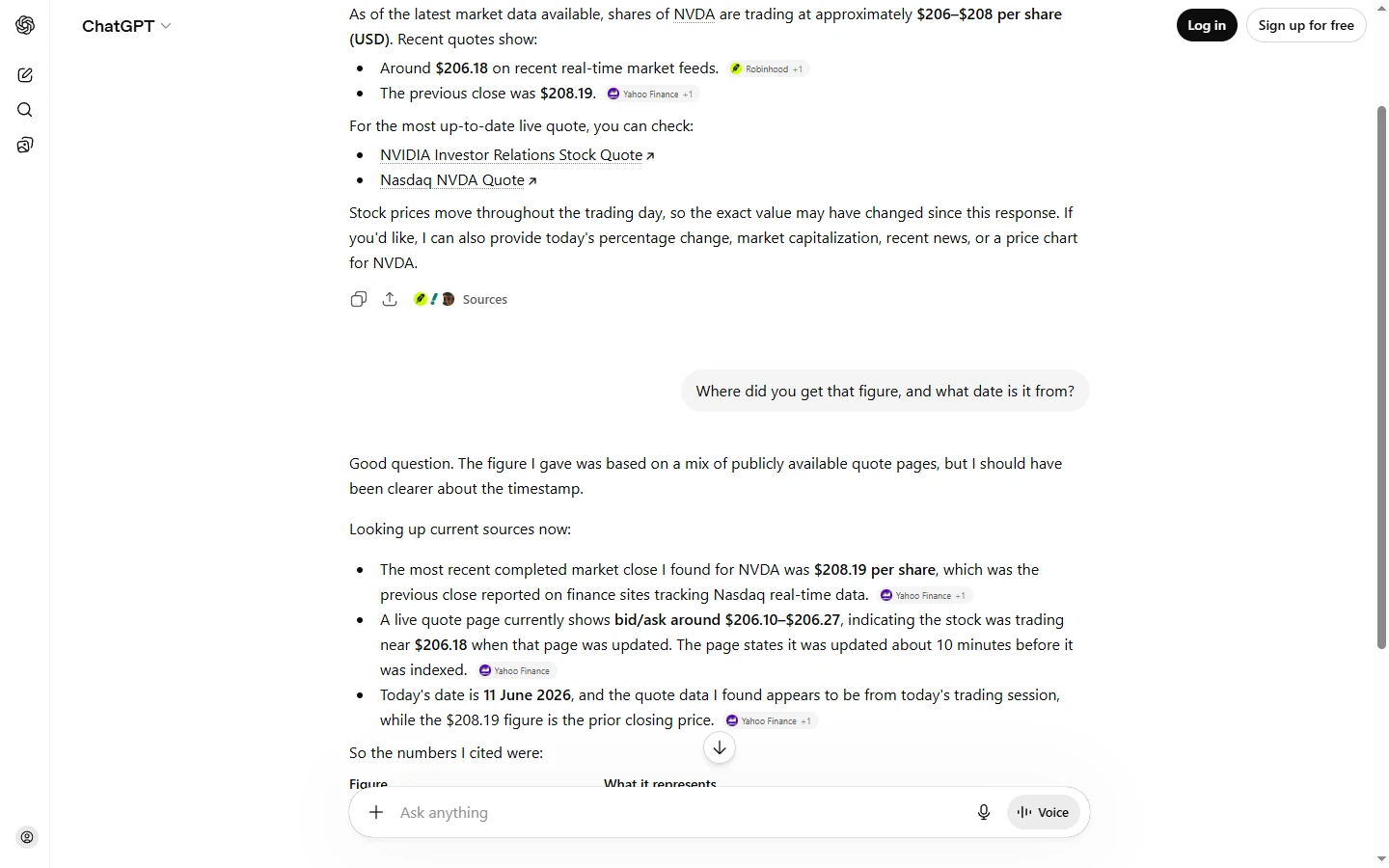
- 11 June 2026, 11:55 UTC
- Free tier, logged out
- Web search on
- Graded against premarket data available at capture time
As of the latest market data available, shares of NVDA are trading at approximately $206–$208 per share (USD). Recent quotes show:
Around $206.18 on recent real-time market feeds. [Robinhood +1]
The previous close was $208.19. [Yahoo Finance +1]
The second session is the one I keep coming back to, because it argues with itself inside a single answer. It gives a price, then cites a range that the price it just gave could not have come from.
- 11 June 2026, 17:40 UTC
- Free tier, signed in
- Web search on
- Graded against the regular-session range
As of the most recent market data I could verify, NVIDIA Corporation (NVDA) is trading at approximately $191.21 per share during today’s session (11 June 2026). [Yahoo Finance UK]
A few caveats:
The market is open, so the price is moving continuously.
Different sources in today’s data show slightly different timestamps and prices. For example, Google’s quote page showed an intraday range of roughly $199.92–$207.22 today, while Nvidia’s investor relations site shows the most recent official closing price as $200.42 on 10 June 2026. [Google +1]
Read those two paragraphs together. It hands over $191.21 as the current price, then three lines later cites an intraday range starting at $199.92, a range its own headline figure sits eight dollars below. Both statements are in the same reply, with sources attached to each. Nothing in the formatting tells you they cannot both be true.
“As of the most recent market data I could verify, NVIDIA Corporation (NVDA) is trading at approximately $191.21 per share during today's session (11 June 2026). [Yahoo Finance UK]”
the regular-session low was $199.54. The figure sat more than eight dollars below that range.
The capture cannot tell me whether $191.21 was generated, extracted from stale data or mismatched to the citation. It can tell me that the answer contradicted the range inside its own reply and that the regular-session market data did not support the figure.
The unsupported price came back in the same confident format as a price that would have been right. The only way to tell them apart was to go and look.
pass · partial · miss · confidently wrong
What this receipt can and cannot prove
The saved answer does not prove why the wrong figure appeared. I first assumed the model had invented a plausible-looking number, but search was on, citations were attached and the source destinations were not preserved. The figure could have come from stale retrieval, a citation mismatch, a bad extraction or model synthesis.
What the receipt proves is simpler: a fluent answer, a source label and a precise decimal did not amount to a verified live quote. Live prices need a working market-data route. ChatGPT now has connected routes that can provide one. For example, OpenAI’s Alpaca integration advertises live stock quotes and snapshots, but that does not retroactively prove which route, if any, supplied these June answers.
A precise decimal is presentation. A timestamped market source is provenance.
That distinction is the useful part. You do not need to diagnose the model’s hidden mechanism before deciding whether the number is safe to use. You only need to see that its provenance does not hold up.
Why web search is not the same as a live feed
The obvious fix is to turn web search on, so the tool goes and looks the price up. It helps, but it is not a guarantee that the returned page, figure and timestamp belong together.
Search changes the failure mode. It doesn't remove it.
In these two runs, search was on and the lead figures still failed the relevant market check. One reply even placed $191.21 above an intraday range beginning at $199.92. In a separate fund test I ran, the tool that searched the web served a fee that had been cut months earlier, while another tool got it right. A citation can help you audit an answer; it does not by itself prove the source was current, relevant or read correctly. (That fund test is its own post.)
So a link next to a price feels reassuring. Mostly it just talks people out of checking. The same trick plays out with sources as well as numbers: I’ve watched an AI cite a real, working link that opens a page which doesn’t actually back the claim, which is harder to catch than an invented figure because nothing about it looks wrong.
The 15-second check before you trade on any AI price
The 15-second check has two moves that caught both misses above. I run them before I act on any price an AI hands me.
First, ask it one follow-up: “What’s your source for that figure, and what time is it from?” The answers split fast. “From the live quote as of 3:42pm” is something you can go and confirm. “Based on my training data” or a vague wave at a source name is a flag to stop. The question drags the difference into the open in one move.
That is exactly what happened when I asked it here. The $191.21 quietly disappears, replaced in the reply by a specifically dated $200.42 close from NVIDIA’s investor page, labelled as end-of-day rather than live.
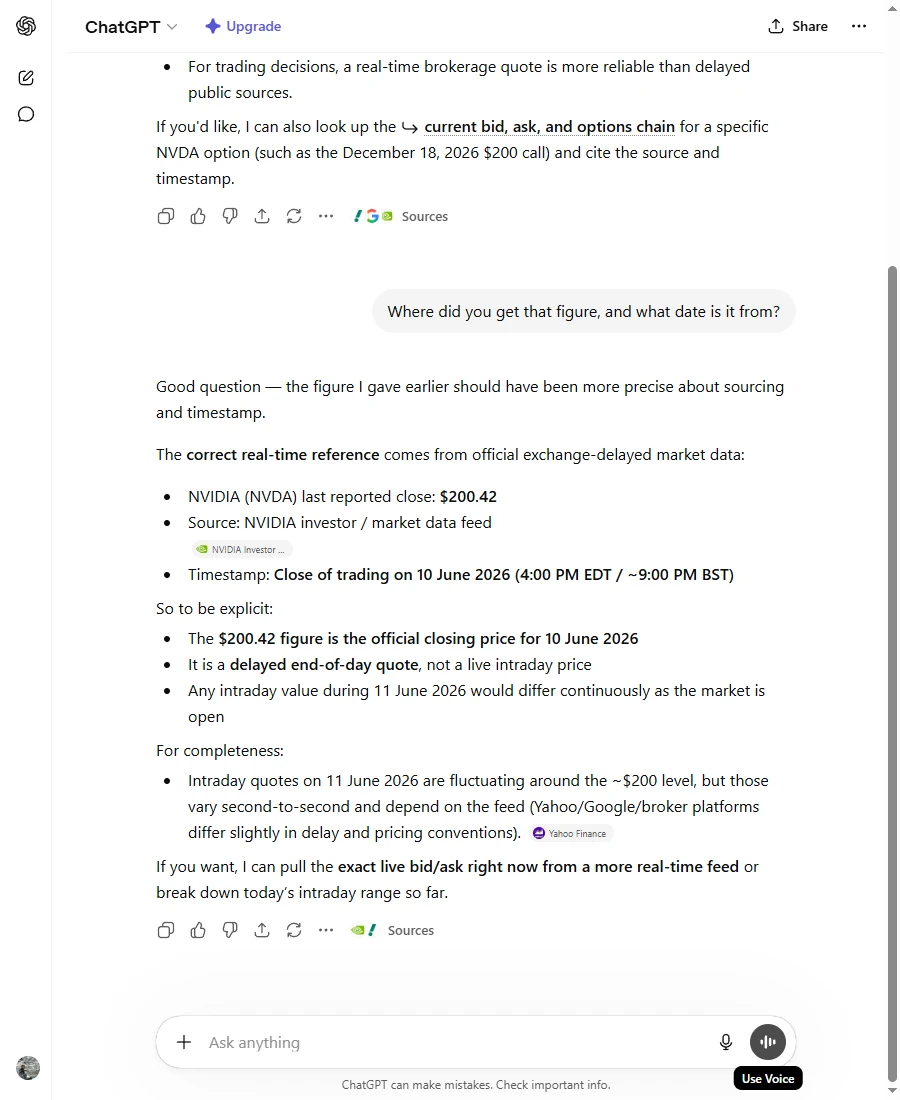
Note what the question bought. It never says the first figure was wrong. It just stops defending it, and offers something checkable instead. That swap is the tell, and one follow-up was enough to expose it in this run, which is why a version of that ask sits on the Guardrails page.
Second, look at the real thing. For a live price, that means your broker app or the exchange, with a visible timestamp. It takes one glance. A quoted price that matches is fine to use. A quoted price that does not match the market data available at that moment is unsupported, and now you’ve caught it before it cost you anything.
There’s nothing clever about the second step. It’s the one nobody does, which is why made-up prices travel as far as they do. Treat any live or moving number from an AI as unconfirmed until you’ve looked, and the failure mode above simply can’t reach your decision.
The short version
Bottom line: ChatGPT can give you a precise live stock price that the time-matched market data does not support, even with web search and citations on. The fix is a 15-second habit you run yourself. Ask the AI for its source and time, then confirm the number against your broker or the exchange before you act on it. What would change the verdict: a verified live-data route and a visible source timestamp inside the answer.
I keep a running tally of these tests, and unsupported moving figures are one of a handful of failures that repeat. If you want the pattern across all of them, including which kinds of question are usually safe and which almost never are, the full running tally is here. For this one question, the answer is short: the price it gives you is worth exactly as much as the fifteen seconds you spend checking it.
Common questions
- Can ChatGPT give you live stock prices?
- It can when a working market-data route is connected, but a precise answer is not proof that route was used. In two tests on 11 June 2026, ChatGPT gave me NVDA prices that did not match the market data available at the time.
- Does turning on web search stop ChatGPT making up stock prices?
- No. Web search was on in both dated tests here, yet one answer contradicted the range cited inside the same reply and neither lead quote matched the time-matched market data. A citation still needs a timestamp and a relevance check.
- How do you check if an AI stock price is real?
- Two moves, about fifteen seconds. Ask the tool what its source is and what time the figure is from. Then compare that timestamped quote with your broker app or the exchange. If the figure is outside the market range available at that moment, do not use it.

Ben tests how far you can trust the main AI assistants, and publishes exactly where they get things wrong. Every post here is a first-hand test with the receipts, including the times a tool simply wasn’t worth the trust. About Ben →
The site tests how far you can trust the main AI assistants, on real decisions. Start with the Prompt Stack for the four-stage framework, free and ungated, or the Bluff Filter for the paste-ready version with a real before and after.