The Bluff Filter is the check I run before trusting any tool. It’s free →
// On this page
A tool once told me one of my own holdings had nearly ceased to exist. Revenue of “$6K”, it said: “down 99.8% from prior year.” The company’s SEC filing reported $6,095 in thousands, or $6.095 million, against $3.31 million a year earlier. Reported revenue had risen. Perplexity had dropped three zeroes and built the collapse story on top.
The exact BMNR revenue question came back correct when I reran it a month later. A separate query on a small UK company was correct too. Those outcomes are less tidy than “good on big companies, bad on obscure ones”, and more useful. They show why one cited answer can’t establish a reliability rule.
My June research sample found plenty of Perplexity feature tours and no documented filing failure like this one. So this audit starts with the receipts: one severe error, its clean rerun and the answers around them. It doesn’t pretend that two companies reveal the single variable behind every result.
How I tested Perplexity for investment research
The May and June Perplexity captures are dated product sessions, not a controlled experiment in company coverage. Everything below comes from my Perplexity Pro account between 14 May and 18 June 2026. Where I quote Perplexity, the wording comes from the stored response. I tested four investor jobs: looking up company figures, summarising earnings calls, finding an options quote and assessing a covered-call setup.
The model label varied. Separate May earnings-call captures for BMNR and Meta showed Claude Sonnet 4.6 in the footer. The 14 May revenue-error capture recorded no displayed model; the 18 June revenue rerun recorded default Search; and the NFC.L capture showed Best, without disclosing which eligible model it selected. Perplexity now documents both its own Sonar models and third-party choices inside Search. So this is an audit of captured Perplexity product sessions, not one permanent underlying model.
What “passing” looks like, per job: the right figure, from a named source, with honesty about anything it couldn’t find.
What the successful runs actually showed
Start with the good news, because it’s in the record. Several captured answers were fast, sourced and correct.
I asked it to summarise Meta’s last two earnings calls: what management said about getting to profitability, and what they dodged. The answer presented both calls, named Brian Nowak at Morgan Stanley, Eric Sheridan at Goldman and Douglas Anmuth at JPMorgan, and labelled a cross-call pattern “the Recurring Blind Spot”. The capture exposed 28 source labels. I didn’t independently reopen every analyst attribution in that answer, so those details remain what the captured response reported rather than a new primary-source verification.
The separate eight-question RDRI run gives a cleaner denominator. Seven answers received full accuracy and honesty marks, including Microsoft’s full-year figures, the Bank of England base rate and the S&P 500 dividend-yield verdict. The eighth was the options lookup discussed below: an honest warning attached to a stale non-answer. That is a strong dated pass, not a product-wide error rate.
A citation gives you a path to check the answer. It doesn't make the answer correct.
So what happened when the filing units were missed?
The 1,000× filing error, and the rerun
I asked Perplexity for BMNR’s revenue. It read the company’s annual report, saw “$6,095,” and reported “$6K.” The filing states its figures in thousands, so $6,095 means $6.095 million. Miss that convention and the answer is out by roughly a factor of a thousand. Perplexity didn’t stop at the wrong number. It built a story on top: revenue “down 99.8% from prior year,” even though the filing shows revenue rising from $3.31 million.
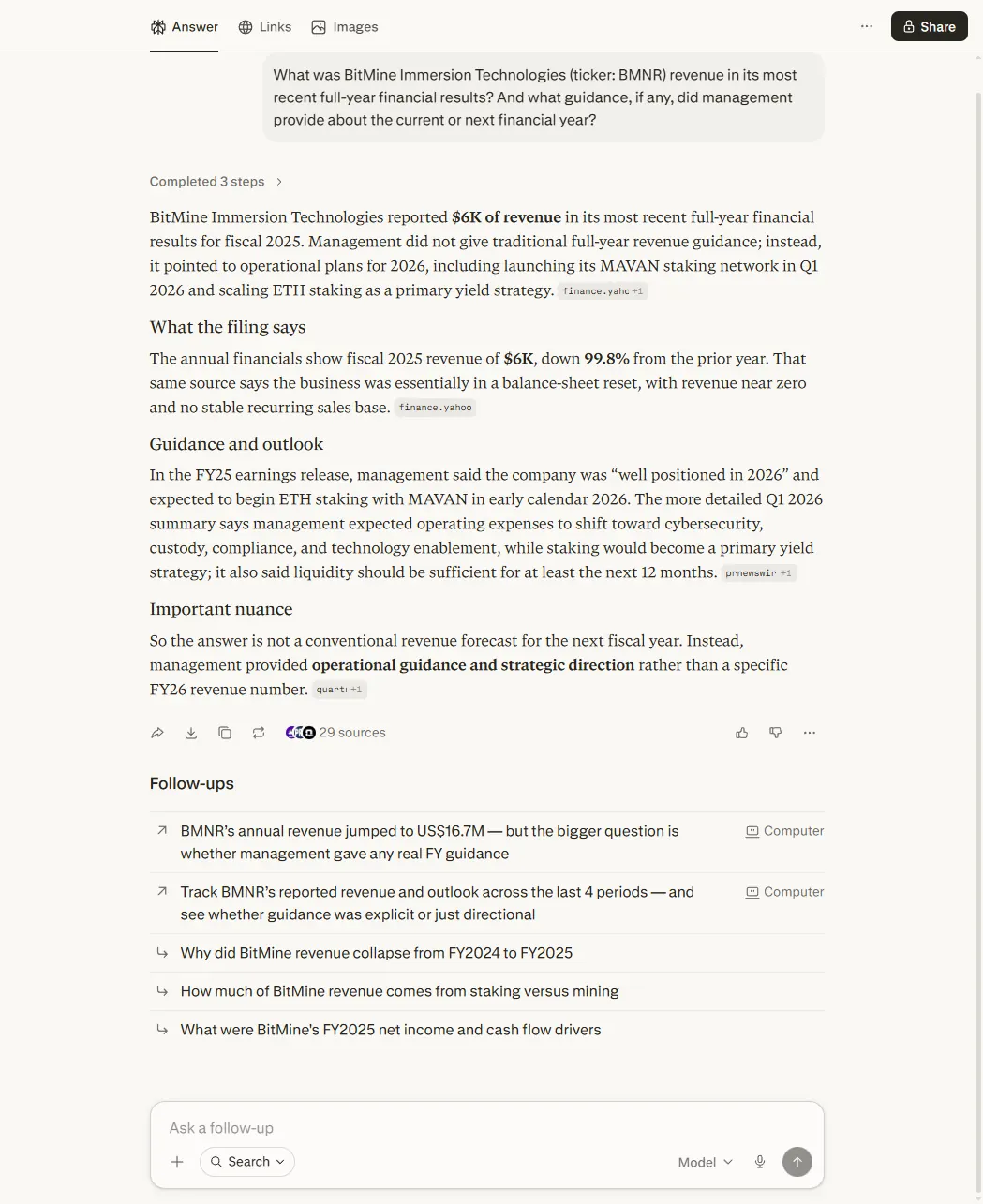
A reader who didn’t open the filing could have left with the direction and scale of the revenue change reversed. That’s not a rounding slip. It’s a decision-affecting error in confident, cited prose.
When I reran the exact revenue test on 18 June 2026, Perplexity returned the correct $6.095 million figure. The original error remains real and dated; the rerun prevents it becoming a permanent capability claim. Both belong in the verdict and in the wider four-tool comparison.
I then tested a different company and reporting regime: Next Fifteen Communications, an AIM-listed UK group. That answer did not repeat the BMNR failure.
I’m researching a small UK-listed company: Next Fifteen Communications (NFC.L). What was its revenue and adjusted EBITDA for its most recent full financial year, and what guidance has management given for the current year?
“For Next Fifteen Communications’ most recent full financial year, revenue was £569.7m and adjusted operating profit was £107.4m […] For the current year, management has said performance is expected to be broadly in line with market expectations, which the company has published as net revenue of £450m and adjusted operating profit of £66.6m for FY26. […] I couldn’t find a clear company-published adjusted EBITDA headline in the retrieved sources for FY25, so I used the company’s reported adjusted operating profit figure, which is the closest recurring earnings measure highlighted in its results materials.”
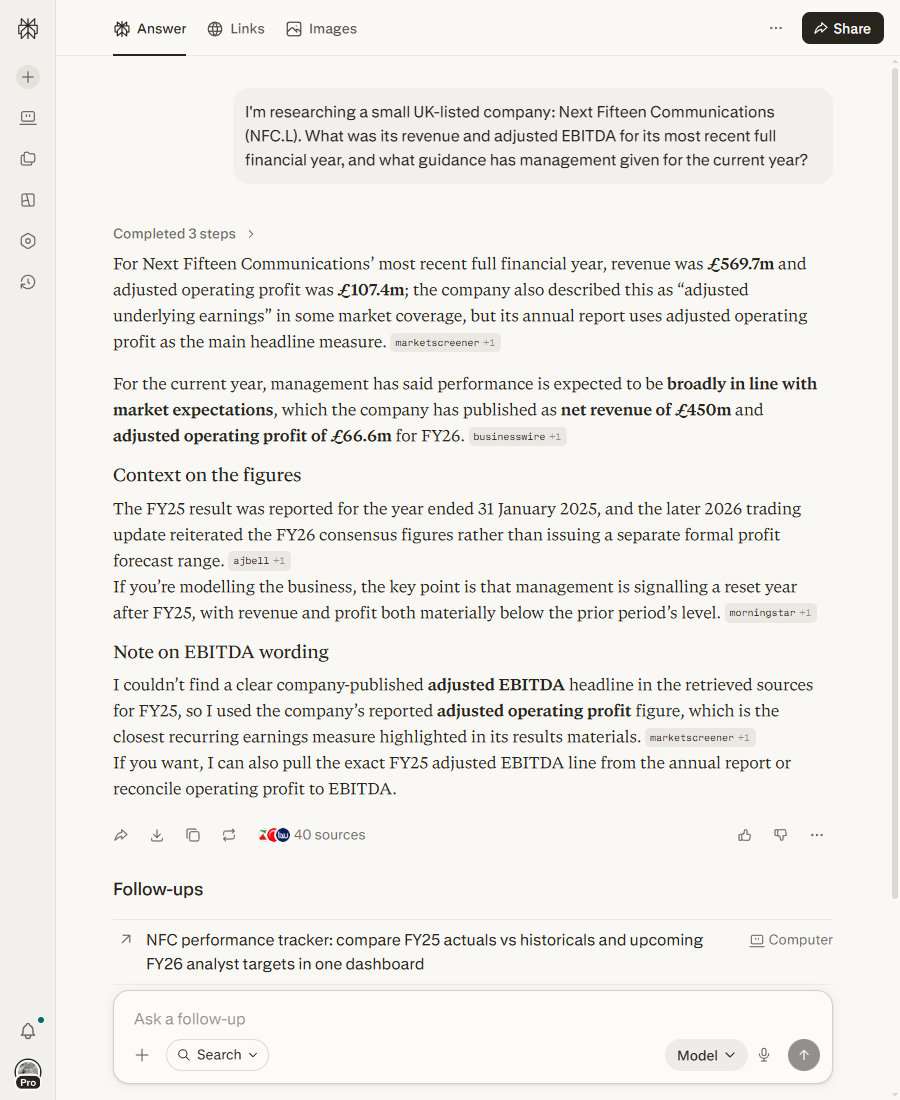
Two things stand out. First, it returned specific figures with named sources, got the unusual January year-end right, and correctly drew the line between official guidance and the consensus number management had simply endorsed. Second, the part the BMNR answer was missing: when it couldn’t find the published adjusted EBITDA figure I’d asked for, it said so and substituted the nearest real measure rather than inventing one.
That single sentence ("I couldn't find a clear company-published adjusted EBITDA headline") is the difference between a tool you can work with and one that quietly leads you off a cliff.
The headline figures held up. Next 15’s FY25 results report net revenue of £569.7 million and adjusted operating profit of £107.4 million. The captured answer also said when it could not find a company-published adjusted EBITDA headline and substituted adjusted operating profit instead.
That is the opposite behaviour from the first BMNR answer. It still does not prove why one answer failed and the others succeeded. Company coverage is a plausible hypothesis, not the measured deciding variable. The repeatable control is simpler: open the cited filing and check the units, period and exact line.
Earnings calls: two different source sets
The Meta and BMNR prompts exposed different source sets. The Meta answer presented named analysts, a pattern across two calls and 28 source labels. On BMNR, Perplexity opened with “full earnings call transcripts for BMNR are not accessible through publicly available sources in my search results” and built a thinner answer from secondary summaries.
That disclosure is useful. It tells the reader the answer is not a transcript audit. In a separate Meta-language test, Perplexity caught obvious hedges and missing figures but missed the signal the comparison was looking for in the word “underestimate”. That is one captured miss, not proof that the product cannot infer. The paired result is described in the earnings-call comparison.
Live data and options: one clean warning, no usable quote
On 14 June I asked for the current bid, ask and delta on the next AAPL monthly $230 call. Perplexity returned a Yahoo result with bid and ask at zero, no delta and a 2 July expiry. That was not the requested monthly contract. It did, however, label the quote stale or illiquid instead of presenting zeroes as a live market. The useful behaviour was the warning; the session produced no actionable quote for the exact contract.
For a separate covered-call prompt, the answer recommended selling one contract rather than two and cited a 30-day expected move of about 5.7%. That is what the capture contains. It does not expose how much came from retrieval versus model reasoning, and the expected move, live price, exact strike, premium and tax consequences still require current independent inputs before a trade decision.
Fast source-finding is useful. The filing and broker screen still decide.
On options specifically, I’ve laid out where these tools fall short.
One more gap, for UK readers
On 25 May 2026, I opened Perplexity Finance for Unilever (ULVR.L) and Apple side by side. The Unilever page carried price data, charts, earnings history and call highlights. Its Analysis tab showed “No data found” for structured analyst consensus, while the Apple page showed named ratings and price targets. That is a dated two-page UI comparison, not a current promise about every London-listed share. The broader tool comparison is in the free stock-research audit.
What to use it for
| Job | Verdict |
|---|---|
| Seven non-options questions in the 14 June battery | Seven fully clean grades in this run |
| Company figures | Mixed: one 1,000× miss, its clean rerun and one accurate UK-company answer |
| Earnings-call summary | Meta answer substantial; BMNR answer disclosed missing transcripts |
| Index-fund comparison | One table mixed non-comparable return figures |
| Live options pricing | No usable quote for the exact contract in this session |
| Covered-call setup | Useful framework; current market and personal inputs still required |
| ULVR.L Finance page | 25 May snapshot: core data present, structured analyst layer absent |
| Reading management language | One comparison caught a signal this answer missed |
The 13 June VUSA/VWRL answer shows the same check-the-cell problem. It labelled VUSA’s 86.21% and VWRL’s 11.83% as five-year returns while warning underneath that the figures came from different sources and were not apples to apples. The stored review concluded that 11.83% was almost certainly an annualised figure or a different period mislabelled as a cumulative return. The warning did not repair the table. When an answer stitches figures from several providers, verify each comparison on one date, currency and methodology.
The short version
What worked: Seven of eight answers in the June battery received full accuracy and honesty marks. The NFC answer matched the company’s headline results and disclosed its substitution. The Meta capture carried a substantial 28-source synthesis.
What didn’t: One BMNR run misread a filing by roughly a factor of a thousand and built a false collapse on top. The options lookup returned the wrong expiry and no usable quote. The fund table left incompatible return figures side by side.
Bottom line: Conditional as a fast first pass. These captures do not prove that coverage or company size predicts correctness. They do prove that a source-rich answer can still reverse a filing’s result. Open the cited document and check the unit, period and line before using the number.
My workflow after these tests was to use Perplexity for a quick source map, then read the filing for any number that could change a decision. The skill is not avoiding the tool. It is separating “here is a source” from “this source proves the figure”. Perplexity is one of four tools in the wider stock-research audit. The reusable check is in the Prompt Stack.
Common questions
- Is Perplexity good for investment research?
- Conditionally, as a source-finding first pass rather than the final record. This dated set includes one roughly 1,000× filing error, a clean exact rerun, an accurate UK-company answer and seven clean answers in an eight-question battery. Open the cited filing and check the units, period and line before using a figure.
- Is Perplexity reliable for figures on small or obscure companies?
- This test can't establish a class-wide rate. One BMNR run misread $6,095 thousand as '$6K'; the exact rerun got $6.1m right, and a separate small UK-company query was accurate. The practical rule is to verify every figure against the filing, not to infer reliability from company size or coverage.
- What decides whether Perplexity gets an answer right?
- These captures don't isolate one deciding variable. Source choice, document units, the selected model, the prompt and retrieval quality can all matter. A visible citation helps you check an answer; it doesn't make the answer correct.
- Can Perplexity analyse earnings calls?
- In one May 2026 Meta capture it produced a substantial, 28-source summary with named analysts and a cross-call pattern. In a separate BMNR query it disclosed that full transcripts were unavailable and used secondary summaries. Those two sessions show a coverage difference, not a universal capability rule.
- Can Perplexity give live options pricing?
- Not from the June 2026 capture used here. It returned a Yahoo result with zero quotes and no delta for a different July expiry, then correctly warned that the result was stale rather than presenting it as live. Use the exact contract in a broker feed for an actionable quote.

Ben tests how far you can trust the main AI assistants, and publishes exactly where they get things wrong. Every post here is a first-hand test with the receipts, including the times a tool simply wasn’t worth the trust. About Ben →
The site tests how far you can trust the main AI assistants, on real decisions. Start with the Prompt Stack for the four-stage framework, free and ungated, or the Bluff Filter for the paste-ready version with a real before and after.